The short answer
A Siwa 4x4 safari usually starts around 14:00 in a Land Cruiser with a Siwan driver. Tyres are let down at the edge of the dunes, then comes roller-coaster driving over ridges, stops for sandboarding, fossil shells and a hot spring, and sunset with tea on a high dune. The afternoon trip costs about US$60 to 130 per person, desert permit included.
Ask us on WhatsAppThe safari at a glance
Short answer: A 4x4 safari takes you from the palm gardens into the Great Sand Sea: tyres deflated, steep climbs and drops over the dunes, sandboarding, a hot spring and sunset with tea. The usual trip lasts about 5 hours from early afternoon. It is thrilling but safe with an experienced driver.
| Duration | About 5 hours; or overnight |
| Start | ~14:00 in winter, later as sunset gets later |
| Vehicle | Toyota Land Cruiser or similar |
| Group | Up to 6 per car |
| Stops | Dunes, sandboarding, fossils, Bir Wahed, sunset |
| Furthest point | Bir Wahed, about 12 km south-west of the market square in a straight line |
| Price | About US$60 to 130 per person, desert permit included |
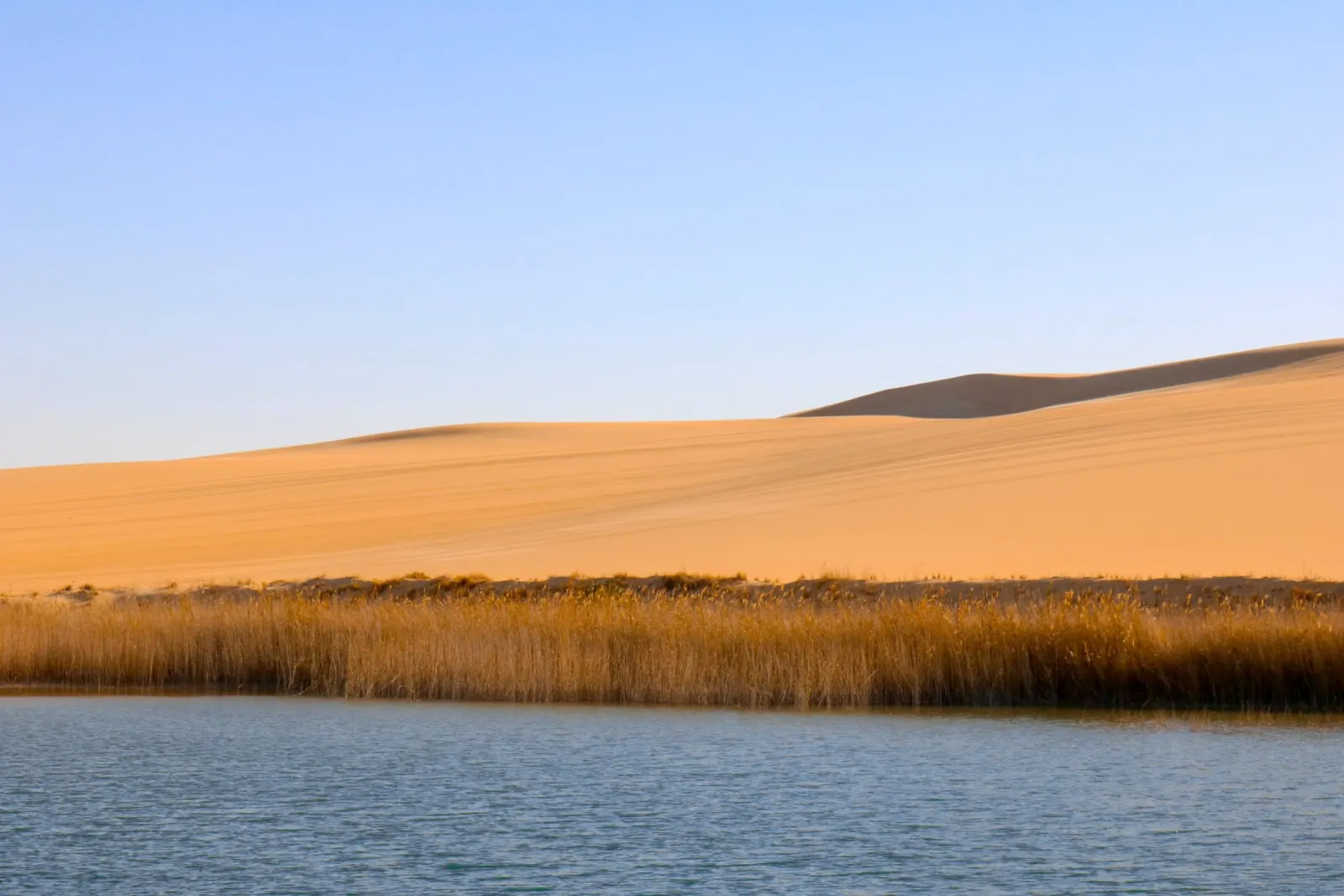
The Great Sand Sea is an erg of about 72,000 km², running roughly 650 km north to south along the Egypt-Libya border, with long ridges aligned close to north-south (Wikipedia). An afternoon safari only touches its northern rim, but the dunes there already fill the whole horizon.
Safari formats compared
Short answer: Most people take the afternoon safari, which ends at sunset. Stay out overnight for the stars and the quiet. A full day deeper in the sand sea is arranged on request.
| Format | Hours | What is included | Price per person |
|---|---|---|---|
| Sunset safari (half day) | About 5 h, ending after sunset | 4x4 and driver, dune driving, sandboarding, fossil stop, Bir Wahed hot spring, sunset tea, desert permit | About US$60 to 130 |
| Full day in the sand sea | Ask us | A longer route deeper into the open part of the sand sea, planned with you | On request |
| Overnight desert camp | About 20 h, afternoon to late morning | 4x4, crew, sandboards, desert permit, dinner, breakfast, tea and water | About US$120 to 220 for two travellers |
| Stargazing evening (no dune driving) | About 3.5 h, after dinner | Short drive to the dune edge, about 2 hours on the sky, tea and a light supper | About US$60 to 80 for two travellers |
Prices are the public ranges on Siwa tours and prices, updated November 2026, where pound equivalents are also shown. Send us your dates and group size for an exact price. Background on the landscape is on our Great Sand Sea page.
Which format suits you
- One free afternoon in Siwa: the sunset safari. It fits after a morning of sights in town.
- Nervous about the driving, or travelling with a toddler: the stargazing evening reaches the dune edge without the steep sections.
- You want silence, a fire and the Milky Way: the overnight camp; see camping in Siwa and stargazing in Siwa.
- Photographers: the overnight camp gives you both sunset and sunrise light on the ridges; see Siwa photography spots.
Timing: sunset sets the schedule
Short answer: The whole trip is planned backwards from sunset. In November sunset is about 17:20; by June it is after 20:00, so pick-up moves later through spring.
Sunset times for Siwa Oasis, local time, from timeanddate.com (checked 17 November 2026). Egypt's daylight saving time ended on 30 October 2026 and starts again on 30 April 2027, which is why the clock jumps an hour.
| Date | Sunset | Typical pick-up |
|---|---|---|
| 1 October 2026 | 19:03 | Ask us for your date |
| 17 November 2026 | 17:22 | Around 14:00 |
| 1 January 2027 | 17:30 | Around 14:00 |
| 31 January 2027 | 17:55 | Around 14:00 |
| 15 April 2027 | 18:44 | Ask us for your date |
| 15 June 2027 | 20:18 | Late afternoon, after the worst heat |
October to April is the comfortable season. Afternoon heat from May to September is the reason summer trips leave late; monthly temperatures are on Siwa weather and the season-by-season picture on best time to visit Siwa. February to April is the windy season, with April averaging about eight days of blowing sand (Siwa weather); a dusty day can spoil sunset or cut a trip short.
A typical afternoon, step by step
| Time | What happens |
|---|---|
| 14:00 | Pick-up from your lodge |
| 14:30 | Tyres deflated at the dune edge |
| 15:00 | Dune driving |
| 15:30 | Sandboarding |
| 16:15 | Fossil stop |
| 16:45 | Bir Wahed hot spring and lake |
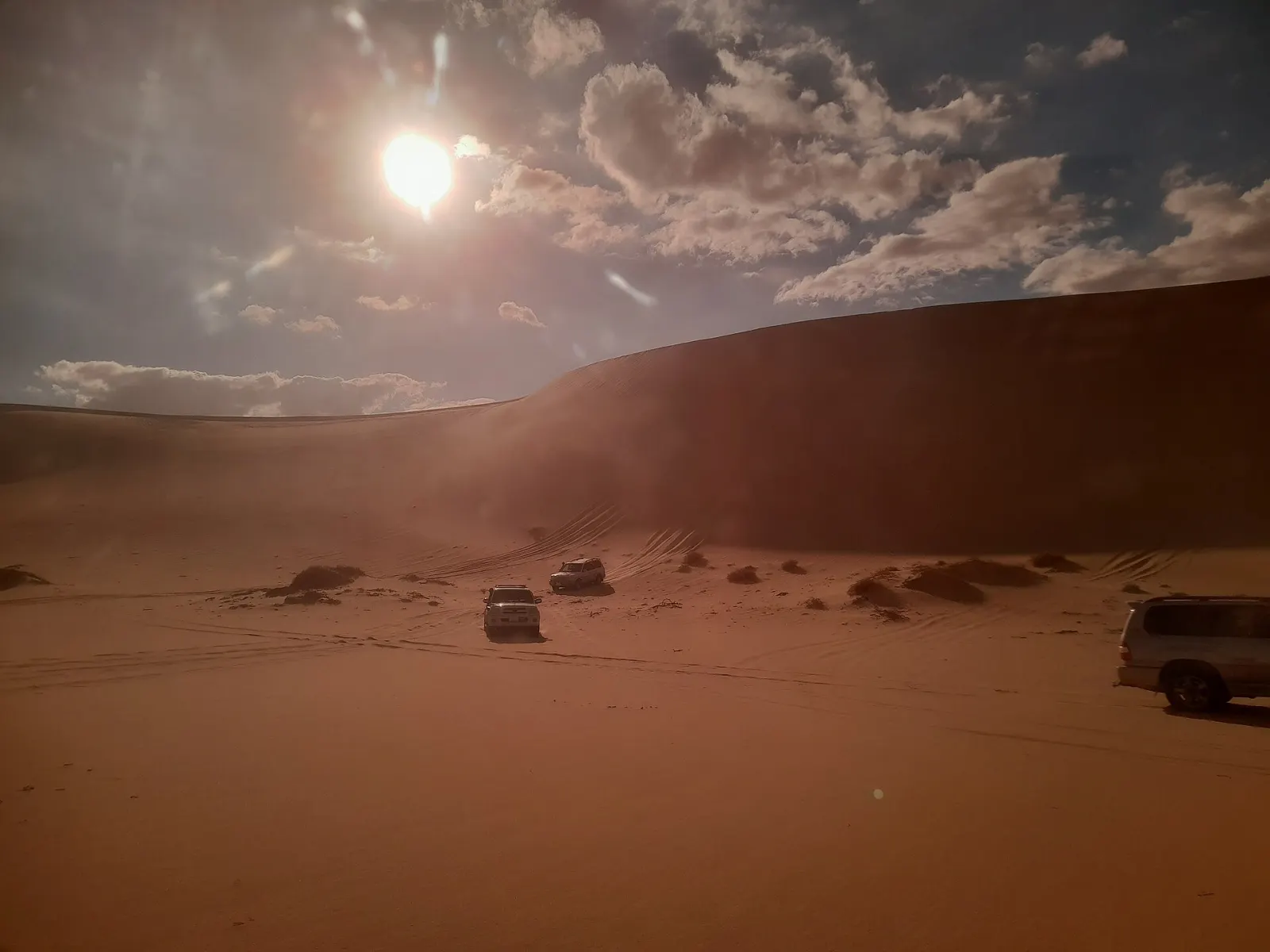
| 17:30 | Sunset on a high dune with tea |
| 18:30 | Drive back; tyres re-inflated |
| 19:00 | Back at your lodge |
This is a winter afternoon. The order can change with the wind and the light, and the sunset dune is chosen on the day. If you want more time in the spring or on the boards, say so at pick-up rather than at the last stop.
Getting there from town
Short answer: The 4x4 collects you from your lodge. Town roads take you to where the tarmac ends, and the rest is sand.
The dunes start a few kilometres south of town. Bir Wahed, the usual turning point, is about 12 km south-west of the market square in a straight line, but the route over the dunes is longer and slower than that figure suggests. Tuk-tuks and ordinary cars cannot follow you; getting around Siwa has distances to the sights you can reach by bike or tuk-tuk. Lodges about 15 km out of town add time to pick-up and drop-off, so mention yours when booking.
How the driving feels
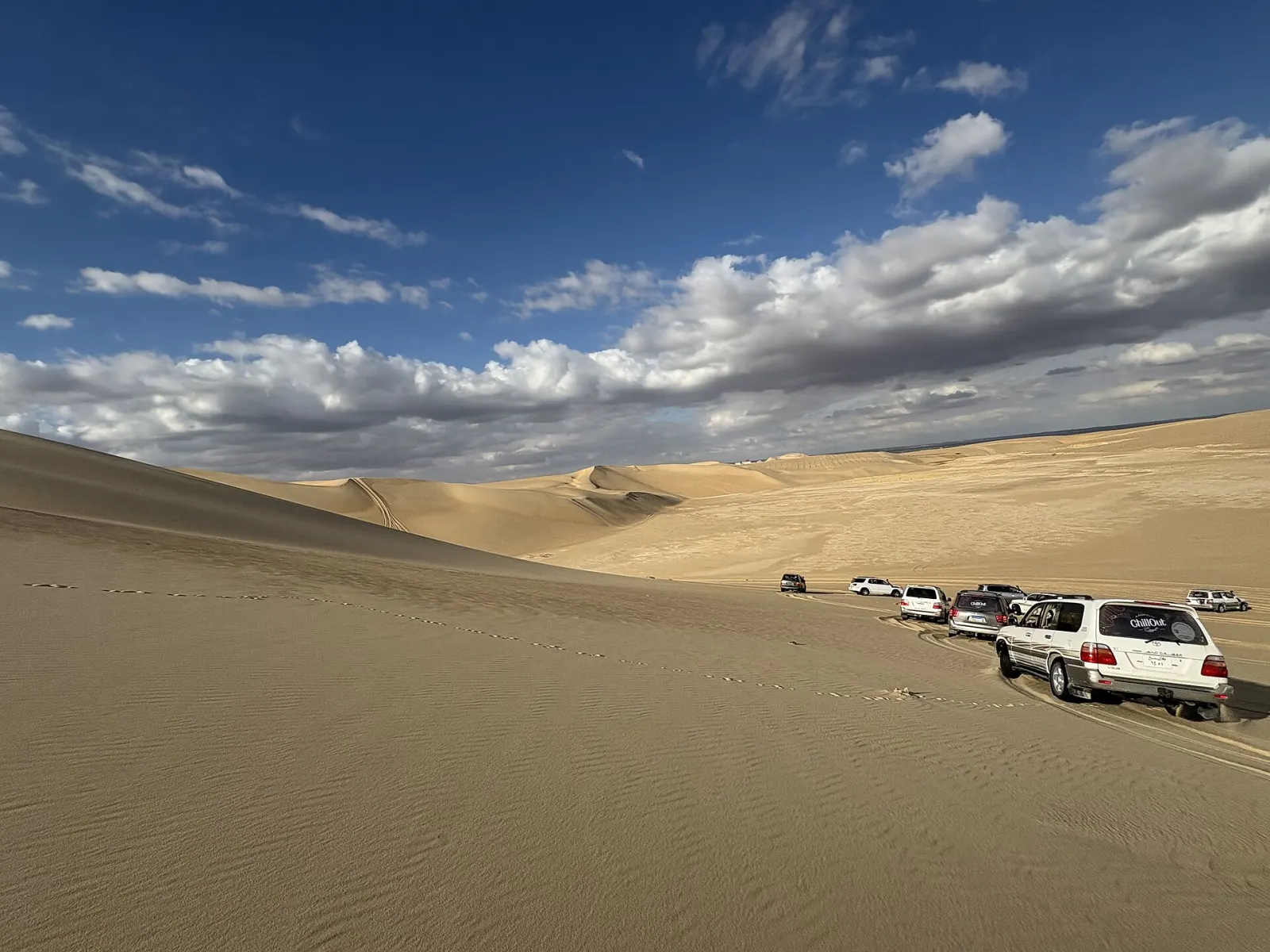
Short answer: Like a rollercoaster: slow climbs to the crest, a pause, then a steep slide down the other side. Ask for gentle or wild.
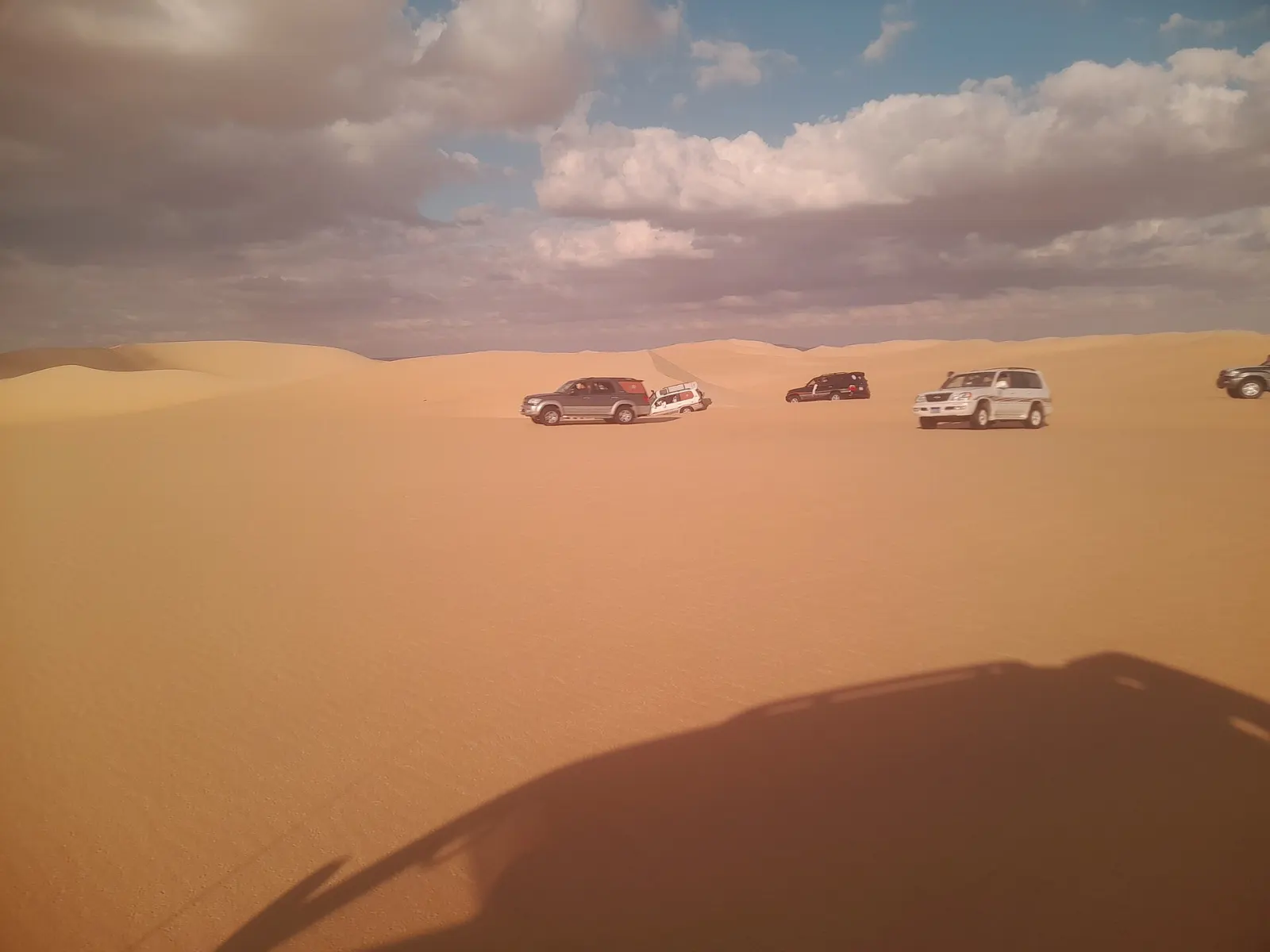
Letting air out of the tyres widens the footprint so the car floats on soft sand; the driver pumps them up again before the tarmac. On the dunes, drivers keep momentum on climbs, approach crests slowly to see the far side, and drop straight down the face rather than across it, because a car sliding sideways on a slope can tip. Buckle up in every seat. The UK government's Egypt advice notes that drivers and front-seat passengers must wear seatbelts (FCDO Egypt safety advice, checked 17 November 2026); in the dunes the back seats need them just as much.
Carsickness
Some people feel sick on the steep drops. The NHS suggests sitting in front, looking at a fixed point such as the horizon, getting fresh air through an open window, and avoiding heavy meals, alcohol and phone screens before and during the ride (NHS: motion sickness, checked 17 November 2026). Tablets and patches are sold in pharmacies; ask a pharmacist which suits you or your child before the trip. On the day, tell the driver as soon as you feel queasy. A pause on a crest and a slower line usually settle it.
The permit
Short answer: Every trip into the Great Sand Sea needs a desert permit. Your operator files it with your passport details before you set off.
Leaving the tarmac anywhere in Egypt calls for two things in British government advice: a Ministry of Interior permit and a qualified guide (FCDO, checked 17 November 2026). Send a scan of your passport photo page and visa when you book. The driver carries the permit and shows it at desert checkpoints. Ours is included in the price; we do not quote a separate fee because older figures online are unconfirmed. See permits and checkpoints. Areas near the Libyan border need special permission and are not part of a normal safari. Siwa town is about 50 km east of the Libyan border, which is closed to travellers.
Children, pregnancy and mobility
- Children: ask for a gentle drive and keep them belted in; tell us their ages when booking and we will say whether the steep sections suit them. Sandboarding sitting down on a short slope suits them; see sandboarding in Siwa.
- Pregnancy, back or neck problems: skip the steep sections. A calm drive to the dune edge for sunset, or the stargazing evening, gives you the view without the jolts.
- Limited mobility: the stops involve stepping up into a high vehicle and walking on soft sand, and the climb back up a sandboarding slope is hard work. Tell us what you can manage when booking and we will say which stops are realistic.
- Older travellers: the drive itself is seated; the effort is in the walking. Choose which stops to get out at.
Combine it with
- A morning in town: the Oracle Temple (2.5 km from the market square) and Shali can be done by bike or tuk-tuk before a 14:00 pick-up. See Oracle Temple of Amun and Shali fortress.
- A cool swim first: Cleopatra Spring, 3.4 km from the square, is an easy morning stop. More pools are on Siwa springs.
- A night out: add the overnight camp and you get sunset, a fire-cooked dinner and sunrise on the same trip.
- Summer visitors: a sand bath is a separate, hot-season activity, not part of the safari.
For where the safari fits in a short stay, see the 3-day Siwa itinerary and how many days in Siwa.
Mistakes to avoid
- Booking your arrival day. Siwa is about 750 km from Cairo by road: about 9 hours of driving, or about 10 hours with stops. You arrive tired and late, so keep the safari for a full day in the oasis.
- Leaving no spare afternoon. Wind can cancel a sunset. With three nights or more there is room to move it.
- Relying on contact lenses alone. Fine sand gets everywhere; bring glasses as backup and sunglasses with side cover.
- Forgetting the warm layer. The desert cools fast after sunset, even after a hot afternoon.
- Comparing prices without the details. Check whether a quote is per person or per car and whether the permit is included.
- Taking stones or fossils home. Leave them where they lie.
Choosing an operator
- Licensed operator that files the desert permit
- Well-maintained car with working seatbelts, spare tyre and tow strap
- Experienced dune driver
- Water and first aid on board
- A clear price: per person or per car, permit included or not
More on staying safe in the oasis is on is Siwa safe.
What to bring
Sunglasses, scarf, hat, swimsuit and towel, a warm layer for after sunset, a dust bag for cameras, water, and your passport. The full list is on our Siwa packing list.
Book the Great Sand Sea safari, browse all tours, or contact us with your dates.
Questions people ask
How much does a Siwa desert safari cost?+
Our afternoon Great Sand Sea safari is about US$60 to 130 per person, and the overnight desert camp about US$120 to 220 per person for two travellers. Both include the 4x4, driver and desert permit. A full day deeper in the sand sea is priced on request.
What time does the safari leave?+
Around 14:00 from November to January, when sunset falls between about 17:20 and 17:55. As sunsets get later, so does the pick-up; in summer it moves to late afternoon. We confirm the time for your date.
Do I need a permit for a 4x4 safari?+
Yes. Trips into the Great Sand Sea need a desert permit. Your operator files it with your passport details; ours is included in the price.
Will I get carsick on the dunes?+
Some people do. Sit in front, watch the horizon, eat lightly beforehand and tell the driver early; they can take the dunes more slowly. A pharmacist can suggest a travel-sickness remedy before you set off.
Can children join?+
Yes, with a gentle drive and a seatbelt in every seat. Tell us their ages when booking and we will say whether the steep sections suit them. Sitting-down sandboarding on short slopes works well for children.
Can pregnant women or people with back problems join?+
Dune driving is bumpy. We advise against it in pregnancy or with back or neck problems; a calm drive to the edge of the dunes for sunset is an alternative.
How many people per car?+
Usually up to six passengers in a Land Cruiser; private cars carry just your group.
Go with us
Trips that include this
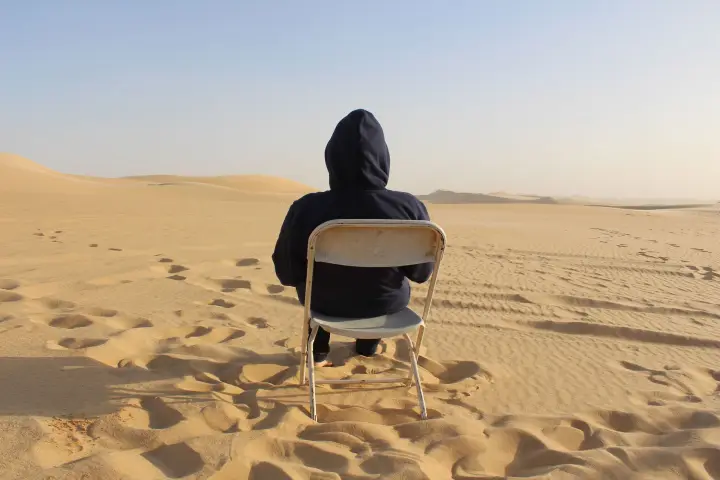
About 5 hours (afternoon to sunset)
Great Sand Sea Safari from Siwa (Half Day)About US$60 to 130 per person (shared or private car)
Check dates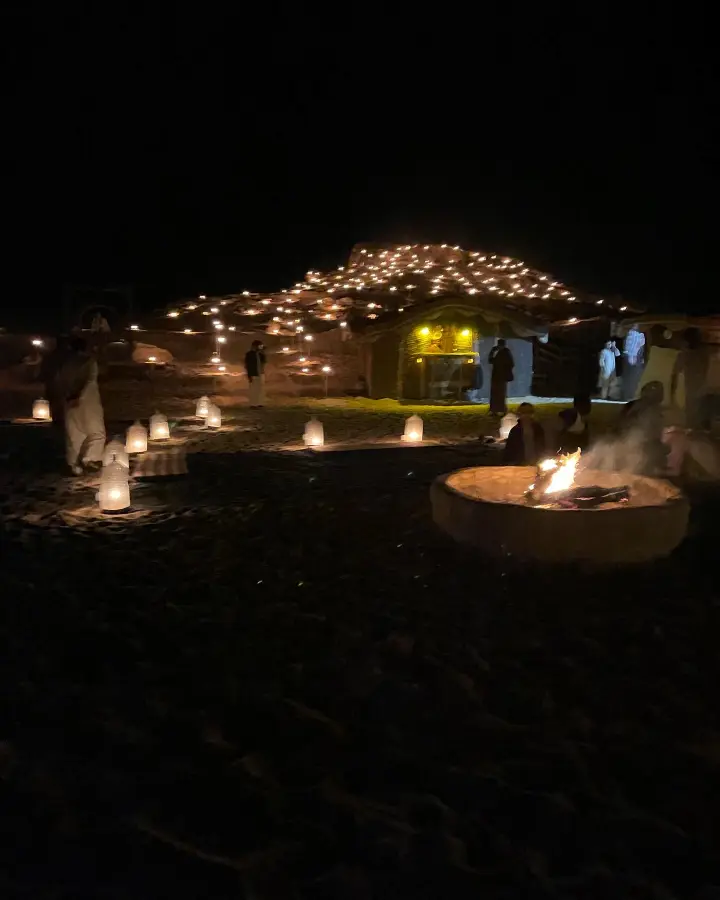
About 20 hours (afternoon to next late morning)
Overnight Desert Camp from Siwa (Private)About US$120 to 220 per person for two travellers
Check dates