The short answer
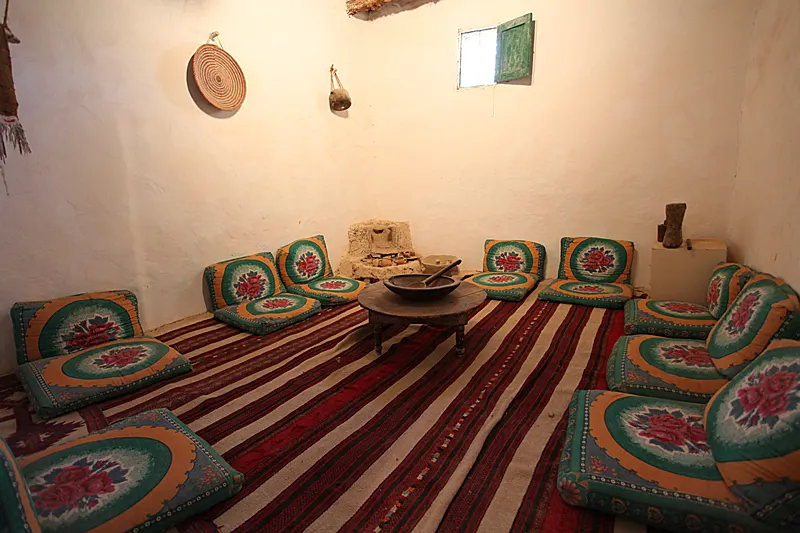
The Traditional Siwan House (House of Siwa Museum) is a one-house museum of Siwan domestic life, about 260 m on foot from Siwa's market square. Built of kershef at the end of the 1980s with Canadian funding, it shows wedding dresses, old silver, baskets and tools. Allow 20 to 40 minutes, confirm the short opening hours the day before and bring small cash.
Ask us on WhatsAppThe museum at a glance
Short answer: A single kershef house in the centre of Siwa town, furnished as a family home and filled with the dress, silver and household objects Siwans used before concrete and cars. It is a 20 to 40 minute stop; confirm the hours before you walk over.
| What | A traditional-style Siwan house kept as a museum of daily life |
| Also called | House of Siwa Museum, Siwa House Museum, Traditional Siwan House |
| Built | End of the 1980s, by a Canadian-funded heritage project |
| Where | Siwa town, about 260 m on foot from the market square |
| Built of | Kershef (salt-crusted mud), palm trunks, palm-leaf ceilings |
| Time needed | 20 to 40 minutes |
| Hours | Short and not officially published; confirm the day before |
| Ticket | Small cash fee at the door (ask us for the current amount) |
| Pair with | Shali, the craft shops, Gebel al-Mawta (about 1 km away) |
Where it is and how to get there
Short answer: Walk. From the market square it is about 260 m through the streets, so 3 to 4 minutes on foot, heading north-west.
The museum sits on the edge of the old centre, north-west of the main square. On OpenStreetMap (checked 17 November 2026) it is about 220 m in a straight line from the square and about 300 m from the foot of Shali; a road route from the square to the door measures about 260 m. Lonely Planet (checked 17 November 2026) puts it a block north-west of the King Fuad Mosque, which is the easiest landmark to ask for, and rates the wedding dresses alone as worth the ticket.
| From | Distance | How | Time |
|---|---|---|---|
| Market square | ~260 m by street | Walk | 3 to 4 min |
| Foot of Shali | ~300 m | Walk | About 5 min |
| Gebel al-Mawta | About 1 km north | Walk or bike | 15 to 20 min on foot |
| Oracle Temple, Aghurmi | About 2.5 km by road east of the square | Bike, tuk-tuk or car | 10 to 15 min by bike |
Town distances are measured between OpenStreetMap points; walking times assume an easy pace on flat ground. For bikes, tuk-tuks and taxis inside the oasis, see getting around Siwa and the Siwa map.
Opening times, costs and season
Short answer: Confirm hours locally the day before, carry small notes in Egyptian pounds and go early in the day. October to April is the comfortable season for walking in town.
Hours. We could find no official published hours for the museum; they are short and they change. Egypt's official weekend is Friday and Saturday, so check those days and public holidays in particular. Ask us or your hotel the evening before, and treat any hours you find online as a guess.
Cost. Entry is a small cash fee. We do not print a figure because it changes and we have not field-checked it this season; ask us for the current price. Bring small notes, as change for large ones is not guaranteed. See money, ATMs and internet in Siwa.
Season. Thick kershef keeps the rooms cool, but the walk to and from the house is in full sun. From May to September, arrive soon after opening and be back in the shade by late morning. October to April suits a full town morning. Monthly figures are on Siwa weather; for shorter working hours during the fasting month, see Siwa in Ramadan.
| Item | What to expect | Where the figure comes from |
|---|---|---|
| Ticket | Small cash fee at the door | Ask us; not published officially |
| Explanations | The attendant sometimes walks you round; ask | Varies by day |
| Getting there from the square | Free on foot | OpenStreetMap distances |
| Photos | Ask at the door | Not published |
The house itself
Short answer: It is a replica, not an old home, and that is part of its story: it was the first kershef building put up in Siwa after the heavy rains that ruined Shali in 1926.
A 2021 architecture thesis at the Politecnico di Torino (checked 17 November 2026) records, citing the museum's director, that a Canadian-funded project came to the oasis at the end of the 1980s to document Siwan traditions before they faded. It built the house from kershef and furnished it with clothes and furniture bought from local families. The same study says it was the first kershef building put up since the heavy rains, that workers had to be persuaded with gifts and payment because the old communal building practice had lapsed, and that the house now has structural problems and has sunk a few centimetres.
So look at the walls as well as the objects: salt-crusted mud, small windows and beams of split palm trunk, the method the same thesis describes for older Siwan houses. For the building method in depth, see kershef architecture.
What you see
Short answer: Bridal dresses, a full set of traditional silver, the women's outdoor shawl, coiled palm baskets, pottery and farm tools.
- Wedding dresses. Embroidered bridal dresses. Note the motifs: Wikipedia's Siwa article points out that the same signs and patterns run through the embroidery on women's dresses, trousers and shawls, so you will meet them again in the market.
- Silver. The centrepiece is the adrim, a large engraved disc hung from the aghraw, a heavy round neck ring. A girl gave up the disc at a special ceremony on the day she married, and a wealthy woman's full set could weigh five to six kilos, according to Wikipedia's Siwa Oasis article. Gold later replaced silver as the jewellery of choice.
- The tarfottet. The grey-blue cloth that covers a Siwan woman completely outdoors. The same Wikipedia article notes that its fabric comes from outside the oasis, from Kirdasa near Giza.
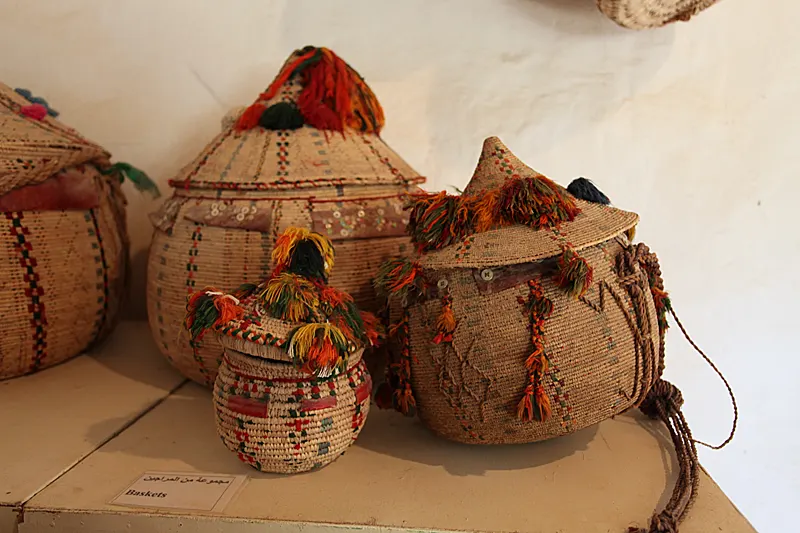
- Baskets. Coiled palm-leaf trays, bread covers and storage baskets trimmed with red wool, leather and tassels.
- Pottery and tools. Water jars, oil lamps, cooking pots and the hand tools used in the palm and olive gardens.
What to combine it with
Short answer: Make it the first stop of a town morning, then climb Shali and shop around the square before the midday heat.
| Time | Plan | Why in this order |
|---|---|---|
| 09:30 | Siwan House museum | Cooler hours; see real silver before shopping (confirm it is open) |
| 10:15 | Shali | 5 minutes' walk; climb before it gets hot |
| 11:15 | Craft shops by the square | You now know what old pieces look like; see Siwan crafts |
| 12:30 | Lunch near the square | See restaurants in Siwa |
| 16:00 | Gebel al-Mawta or a spring | Softer light; about 1 km north |
The museum is not on every day-tour route, but it is a short detour from Shali. On our private Siwa Oasis day tour you can ask the guide to add it; for longer plans see the 3-day itinerary and things to do in Siwa.
Mistakes to avoid
- Turning up without checking the hours. The usual way to miss it. Ask the day before, and allow for Fridays and holidays.
- Shopping first. See the originals, then judge what is for sale; ask a seller plainly whether a piece is old or newly made.
- Photographing Siwan women in town. The museum lets you see dress and jewellery without doing that; see etiquette in Siwa.
- Touching textiles or walls. Old embroidery is fragile and kershef crumbles.
- Arriving with only large notes. Carry small change for the door.
Families and accessibility
The visit is short, which suits children; the baskets, lamps and jewellery are the easiest things to point out. The walk from the square is about 260 m. The house is a traditional building with thresholds and uneven floors, so a wheelchair user should expect to need help at the door and inside. We have not measured step heights or confirmed that every room is reachable, so ask us before you go. Plan toilets and drinks at the cafés by the square.
Why it matters
Siwan women rarely appear in public and should never be photographed, so this is the respectful way to see traditional dress and bridal silver close up. It also makes the rest of the oasis easier to read: after half an hour inside you will recognise kershef walls in the palm gardens and the old motifs on new embroidery. For the wider picture, see Siwi people and culture and Siwa history.
Questions people ask
Is the Siwan House museum worth visiting?+
Yes, if Siwan life interests you. It is small and quick, and it is the one place in town where you can study old bridal silver and embroidered dresses up close, things you will not see worn in the street.
How long do I need?+
20 to 40 minutes for the rooms, a little longer if someone explains the wedding objects. It fits easily before Shali on the same morning.
How far is it from the market square?+
About 220 m in a straight line and about 260 m by the streets, so a 3 to 4 minute walk. Lonely Planet places it a block north-west of the King Fuad Mosque.
When is it open, and what does it cost?+
Hours are short and the fee is a small cash payment at the door. Neither is published by any official source and both change, so ask us or your hotel the day before, especially for a Friday or a holiday.
Is the house really old?+
No. A Canadian-funded project built it new at the end of the 1980s as a replica of a traditional house, using kershef, and furnished it with clothes and furniture bought locally. The building is part of the exhibit.
Can I buy crafts at the museum?+
It is a display, not a shop. For embroidery, baskets and silver in the old style, go to the shops around the square, a few minutes away.
What is the difference between this museum and the one linked to Shali?+
The Siwan House shows how a family lived: clothes, silver and household objects. The Earth Architecture Museum set up by the EU-funded Shali restoration is about building with earth.
Go with us
Trips that include this
About 8 hours
Siwa Oasis Day Tour (from Your Siwa Hotel)About US$65 to 80 per person for two travellers (about US$130 to 160 per car)
Check dates