The short answer
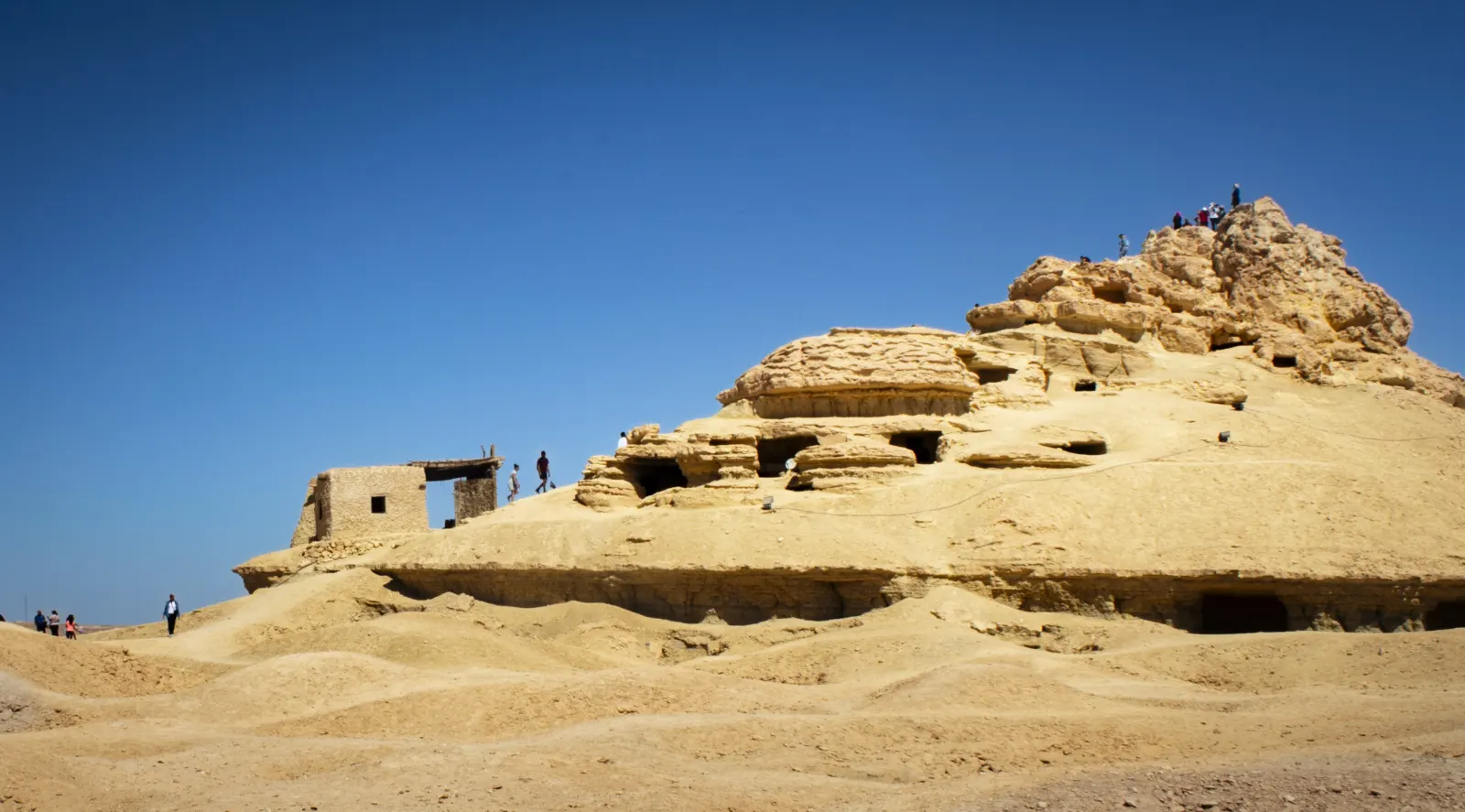
Gebel al-Mawta, the Mountain of the Dead, is a limestone hill about 1 km north of Siwa's market square, cut with rock tombs used mainly in Ptolemaic and Roman times. A few keep wall paintings, the finest being the Tomb of Si-Amun, where a bearded, Greek-looking owner stands among Egyptian gods. Tickets were EGP 120 for foreigners on the ministry's list. Allow 45 minutes.
Ask us on WhatsAppGebel al-Mawta at a glance
Short answer: The Mountain of the Dead is a small limestone hill about 1 km north of Siwa town, cut with tombs used mainly in Ptolemaic and Roman times. The highlight is the Tomb of Si-Amun, with some of the finest painted walls in the Western Desert.
| What | Necropolis of ancient Siwa (Ammonium) |
| Date | Ptolemaic and Roman periods; some accounts start it in the 26th Dynasty |
| Where | About 1 km north of the market square |
| Time needed | About 45 minutes, including the climb to the top |
| Hours | 9:00 to 17:00 (Ministry of Tourism and Antiquities list, checked 17 November 2026) |
| Ticket | EGP 120 foreign adult, EGP 60 foreign student; EGP 10 and 5 for Egyptians (same list) |
| Photography | Ask at the ticket office; no flash in the tombs |
What it is
Short answer: The hill was the main cemetery of the oasis for several centuries. Many tombs are cut into its terraces, most plain, a few richly painted.
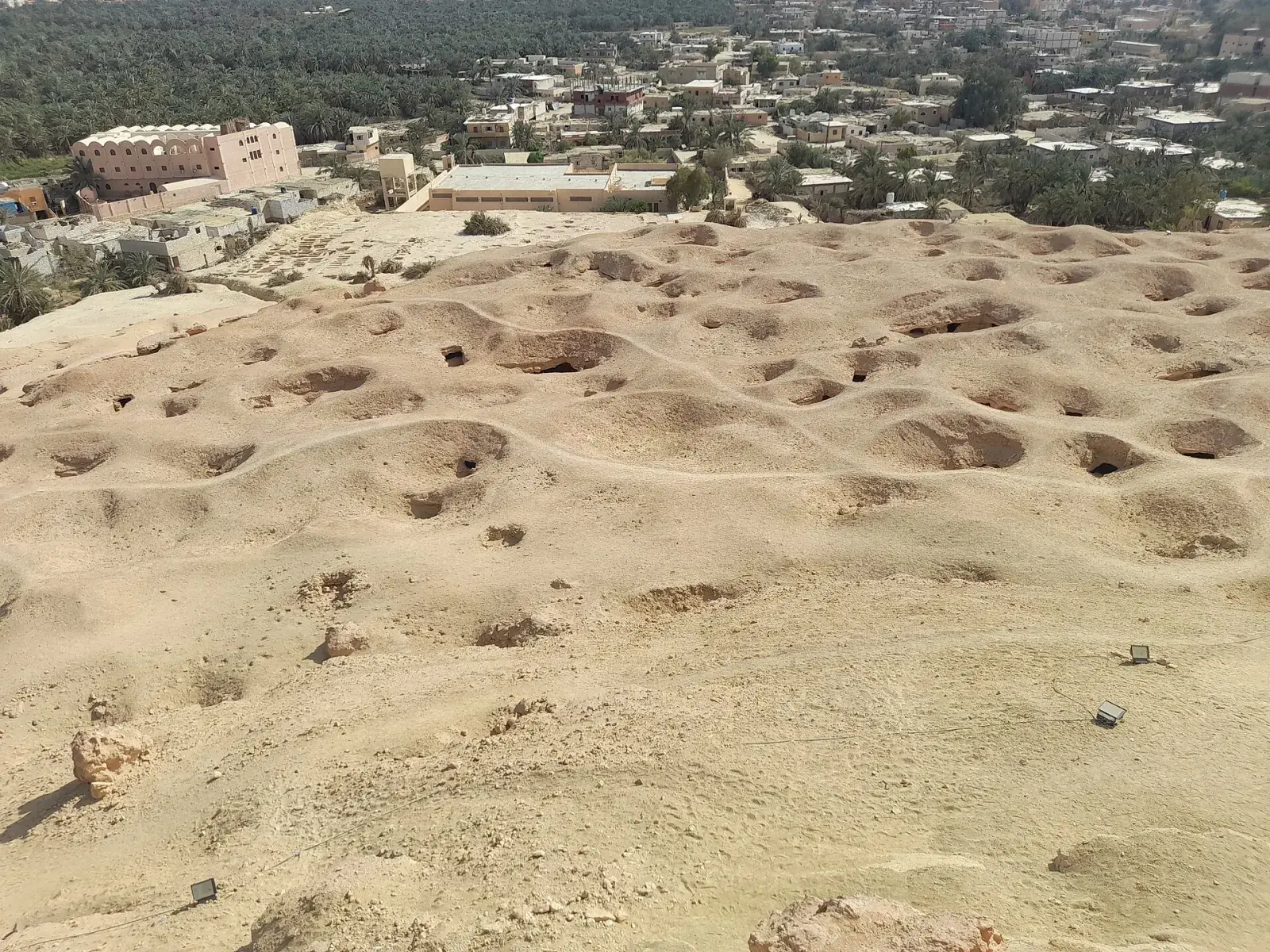
Seen from the road, Gebel al-Mawta is a pale cone riddled with square holes: each is a tomb, a burial niche or a shaft, cut into soft limestone in tiers. Counts differ wildly: Wikipedia's Siwa Oasis article speaks of dozens of rock-cut tombs, while Egyptian Streets (below) says thousands of graves. Most are plain; only a handful carry paintings.
How far back it goes is still argued over. Some writers trace the first burials to the 26th Dynasty, when, Wikipedia notes, the earliest evidence of Egyptian ties with the oasis appears; the Oracle Temple on Aghurmi carries inscriptions from the 4th century BC. The most detailed modern study, Katja Lembke's 2014 publication of the Si-Amun tomb, assigns the necropolis's tombs to Ptolemaic and Roman times, as summarised in a 2017 review in the Journal of Ancient History and Archaeology. Either way, this was the burial ground of a prosperous oasis on the caravan routes.
The tombs were known long before the war. The same review notes that the British traveller W. G. Browne mentioned the hill in 1792 and that Frédéric Cailliaud first hinted at painted tombs in 1826. According to the review, the Egyptian archaeologist Ahmed Fakhry made the first careful investigation in 1938 and 1941.
During the Second World War, Siwans hid in the tombs during the fighting and air raids, and in doing so opened up decorated chambers. Egyptian Streets (2019) dates the finds to 1944.
The painted tombs
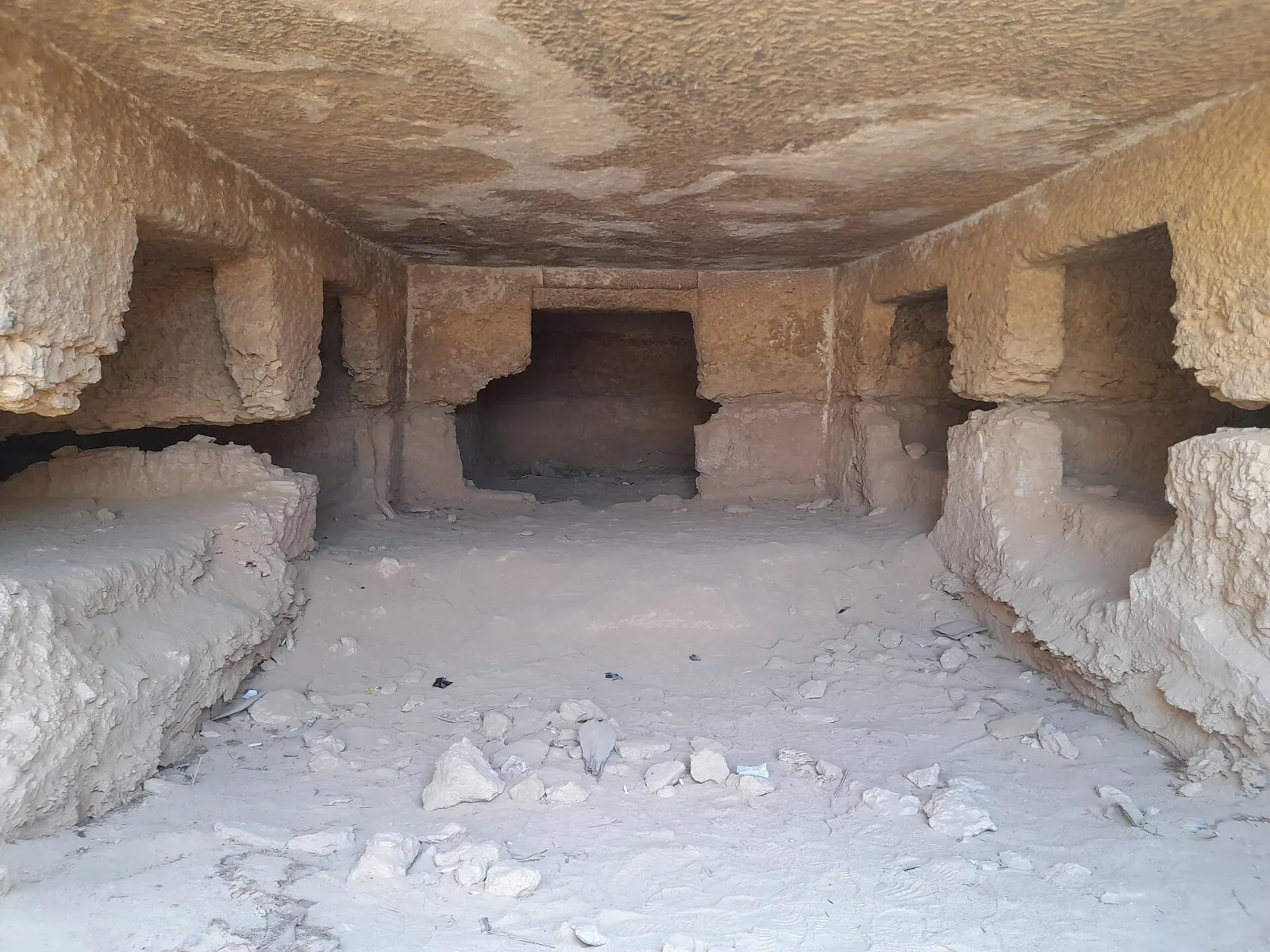
Short answer: Four decorated tombs are usually named: Si-Amun, Mesu-Isis, Niperpathot and the Crocodile. Si-Amun is the reason to come.
Tomb of Si-Amun
A single long room, about 9.5 m by 2.6 m, reached down a six-step staircase on the western side of the plateau just north of the hill, with the main burial chamber behind its far (southern) wall and side chambers for later burials. Egyptian Streets describes the owner as a Greek landowner or merchant. His paintings blend Egyptian religion with a Greek idea of a portrait: Si-Amun appears with curled hair and a beard, unlike the stylised faces of pharaonic art. The colours are mainly reddish-brown, green and dark blue, with turquoise, light blue, pink, ochre, dark brown, black and red cinnabar, the last used unusually for the skin of his son. The paint was applied a secco, on dry plaster. Lembke suggests that the mix of a realistic portrait with Egyptian clothing and storytelling may date the tomb to the start of the Roman Empire.
Tomb of Mesu-Isis
Its walls carry paintings of blue and red cobras, according to Egyptian Streets.
Tomb of Niperpathot
Also spelt Niperbathot. Its walls are covered in red-ink drawings rather than full colour.
Tomb of the Crocodile
Linked to the crocodile god Sobek, with walls painted in red ochre and cobalt blue (same source).
A guardian with a key decides which tombs are open on the day, so you may not see all four. Ask us what is currently open.
Reading the paintings in the Tomb of Si-Amun
Short answer: Work from the entrance back. The owner appears as a living man near the door and as a transfigured, Osiris-like figure towards the rear.
| Where | What you see | What it means |
|---|---|---|
| North wall and front of east wall | Funeral procession, door guardians | The burial and the protectors of the tomb |
| East wall | The dead man's journey through the underworld | His transformation into an Osiris |
| West wall | Judgement of the dead, mummification, opening of the mouth | The rites that let him live again |
| Front ceiling | Sky goddess Nut and solar boats | The sun's daily course, which the dead join |
| Rear ceiling | Alternating vultures and hawks | Divine protection over the burial |
| Owner's portrait | Curled hair and beard; an older man with a youth touching his knee | Greek taste inside an Egyptian scheme |
Scene placement follows the 2014 publication as summarised in the Journal of Ancient History and Archaeology review. That study notes empty bands where inscriptions were never added, a sign that painters and scribes worked separately and the scribes never finished.
The mix of Egyptian gods and a Greek-looking owner sums up Graeco-Roman Siwa: a local elite that kept Egyptian beliefs about the afterlife while adopting a Mediterranean style of portrait.
Visiting
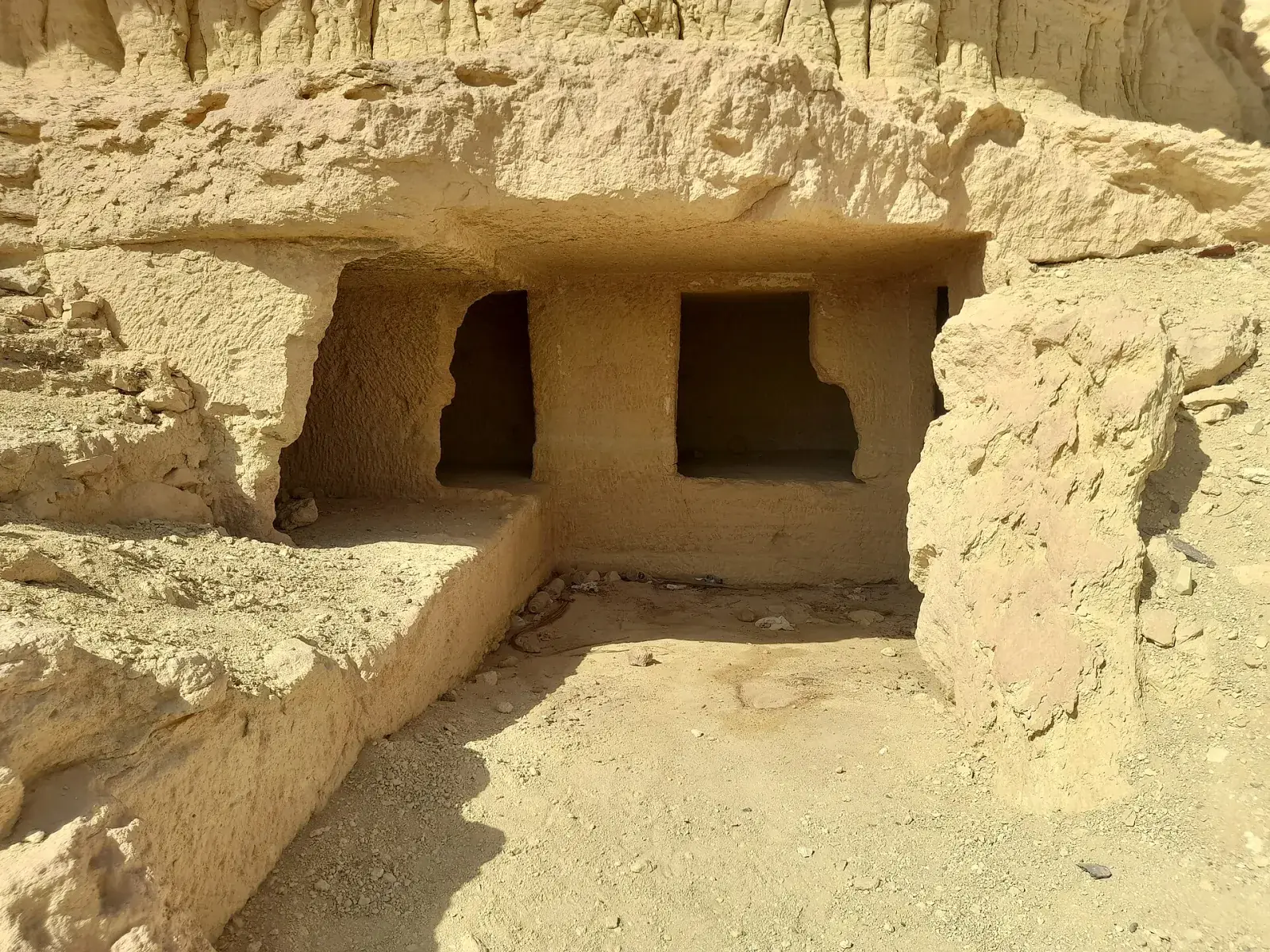
Short answer: Buy a ticket at the entrance, go at 9:00, and climb to the top afterwards for one of the best views of Siwa.
- Tickets: EGP 120 for foreign adults on the ministry's November 2024 list (checked 17 November 2026). Egypt raised foreign prices at Bahariya's sites from EGP 100 to EGP 400 from 1 October 2026 (Ahram Online, 10 July 2026), and Siwa's rates could follow, so carry extra cash in Egyptian pounds.
- Light: the tombs are dim; a phone torch helps.
- Respect: do not touch the painted plaster.
- The view: from the top you see the town, Shali, the palm groves and the lakes.
- Combine: it is a 15-minute walk from Shali.
- Heat: the hill has no shade. From May to September, arrive at opening time.
What to expect
Short answer: A short, focused visit. The colour in the open tombs and the summit view are the payoff; most of the hill is empty holes in the rock.
- Scale: this is a small site, not a Theban necropolis. Judge it against the other oasis tombs, such as those at Bahariya, not Luxor.
- Context matters: the paintings make far more sense if you know the scenes above, or come with a guide who can point them out.
- Condition: colours are bright where they survive, but large areas are lost; the 2014 study catalogues more than 1,000 painted fragments from Si-Amun alone.
On a trip
Our Siwa in 3 days and Siwa oasis day tour include Gebel al-Mawta with a guide who explains the paintings. Ask us which tombs the guardian is currently opening.
A short timeline
| Period | What happened on the hill |
|---|---|
| 26th Dynasty (disputed) | Earliest burials, according to some accounts |
| Ptolemaic and Roman | Decorated tombs such as Si-Amun; many simple burials |
| 1792 and 1826 | Browne mentions the hill; Cailliaud notes painted tombs |
| 1938 and 1941 | Ahmed Fakhry surveys the necropolis |
| Second World War | Siwans shelter in the tombs and find painted chambers |
| 2014 | Full publication of the Si-Amun tomb by Katja Lembke, suggesting an early Roman date |
| Today | Ticketed antiquities site; a guardian opens a few tombs |
Combine with
- Shali in the late afternoon
- The market and dinner on the square
- The Siwan House museum in the morning
- More of the oasis's past in Siwa history
Where it is
Close-up: around Siwa town
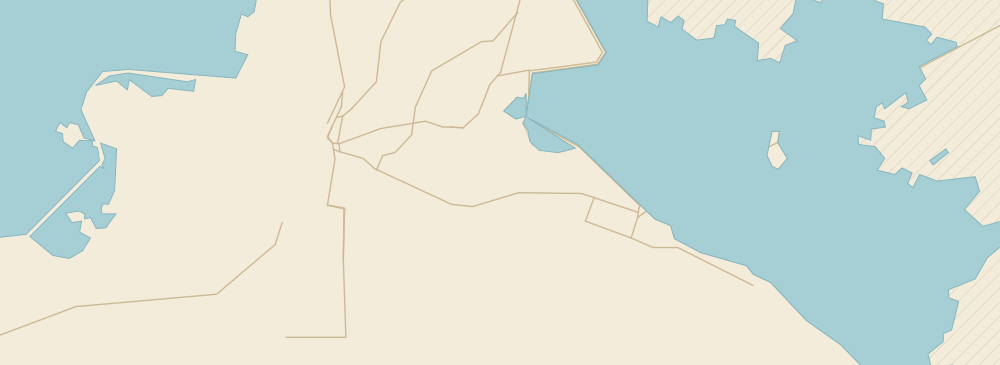
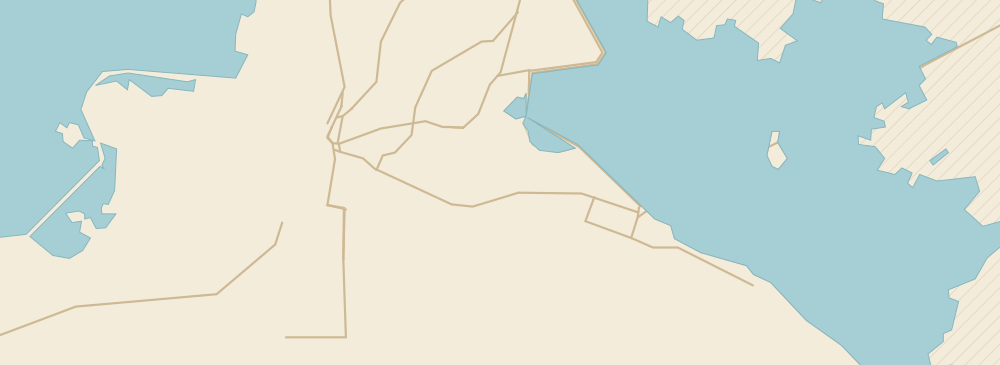
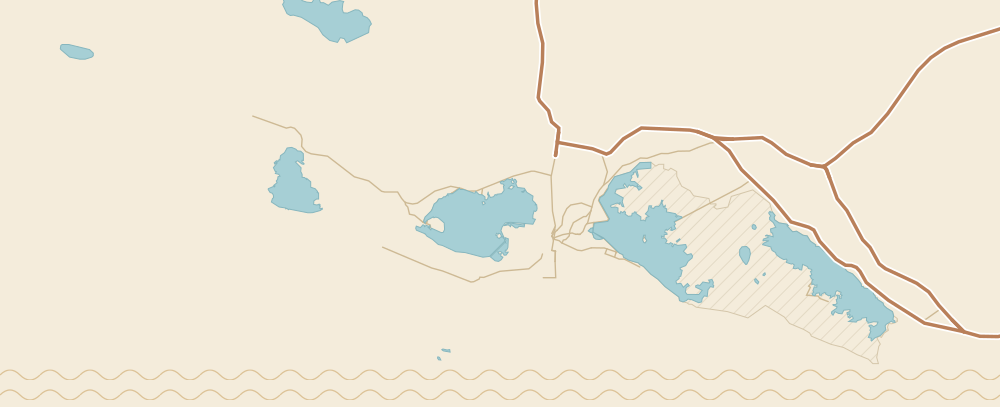
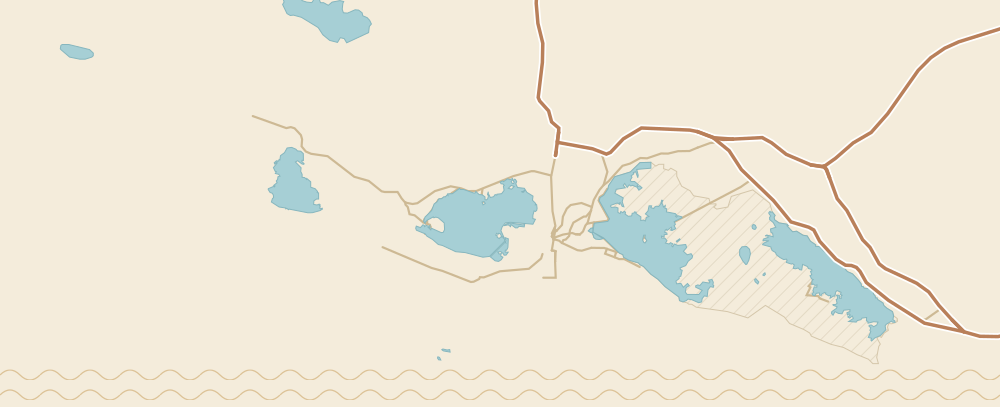
Lakes and roads drawn from OpenStreetMap; pin positions are approximate. The salt flats (hatched) dry out and flood with the seasons. Map data © OpenStreetMap contributors, ODbL.
Questions people ask
How much is the ticket to Gebel al-Mawta?+
The Ministry of Tourism and Antiquities list (updated 5 November 2024) gives EGP 120 for foreign adults, EGP 60 for foreign students, and EGP 10 and 5 for Egyptians. Prices at other oasis sites rose in 2026, so check at the gate.
What are the opening hours?+
The ministry lists 9:00 to 17:00. Come at 9:00 in the warmer months, as the hill has no shade.
Can you go inside the tombs?+
Yes, but only the few that a guardian unlocks. Which painted tombs are unlocked varies from day to day, so ask us before you go. A small tip for the guardian is customary.
Can you take photos in the tombs of Gebel al-Mawta?+
Camera rules inside the painted tombs change, so ask at the ticket office first. Never use flash. You can photograph the hill and the view from the top freely.
Which tomb is the best at Gebel al-Mawta?+
The Tomb of Si-Amun: a single long room with funeral, underworld and judgement scenes, a sky goddess on the ceiling, and the owner shown with curled hair and a beard in a Greek manner. Its 2014 study suggests an early Roman date.
How old are the tombs?+
Dates are debated. Some accounts start the cemetery in the 26th Dynasty (664 to 525 BC); the fullest modern study of the Si-Amun tomb assigns the necropolis to Ptolemaic and Roman times.
How do I get there from the centre of Siwa?+
It is about 1 km north of the market square: a 15-minute walk, a short bike ride or a few minutes by car or tuk-tuk.
Go with us
Trips that include this
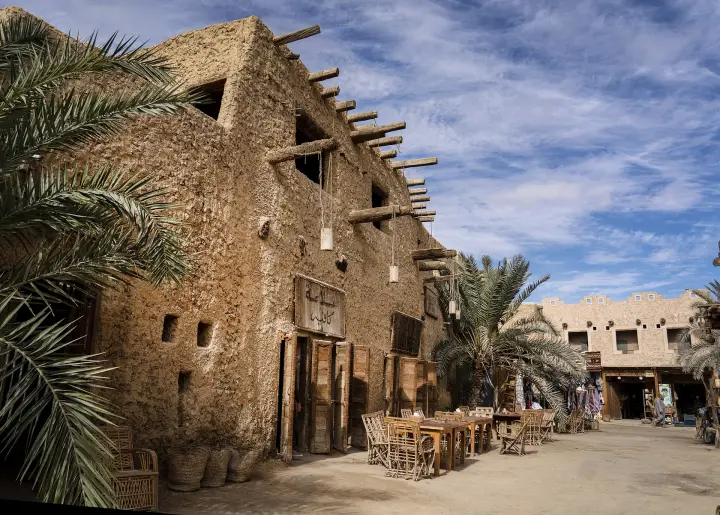
3 days, 2 nights
Siwa Oasis in 3 Days from Cairo (Private Trip)About US$420 to 650 per person for two travellers
Check dates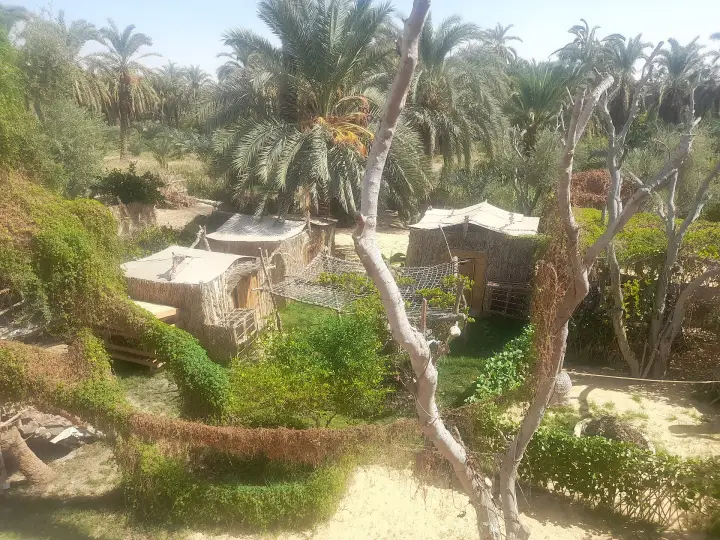
4 days, 3 nights
Siwa in 4 Days: Eco-Lodge and a Night in the Great Sand SeaAbout US$495 to 825 per person for two travellers (the lodge level decides the price)
Check dates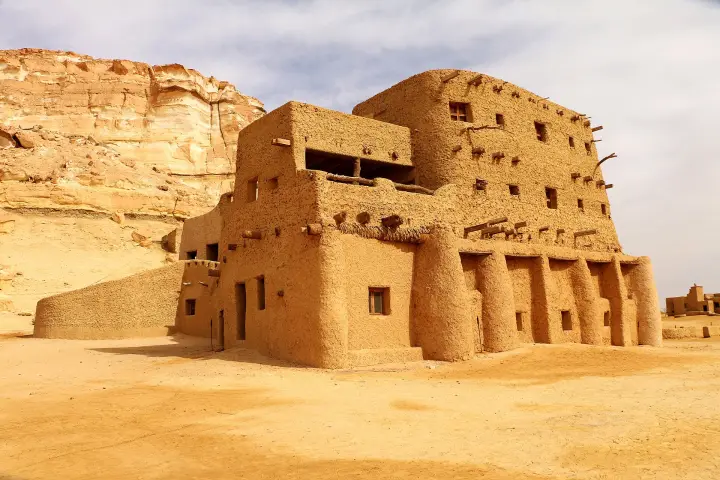
4 to 5 days (3 or 4 nights in Siwa)
Luxury Siwa: Candlelit Eco-Lodge EscapeOn request (depends on the lodge and season)
Check dates