The short answer
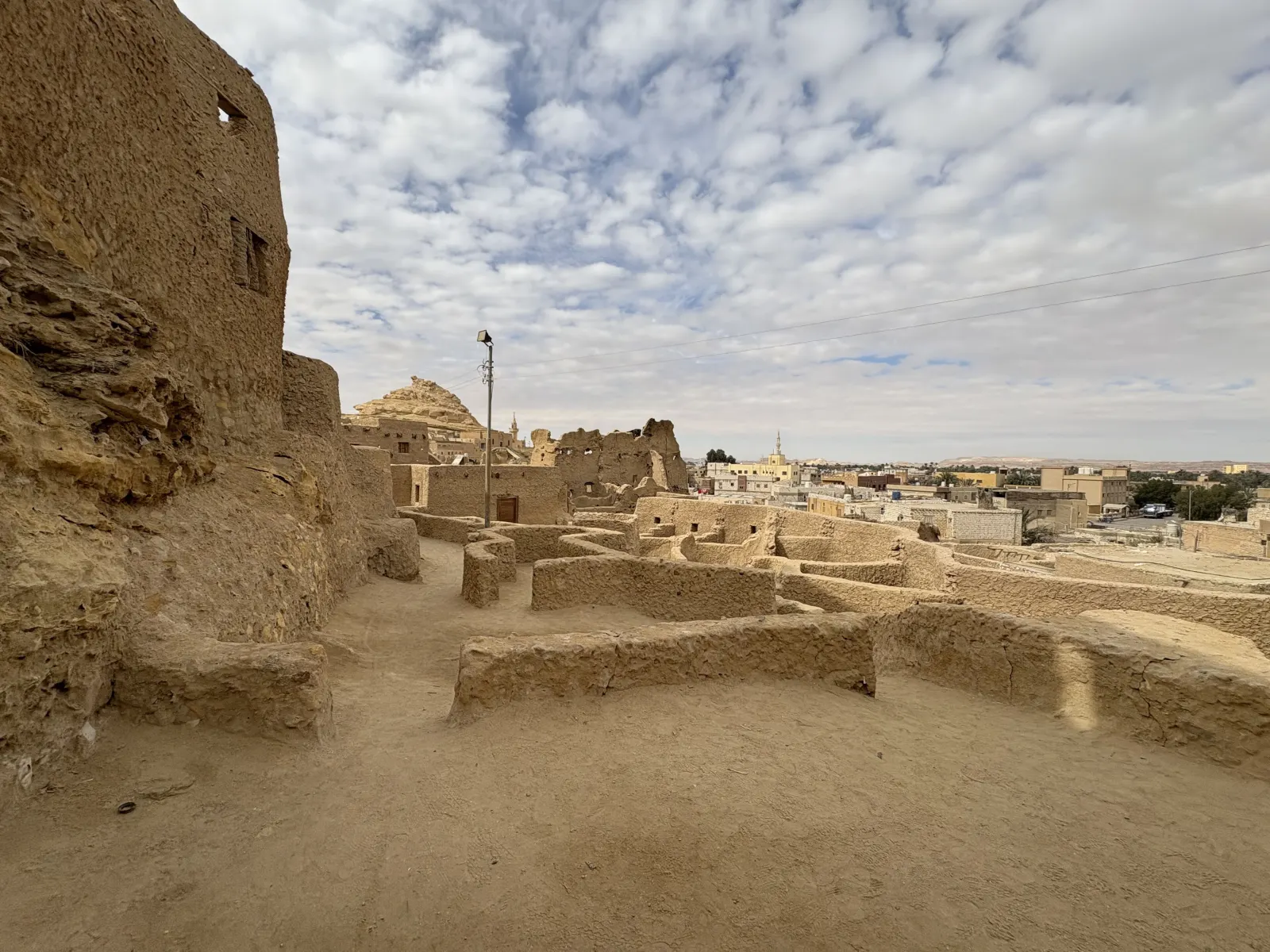
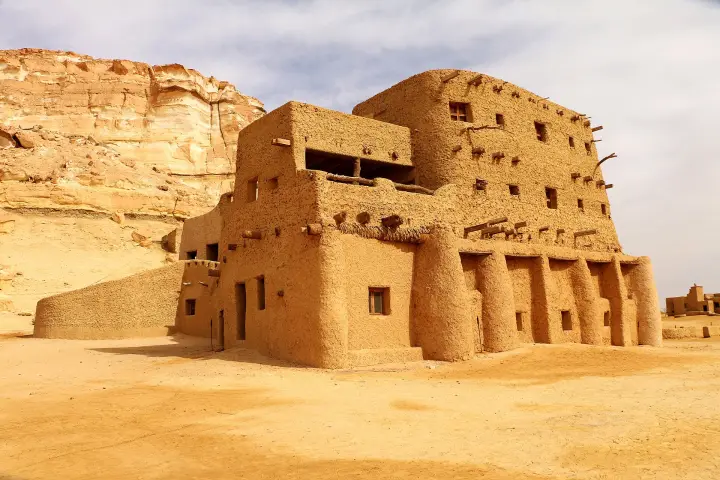
Kershef is Siwa's traditional building material: chunks of salt-rich mud from the lake edges, laid with mud mortar and dried hard by the sun, with palm trunks for beams and palm fronds for ceilings. It keeps houses cool by day and warm at night. Its weakness is water: rare heavy rain in 1926 dissolved much of Shali. Today restorers and eco-lodges are reviving the technique.
Ask us on WhatsAppKershef at a glance
Short answer: Kershef (also karshif) is Siwa's traditional building material: chunks of salt-crusted mud dug from the lake shores, laid with mud mortar, plastered with mud and roofed with palm trunks. It keeps houses cool in summer and warm in winter, but melts in heavy rain, which is why Shali collapsed in 1926.
| Made of | Salty mud and clay from the shores of salt lakes |
| Bound with | Mud mortar; palm trunks as beams and lintels |
| Finish | Mud plaster, sometimes whitewashed |
| Strengths | Free, local, insulating, hard as stone when dry |
| Weakness | Dissolves in sustained rain |
| See it at | Shali, Aghurmi, the Siwan House museum, eco-lodges |
| Time to see the best of it | A day: town on foot, plus a short ride to Aghurmi |
How it works
Short answer: Salt and clay crystallise as they dry, binding the mud into a rock-hard block that is also a good insulator.
Builders cut irregular lumps of salty earth from the edges of the lakes and let them dry. The salt crystals act like cement. Walls are built thick at the base and thinner higher up, with small windows to keep out sun and sand. Floors and roofs rest on split palm trunks covered with palm ribs, matting and mud. Doors and window frames are of palm or olive wood. In a place where it rains only a few millimetres a year, buildings last for generations.
A 2021 architecture thesis at the Politecnico di Torino (Y. Mekael, checked 19 November 2026) adds detail on the chemistry. The blocks, which Siwans call arigh, are mostly sodium chloride crystals with silt and sand mixed in. The mortar is made from a local silt called tafla. As that mortar dries, salt crystallises inside it and locks onto the blocks, so a finished wall behaves almost like one solid mass rather than a stack of bricks.
What goes into a kershef wall
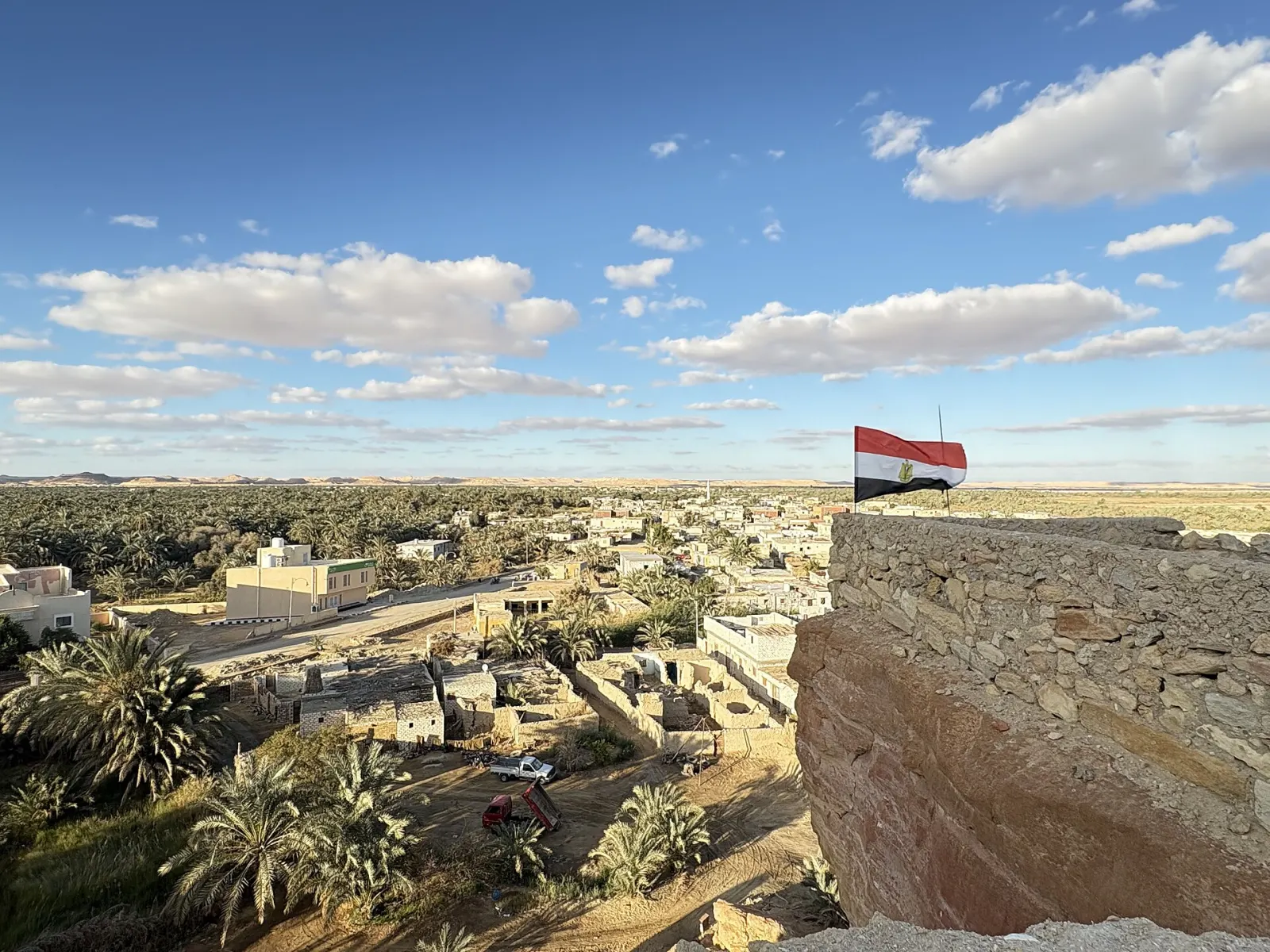
Short answer: Sun-dried lumps of salty earth, a mud mortar called tlakht, palm wood for the roof and a mud plaster skin. Walls taper from about 50 cm thick at the bottom to about 30 cm at the top.
| Part | What it is | Notes |
|---|---|---|
| Blocks | Lumps of salt-rich earth dug near the salt lakes | Left in direct sun until hard |
| Mortar (tlakht) | Wet salty mud | Left to ferment for one to two weeks before use |
| Wall thickness | About 50 cm at the base, about 30 cm at the top | Built course by course, each one dried before the next |
| Base (some houses) | A concrete wall about 50 cm high at ground level | Keeps groundwater away from the salt blocks |
| Beams and lintels | Split palm trunks; olive wood in narrow spaces | Also used as a decorative ceiling pattern |
| Ceiling | Palm ribs, matting and mud | Carries the flat roof |
| Roof skin | Tafla silt mixed with dried olive leaves | The leaves limit cracking in strong sun |
| Finish | Mud plaster, often light-coloured | Pale walls reflect the sun |
The wall thickness, the tlakht mortar and the concrete base come from a study of three Siwan buildings by R. M. Ahmed of University College London (ISARC 2014, PDF, checked 19 November 2026). The same study notes that ordinary houses normally stay under about 5 m high; Shali, built as a fortified town, rose higher. The olive-wood and olive-leaf details are from the Turin thesis.
Who built it, and how
Traditionally a wall went up with a team of three: a master builder, the meaalem, with one helper passing blocks and another passing mortar. Building a house was a neighbourhood event called fazaa, in which relatives and the whole street joined in, cutting blocks, preparing palm trunks and cooking for the workers, so labour cost little or nothing (Mekael, 2021).
Palm trunks were felled from October to December, after the date harvest, when insect damage is least likely, then buried in salt by the lakes for several weeks and sun-dried. Leaves went to fences and furniture and the sheath became rope.
Inside a Siwan house
Short answer: Thick walls were only part of the climate control. Room layout, roof sleeping, shaded lanes and a stair tower that moved air and light did the rest.
Ahmed's UCL study looked at a two-storey kershef family house in good repair and listed the ideas it uses. The Turin thesis describes the typical house built after Siwans moved out of Shali. Together they explain what you are looking at when you see an old house from the lane.
| Feature | What it does | Source |
|---|---|---|
| Few or no ground-floor windows | Keeps the soil's damp out; the ground floor was for storage and animals | Mekael 2021 |
| South-facing winter room | A family room used only in the cold months, catching low winter sun | Mekael 2021 |
| Flat roof with low parapet walls | Summer bedroom for the whole family, with privacy | Both |
| Stair tower | Acts as a ventilation shaft; in one house mirrors bounce daylight down it | Ahmed 2014 |
| Windows opposite each other | Cross-draughts in place of air conditioning | Ahmed 2014 |
| Small, low, four-part shutters | Light for people sitting on the floor; opened in summer | Mekael 2021 |
| Half-open kitchen roof | Lets smoke from the oven escape; Ahmed calls the upper kitchen the tabent | Both |
| Guest room with its own door | Visitors are received without entering family space | Both |
Palm beams that were too long were left sticking out of the wall. The thesis records that bundles of bones were hung from them to ward off the evil eye, so if you see a beam end poking from a façade, it is part of the design.
The weakness: rain
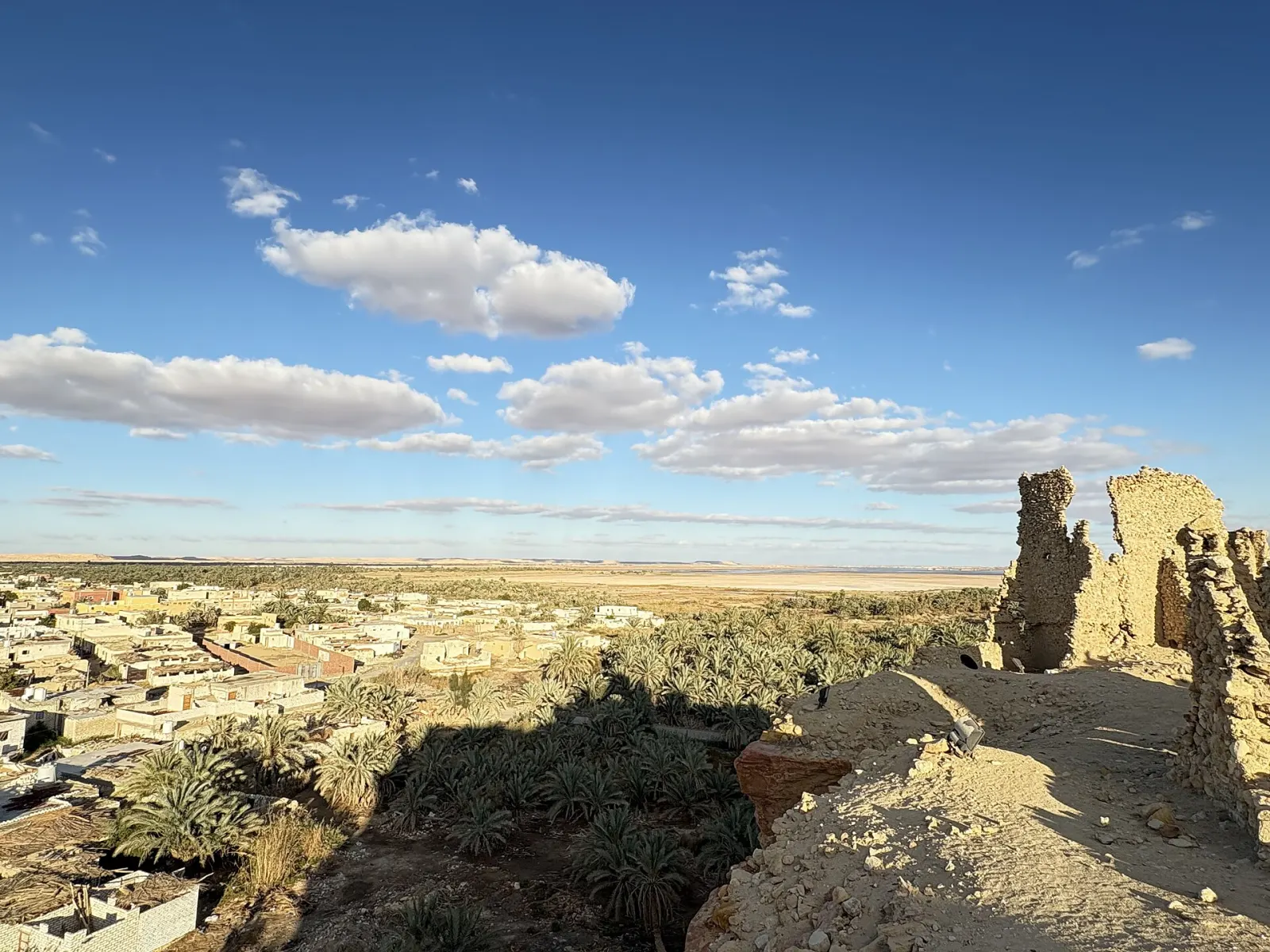
Short answer: Water dissolves the salt, so a long rainstorm can bring a kershef building down.
In 1926 three days of heavy rain fell on Siwa and badly damaged Shali; most families moved out to new houses on the plain (Al-Monitor, 2018). Many salvaged beams, doors and fittings to build again (Ahmed, 2014), and the old town became the melted ruin you see today. Wikipedia's Siwa article (checked 19 November 2026) notes that some of those later houses have since been replaced by cinder-block buildings with sheet-metal roofs.
A second blow came in 1985. Several days of heavy rain flooded the oasis, roofs collapsed, and the worst-hit houses were those built on soft, muddy ground. According to a tribal sheikh interviewed for the Turin thesis, most were rebuilt in white stone from a new quarry near Siwa, later with concrete slabs, because that takes only a few weeks. Families who kept their kershef homes often added one or two rooms in stone as a refuge for the next storm. Around the same time, the fazaa custom faded and building became paid work.
Humidity matters as well as rain. Lab tests published in 2019 found that karshif starts to dissolve when relative humidity stays above about 80%, while in normal desert conditions it handles moisture very well. They advise using it only where humidity rarely reaches that level (Makhlouf et al., Construction and Building Materials, 2019, checked 19 November 2026). Siwa sits well below that line: the WMO normals on our Siwa weather page give a monthly mean humidity under 60% in every month.
The revival
Short answer: Starting with the Siwan House museum at the end of the 1980s, then eco-lodges and the restoration of Shali, kershef has come back into use.
Lodges such as Adrère Amellal were built entirely in traditional style, without concrete, and won international attention. When Shali Lodge was built, so few Siwans still knew the craft that a kershef contracting company had to be set up to do the work, and the number of trained builders grew from there; Ahmed puts the number of Siwans employed on that project at over 45. Lodge builders also began using dried salt blocks for lamps and furniture, such as a salt-block table, a new use for an old material.
Timeline
| Year | Event | Source |
|---|---|---|
| c. 1203 | Shali founded as a walled town of kershef | Shali guide |
| 19th century | Families allowed to build outside the walls; a council sets street widths of 20, 12 and 8 cubits | Mekael 2021, citing Fakhry |
| 1926 | Three days of rain wreck Shali | Al-Monitor 2018 |
| 1985 | Flood damages many houses; stone and concrete take over | Mekael 2021 |
| End of the 1980s | Siwan House museum, the first new kershef building since the rains | Mekael 2021 |
| 2015 | Restoration of Shali's Tetnadi mosque completed | Mekael 2021 |
| 2018 to 2020 | EU-funded revival of Shali | EU Delegation 2020 |
The Shali restoration, 2018 to 2020
The EU funded the revival of Shali, and the Egyptian firm Environmental Quality International (EQI) designed and carried it out. Work began in 2018 and the restored fortress was inaugurated on 6 November 2020. The project:
- conserved the kershef lanes and ruins and gave some buildings new uses;
- rebuilt the traditional market spaces (khoss) for small traders and craftspeople;
- set up an Earth Architecture Museum on Siwan building;
- trained local residents to repair their own houses with traditional methods.
Sources: EU Delegation to Egypt, November 2020 (checked 19 November 2026); Al-Monitor, 2018. The Turin thesis gives the EU grant as €540,000, with €60,000 more from EQI, and records a separate British Council-funded scheme that trained 92 Siwans, many under 30, while restoring the stairs and mosque on the Aghurmi rock.
Rules for new building
Egypt's building code does not recognise kershef as a structural material. The Turin thesis reports that the governorate gets round this by approving it case by case for tourism projects, caps new buildings at 11 m and asks for a beige palette so new blocks blend with the old. It also records a bank branch built in stone and mud to the security standard the interior ministry requires. So new Siwa often looks traditional even with concrete behind the plaster; see eco-lodges for kershef you can sleep in.
Further reading
For the history of the oasis and its old town, the standard work is Ahmed Fakhry's Siwa Oasis (American University in Cairo Press, 1973; later reprinted as volume 1 of The Oases of Egypt), which is catalogued on the Internet Archive.
Where to see it
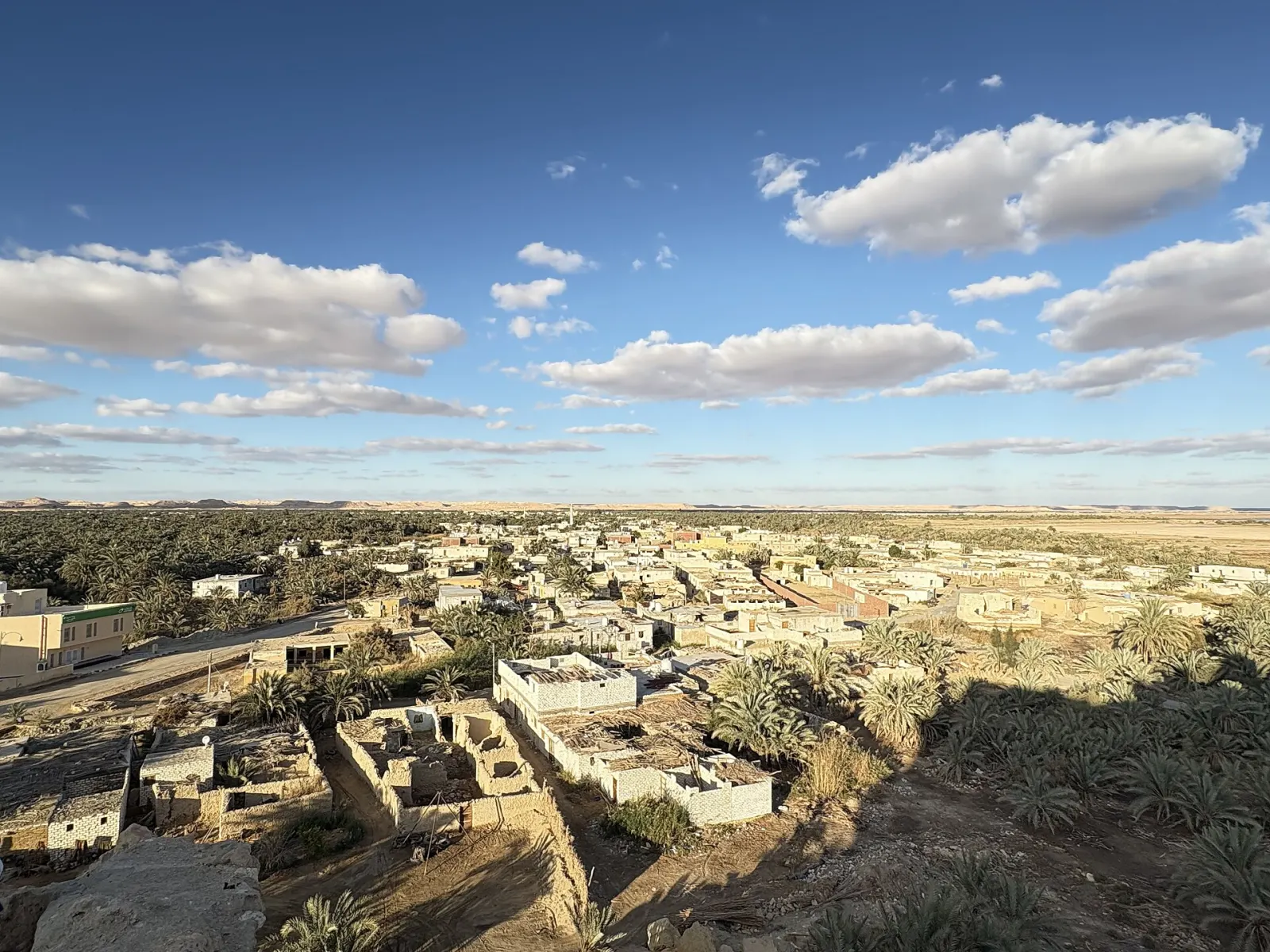
Short answer: Start at the market square, where Shali begins, and you can see three kinds of kershef within a few minutes' walk; Aghurmi is a short bike ride east.
| Place | From the market square | What it shows | Allow |
|---|---|---|---|
| Shali | At the square | Medieval ruin, restored lanes, Earth Architecture Museum | 45 to 60 min |
| Siwan House museum | About 260 m on foot | A whole house, furnished, built at the end of the 1980s | 20 to 40 min |
| Aghurmi and the Oracle Temple | 2.5 km by road east | Old village on a rock, restored stairs and mosque | About 1 hour |
| Adrère Amellal and other eco-lodges | About 15 km by road for the White Mountain lodges | Kershef and rock salt used for comfort | Guests only, as a rule |
Town distances come from our getting around Siwa guide and the Siwa map. Opening hours for the Earth Architecture Museum and the Siwan House museum are not officially published; ask us the day before.
Costs
Walking the lanes at the foot of Shali costs nothing. The Siwan House museum charges a small cash fee at the door, and ticket arrangements for Shali have changed over the years; we do not print figures we have not checked this season, so ask us for current prices. A bike or tuk-tuk covers Aghurmi; see getting around Siwa.
A one-day kershef route
- Early morning: cycle or take a tuk-tuk 2.5 km to Aghurmi and climb the restored stairs before the heat.
- Mid-morning: back in town, visit the Siwan House museum if it is open that day, to see a complete house with its roof and furniture intact.
- Midday: rest indoors; this is when kershef rooms earn their keep.
- About an hour before sunset: climb Shali, looking at wall sections where the plaster has fallen away, and stay at the top for the light.
Our private day tour can follow this order on request; for a longer plan see the 3-day itinerary.
Look closely
Run your hand along a wall (gently): you will feel salt crystals and see straw and palm fibre in the plaster. Where plaster has gone, look for the irregular lumps of the blocks and the thick mortar joints between them, then look up at ceilings for split palm trunks laid side by side. At sunset, walls glow pink and gold. Please do not climb on ruined walls; they crumble easily.
Mistakes to avoid
- Climbing Shali at midday from May to September. The ruin has little shade. Go early or late; see Siwa in summer.
- Sitting on wall tops for photos. Edges break off and you damage what the restorers saved.
- Prising out salt crystals as souvenirs. Buy salt pieces from craft shops instead.
- Treating the western side of the old town as empty. People still live there; keep your voice down and follow etiquette in Siwa.
- Booking an off-grid lodge without meaning to. Some kershef lodges have no electricity at all; check before you book, using our eco-lodges guide.
Families and access
Shali's paths are uneven, dusty and stepped in places, with drops at the edges, so hold small children's hands and skip the summit with a pushchair. There is no step-free route that we can vouch for. The lanes at the base and the square are flat and easier. Wheelchair access to the museums is not published; ask us before you go and we will check what we can.
Kershef vs concrete
| Kershef | Concrete | |
|---|---|---|
| Summer | Cool inside | Hot |
| Winter | Holds warmth | Cold |
| Rain | Dissolves | Resists |
| Cost | Local, labour-heavy | Bought in |
| Build time | Slow: each course must dry | A few weeks |
| Look | Blends into the landscape | Stands out |
Questions people ask
Why did people stop building with kershef?+
Two bouts of heavy rain did most of the damage: 1926 emptied Shali, and a flood in 1985 pushed many families towards white stone and concrete, which go up in a few weeks and need less upkeep.
Is kershef still used in Siwa?+
Yes, mainly in eco-lodges, restorations and some public buildings. Most new family homes use stone or concrete.
What happens to kershef in the rain?+
Water dissolves the salt that binds it. A light shower only marks the plaster, but the three days of heavy rain in 1926 brought down much of Shali. Lab tests also show it starts to dissolve when the air stays above about 80% humidity.
Can you still build with kershef today?+
Yes. Lodges and restoration projects have trained Siwan builders in the method. Each course must dry before the next goes on, and some houses start with a low concrete wall at ground level to keep groundwater out of the salt blocks.
How cool does a kershef room stay?+
Noticeably cooler than a concrete room on a summer afternoon, thanks to thick walls, small windows and shaded lanes. We have not found a published measurement of the exact difference, so treat any precise figure you hear with care.
Where is the best place to see kershef up close?+
Shali, which rises from the market square, then the Siwan House museum about 260 m away and the old village of Aghurmi, 2.5 km by road to the east. A day covers all three.
Is it fine to touch or climb kershef walls?+
Touch lightly if you like, but do not climb, sit on or lean against ruined walls. Salt-and-mud edges crumble under weight, and many walls in Shali are cracked.
Go with us
Trips that include this
4 to 5 days (3 or 4 nights in Siwa)
Luxury Siwa: Candlelit Eco-Lodge EscapeOn request (depends on the lodge and season)
Check dates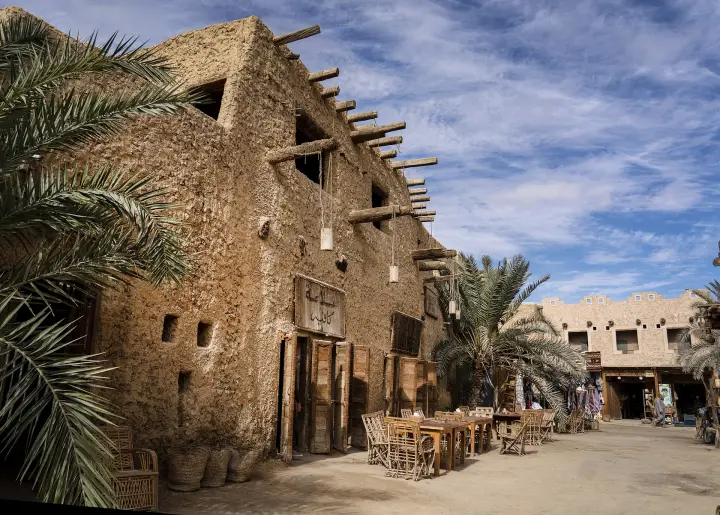
3 days, 2 nights
Siwa Oasis in 3 Days from Cairo (Private Trip)About US$420 to 650 per person for two travellers
Check dates