The short answer
No accepted evidence puts Alexander the Great's tomb in Siwa. Ancient writers say Ptolemy buried him at Memphis and later moved him to Alexandria. In 1995 the Greek archaeologist Liana Souvaltzi announced she had found his tomb at Maraqi, in west Siwa; a Greek Ministry of Culture team doubted the building was a tomb, and Egypt revoked her permit in 1997.
Ask us on WhatsAppThe short answer
Short answer: No credible evidence shows Alexander the Great is buried in Siwa. Ancient writers say his body went to Memphis and then to Alexandria, where his tomb was a famous monument for centuries before it was lost. A 1995 claim that it lay at Maraqi, in the west of the oasis, was rejected by Greek and Egyptian experts, and Egypt withdrew the excavator's licence in 1997.
| Question | What the evidence says |
|---|---|
| Did he ask to be buried at Siwa? | Curtius and Justin say so; the wish was not honoured |
| Where was he first buried? | Memphis, by Ptolemy I (Pausanias; the Parian Chronicle) |
| Where was the tomb for most of antiquity? | Alexandria, in the mausoleum Strabo calls the Soma |
| What was claimed in Siwa? | In 1995, that a ruined building at Maraqi (Bilad al-Rum) was his tomb |
| Who rejected it? | A Greek Ministry of Culture team (1995); Egypt's Supreme Council of Antiquities revoked the dig licence (1997) |
| Can you see it? | Not as a ticketed site; the place to stand where Alexander stood is the Oracle Temple |
The burial history in this table follows Wikipedia's article on the Tomb of Alexander the Great (checked 21 November 2026), which cites the ancient authors; the 1995 to 1997 story is sourced in the sections below.
Why anyone thought of Siwa
Short answer: Alexander had been greeted at Siwa's oracle as the son of Amun in 331 BC, and two ancient writers say he later asked to be buried there.
The visit itself is well documented: winter 332 to 331 BC, a desert crossing from the coast at Paraetonium (Marsa Matruh), and a private consultation whose answers he kept to himself. We tell that story, with the ancient sources side by side, in Alexander the Great in Siwa.
What matters here is what happened eight years later. Alexander died in Babylon in 323 BC. According to Quintus Curtius Rufus and Justin, he had asked to be laid to rest in the temple of Zeus Ammon at Siwa rather than beside his father at Aegae in Macedonia. Diodorus describes the hammered-gold coffin made for the body.
The funeral cart never reached the desert. In late 322 or early 321 BC Ptolemy, the general who had taken Egypt, diverted it in Syria and brought the body to Egypt himself, while his rivals Perdiccas and Eumenes held on to Alexander's armour, diadem and sceptre. Possession of the corpse was a claim to Alexander's legacy, and Ptolemy kept it close to his own capital.
What happened to the body
Short answer: Memphis first, then Alexandria, where the tomb was visited by Julius Caesar, Augustus and later emperors. By about AD 400 nobody could say where it was.
| Date | Event |
|---|---|
| 321 to 320 BC | Ptolemy I buries the body at Memphis |
| c. 280 BC | Body moved to Alexandria; Pausanias credits Ptolemy II |
| Late 3rd century BC | Ptolemy IV places it in a communal royal mausoleum |
| 48 BC | Julius Caesar visits the tomb |
| 30 BC | Augustus lays flowers and a golden diadem on the body |
| AD 199 | Septimius Severus seals the tomb |
| AD 215 | Caracalla visits and leaves his own tunic, ring and belt |
| c. AD 400 | John Chrysostom remarks that even Alexander's own people do not know where his tomb is |
All dates as given in the Wikipedia article and the ancient writers it cites. Every reliable thread in this chain runs through Alexandria, not Siwa. That is why most of the serious searching has happened under the modern city.
The 1995 Maraqi claim
Short answer: Liana Souvaltzi announced in early 1995 that a ruined building at Maraqi was Alexander's tomb. Within days a Greek government team questioned whether it was a tomb at all, and two years later Egypt revoked her licence.
The site
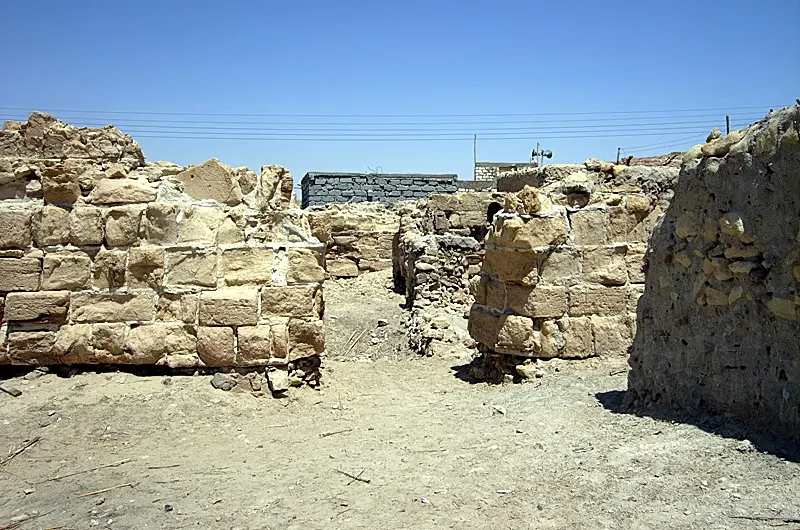
Maraqi, also called Bilad al-Rum ("land of the Romans"), lies in the western part of the Siwa depression. The building Souvaltzi dug is a ruined stone temple in a Doric style. It was not a new discovery: Robert Bianchi, writing in Archaeology magazine, notes that Frédéric Cailliaud and Heinrich Minutoli in the 1820s, and Gerhard Rohlfs in 1869, had already described it. Bianchi took it to be a temple of the Greco-Roman period, not a tomb (Archaeology, archive feature on the tomb hunt).
What was claimed
According to the same feature, Souvaltzi's team renewed excavation at the site in 1989, and she first put the idea forward at the Sixth International Congress of Egyptology in Turin in September 1991, where Egyptologists rejected it. Her case rested on Alexander's wish to lie near Amun, the Doric style of the building, a star she read as an emblem of the Macedonian royal house (the feature calls it 16-pointed; the New York Times report below says eight-pointed), and three tablets she said were inscribed in Greek. In late January 1995 she announced the find to the press. The New York Times, reporting from Cairo on 5 February 1995, quoted her as saying she had no reservations (NYT report as circulated on a University of Pennsylvania classics list, February 1995).
Why it was rejected
| Who | When | What they said |
|---|---|---|
| Greek Ministry of Culture team led by general secretary George Thomas | February 1995 | Unclear whether the structure was even a tomb; the style was not Macedonian; the tablet fragments did not support her translations |
| Yannis Tzedakis, Greek Director of Antiquities, on the same team | February 1995 | The building had Hellenistic elements but appeared to be later; the team did not see the words she said were inscribed |
| The same team, on the tablets | February 1995 | The fragments dated from the Roman period, about three centuries after Alexander |
| Abdel-Halim Nureddin, head of Egypt's antiquities organisation | February 1995 | Had first backed the announcement, then said the texts needed further study |
| Ali Hassan, secretary general of the Supreme Council of Antiquities | January 1997 | Egypt revoked her licence after 22 specialists reviewed her work; he called the report on her methods one of the worst he had seen |
The 1995 statements are reported in The New York Times (as above) and The Baltimore Sun of 6 February 1995 (cited by Wikipedia). The licence decision is from The Irish Times, 25 January 1997. Souvaltzi rejected the criticism and said she would take the matter to court. Wikipedia's Siwa Oasis article states that the case is still active in the Greek courts; we could not confirm its current status.
Evidence versus legend
Three different things often get blended together:
- Evidence: ancient authors agree the body went to Memphis and then Alexandria, and Roman emperors visited it there.
- A recorded wish: Curtius and Justin say Alexander asked to be buried at Siwa. That tells us about his intentions, not about where he ended up.
- A modern claim: the Maraqi identification, which rested on readings that the Greek team said it could not see on the stones.
The idea still resurfaces. In October 2021 the Egyptian press reported a claim by Mohamed Omran, director of Siwa's tourism department, in a television interview, that the tomb lies in the Siwa area (Egypt Independent). No excavation result has been published to support it.
The search in Alexandria
Short answer: Most specialists look for the lost tomb under central Alexandria. Wikipedia counts more than 140 officially recognised attempts, and none has found it.
Searchers have looked under the Nabi Daniel Mosque, where the officials who run the mosque obtained a halt to digging for fear the building could collapse. A Polish mission working at Kom el-Dikka from 1960 dug more than 50 feet down and found a small Roman theatre (an odeum) and baths rather than a tomb (Archaeology, as above). More recently Calliope Limneos-Papakosta of the Hellenic Research Institute of Alexandrian Civilization has excavated in the Shallalat Gardens, part of the ancient royal quarter (Wikipedia).
Other theories place the body in Venice, at Vergina or at Amphipolis in northern Greece, and none of these has wide support either. Siwa's case is weaker than Alexandria's for a simple reason: no ancient source says the body ever arrived there.
What you can see in Siwa today
Short answer: The real Alexander site is the Oracle Temple at Aghurmi. The Maraqi ruins are not a ticketed sight; for the Greco-Roman oasis around them, go to Gebel al-Mawta and Umm Ubayda.
Distances below are by road from the market square below Shali, measured on OpenStreetMap, as on our Siwa map.
| Place | By road from the market square | What it tells you |
|---|---|---|
| Oracle Temple of Amun, Aghurmi | 2.5 km | Where Alexander consulted the god; ticketed site |
| Temple of Umm Ubayda | 2.8 km | The second Amun temple, built under Nectanebo II about a generation before Alexander came |
| Gebel al-Mawta | 1.7 km | Ptolemaic and Roman tombs: how the oasis's elite were buried in the centuries after Alexander |
| Shali | Walk up from the square | The medieval town, for the long view of Siwa's history |
| Maraqi (Bilad al-Rum) | Far west of the oasis | The building claimed in 1995; not an organised visitor site |
Visiting Maraqi
We do not include Maraqi on standard itineraries. It is off the usual loop, we know of no visitor facilities, and access to the desert around Siwa depends on permits that change; see Siwa permits and checkpoints. If you have a serious interest, ask us what is possible for your dates. Do not climb on or remove anything from the ruins.
Timing and tickets
The Oracle Temple and Gebel al-Mawta are ticketed antiquities sites. The Ministry of Tourism and Antiquities ticket list (updated 5 November 2024) gives EGP 120 for a foreign adult and EGP 60 for a foreign student at each, and lists Gebel al-Mawta as open 9:00 to 17:00. Fees change at short notice, so carry spare Egyptian pounds and check at the gate; more detail is in our Gebel al-Mawta guide. Neither site has shade, so from May to September go at opening time or in the late afternoon. See Siwa weather for the monthly picture.
A half-day on the real Alexander trail
- Oracle Temple at opening. Read the ancient accounts first, in Alexander the Great in Siwa.
- Umm Ubayda. About 500 m from the temple rock.
- Gebel al-Mawta. On the way back towards town, for the painted tomb of Si-Amun.
- Lunch in town, then the wider timeline in Siwa history.
Why the legend lasts
Short answer: It combines a famous wish, a real oracle and a real ruin. Only the link between them is missing.
Alexander did come to Siwa, he was honoured as Amun's son, and his successors put the ram's horn of Ammon on his portrait on their coins. Two ancient writers say he wanted to come back for good. The ruin at Maraqi is genuinely old and Greek in style. Put together, those facts make a story that is easy to believe. But the documented trail of the body runs from Babylon to Memphis to Alexandria, and nothing reported from Maraqi has changed that.
See it with us
Our Siwa in 3 days trip covers the Oracle Temple, Umm Ubayda and Gebel al-Mawta with a guide who knows the story. Coming from the coast, Siwa from Alexandria follows Alexander's own route via Marsa Matruh. Already in town? The Siwa oasis day tour starts at Aghurmi. For dates and prices, contact us or browse all tours.
Questions people ask
Did Alexander want to be buried in Siwa?+
Two Roman-era writers, Curtius and Justin, say that shortly before he died he asked to be buried at the temple of Zeus Ammon in Siwa. The wish was not honoured: Ptolemy took the body to Egypt and buried it at Memphis, and it was later moved to Alexandria.
Who claimed to have found Alexander's tomb in Siwa?+
Liana Souvaltzi, a Greek archaeologist, who announced in early 1995 that a ruined building at Maraqi (Bilad al-Rum) in the west of the oasis was his tomb. Her team had worked there since 1989.
Why was the 1995 claim rejected?+
A Greek Ministry of Culture team led by its general secretary, George Thomas, visited in February 1995. It said the building's style was not Macedonian, that the inscribed fragments did not support her readings, and that it was unclear the structure was a tomb at all.
Can I visit the site at Maraqi?+
It is not an organised visitor site, with no ticket office or signage that we know of. It lies in the far west of the oasis, beyond the usual sightseeing loop. Ask us whether current permits allow a visit for your dates.
Where do archaeologists think Alexander's tomb was?+
In Alexandria. Roman emperors visited a tomb there, and it was lost in late antiquity. Wikipedia, citing Egypt's Supreme Council of Antiquities, counts more than 140 officially recognised attempts to find it; none has succeeded.
What can I see in Siwa that is really linked to Alexander?+
The Oracle Temple of Amun at Aghurmi, where he consulted the god in 331 BC. It is 2.5 km by road from the market square. The Ministry of Tourism and Antiquities ticket list gives EGP 120 for a foreign adult; check at the gate, as fees change.
Go with us
Trips that include this
3 days, 2 nights
Siwa Oasis in 3 Days from Cairo (Private Trip)About US$420 to 650 per person for two travellers
Check dates