- Duration
- 4 days, 3 nights
- Starts from
- Cairo
- Style
- Private
- Price per person
- About US$530 to 880 per person for two travellers
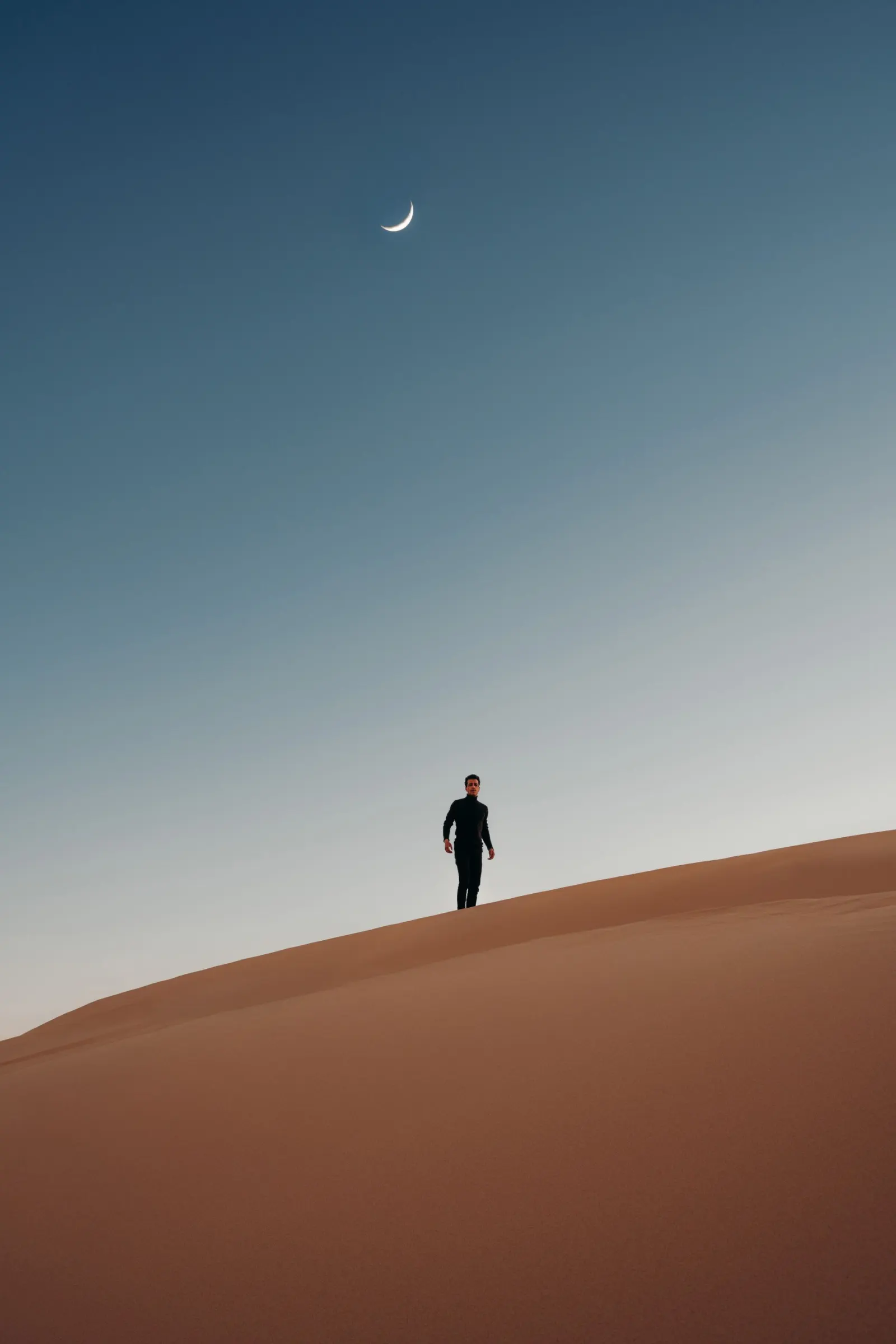
Siwa Sky Nights is our private 4-day trip from Cairo with one Great Sand Sea camp night timed to the sky. Fixed 2026-27 dates: Geminids on 13/14 December 2026 (moon-free maximum), Quadrantids on 3/4 January 2027 (peak 05:25 Egypt time), Eta Aquariids on 5/6 May at new moon, and full-moon dune nights on 23/24 December and 22/23 January.
Check dates on WhatsAppHighlights
- ✦Geminids camp night 13/14 December 2026: the crescent Moon sets around 21:10, before the radiant climbs high
- ✦Quadrantids before dawn on 4 January 2027, peak 05:25 Egypt time
- ✦Full-moon dune walks on 23/24 December and 22/23 January
- ✦New-moon dark nights from January to May 2027, with the Eta Aquariids at new moon, and the Southern Delta Aquariids in late July
- ✦Any date as a private trip: we time the camp night to the Moon for you
Day by day
Day 1
Day 1: Cairo to Siwa
Private car from your Cairo or Giza hotel along the coast road and south from Marsa Matruh. Check in at an eco-lodge and climb Shali for the last light.
Day 2
Day 2: The oasis, then an early night
Oracle Temple and Gebel al-Mawta in the cool morning, a spring and the salt pools after lunch. Dinner early and to bed: tomorrow night runs late.
Day 3
Day 3: The sky night
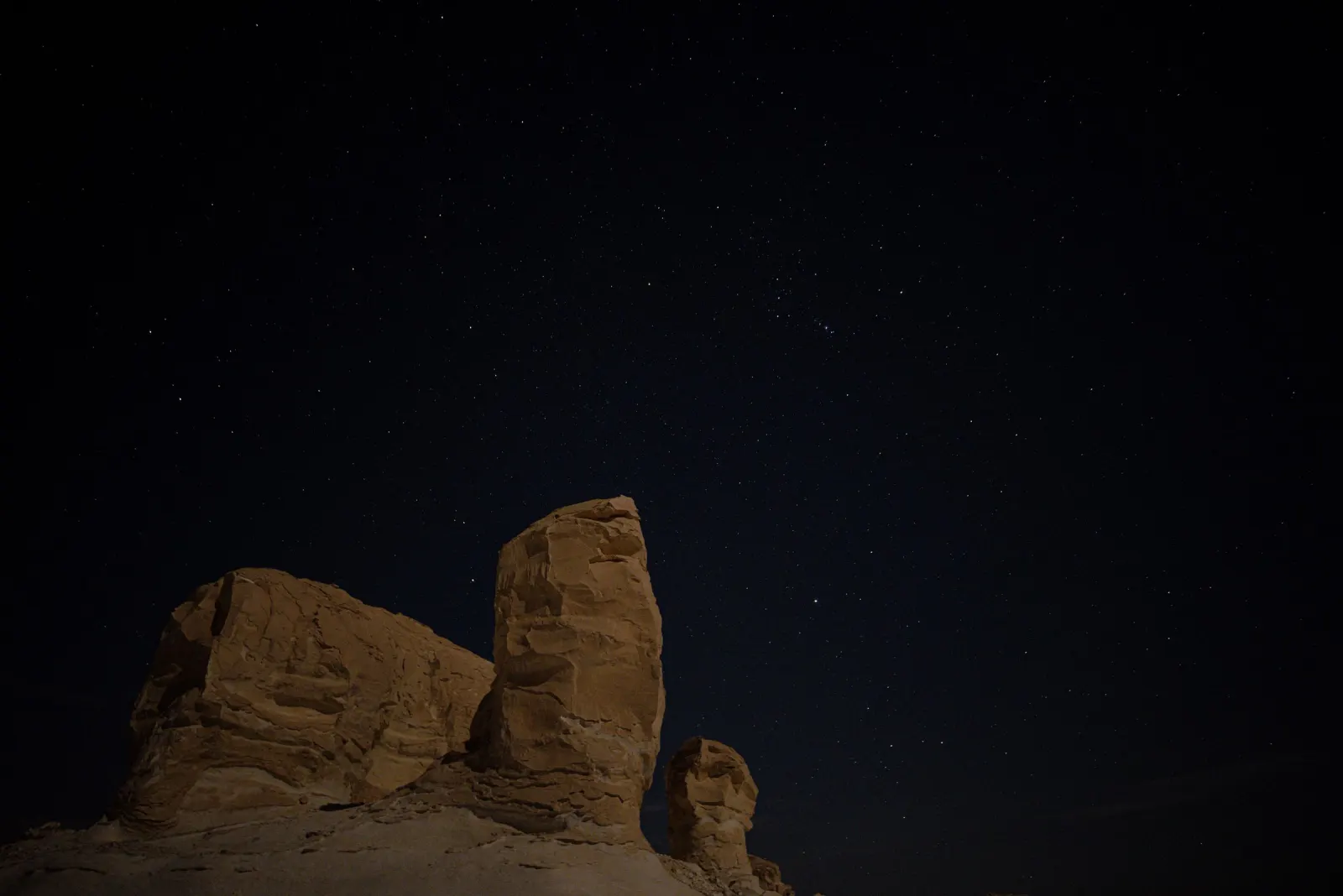
Into the Great Sand Sea by 4x4 in the afternoon, with a stop at Bir Wahed, a sulphur spring in the dunes. Camp is pitched well away from any light before sunset. Dinner on the fire, then fires and torches go low so your eyes can adapt. For the Quadrantids and Eta Aquariids we wake you around 03:00 for the pre-dawn hours.
Day 4
Day 4: Sunrise and the road back
Tea and sunrise from the dune crest, breakfast at camp, back to Siwa to wash, and the long drive to Cairo, arriving late in the evening.
Included
- ✓ Private car and driver from Cairo and back
- ✓ Siwan guide and 4x4 with an experienced desert driver
- ✓ 2 eco-lodge nights with breakfast
- ✓ 1 desert camp night with dinner and breakfast, mattresses, blankets and ground mats
- ✓ Desert permit and site entry fees
Not included
- – Tips
- – Lunches and dinners in Siwa town
- – Sleeping bag (strongly advised December to February)
The short version
Short answer: Four private days from Cairo, two lodge nights and one camp night in the Great Sand Sea chosen for the sky. Pick a fixed date below, or any date you like as a private trip.
The one thing that makes a desert sky night work is being in the right place on the right night: far enough from Siwa town that its lights sink below the horizon, and on a date when the Moon helps rather than hinders. This trip is built around that single night. The rest of it, two days in the oasis and two road days, is the frame.
Who this trip suits, and who should choose another
| You are... | Sky Nights? | Better choice |
|---|---|---|
| Starting in Cairo and wanting the sky as the main reason to go | Yes | |
| Chasing a specific meteor shower or a full moon in the dunes | Yes | |
| A couple or small group happy with one basic camp night | Yes | |
| Already in Siwa with one free evening | No | Stargazing evening, back in bed the same night |
| Already in Siwa and happy to sleep out on any date | No | Overnight desert camp |
| Keen on the oasis and a camp, but not fussy about the Moon | Partly | 4 days with eco-lodge and desert camp |
| Needing a proper bathroom every night | No | 3 days from Cairo |
| Wanting to see the White Desert too | No | White Desert and Siwa in 4 days |
| Hoping to use a telescope | Ask first | No telescope is listed in what this trip includes |
The Sky Nights and the standard 4-day camp trip share a shape. The difference is the date: here the camp night is chosen by the Moon and the meteor calendar, and the Day 2 evening is kept short so you can stay up late on Day 3.
2026-27 departures
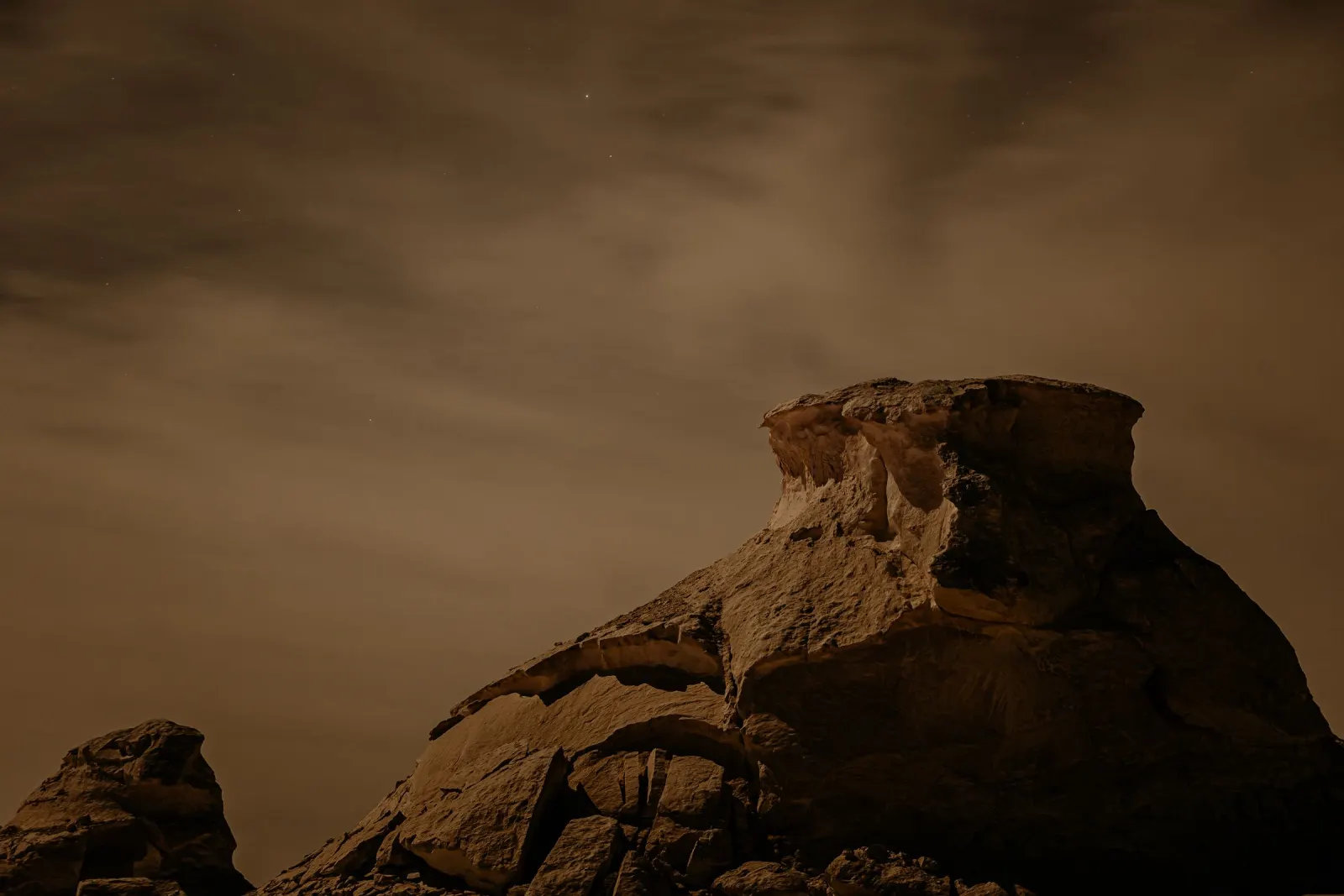
Moon phase times are in Egypt local time (UTC+2), converted from the AstroPixels lunar phase tables. Shower peaks and rates are from the International Meteor Organization calendar. Each trip runs Day 1 to Day 4, with the camp night on Day 3.
| Camp night | Sky event | Moon | Trip dates | Notes |
|---|---|---|---|---|
| 13/14 Dec 2026 | Geminids peak (ZHR 150) | Crescent about 19% lit, sets around 21:10 | 11-14 Dec | The year's best shower, moon-free at maximum |
| 23/24 Dec 2026 | Full moon (03:28, 24 Dec) | Full | 21-24 Dec | Silver dunes over Christmas |
| 3/4 Jan 2027 | Quadrantids peak (05:25, ZHR 80) | Thin waning crescent, rises around 04:25 | 1-4 Jan | Short peak, pre-dawn watch |
| 7/8 Jan 2027 | New moon (22:24, 7 Jan) | None | 5-8 Jan | Orion, the Pleiades, winter band |
| 22/23 Jan 2027 | Full moon (14:17, 22 Jan) | Full | 20-23 Jan | Coldest month for camping |
| 6/7 Feb 2027 | New moon (17:56, 6 Feb) | None | 4-7 Feb | Ramadan expected from about 8 Feb |
| 7/8 Mar 2027 | New moon (11:29, 8 Mar) | None | 5-8 Mar | Milky Way core before dawn (estimate); last days of Ramadan (expected) |
| 22/23 Mar 2027 | Full moon (12:44, 22 Mar) | Full | 20-23 Mar | Windiest month; khamsin season begins |
| 6/7 Apr 2027 | New moon (01:51, 7 Apr) | None | 4-7 Apr | Core before dawn (estimate); dust risk |
| 5/6 May 2027 | Eta Aquariids (ZHR about 50) + new moon | None | 3-6 May | Pre-dawn only; hot afternoons |
| 30/31 Jul 2027 | Southern Delta Aquariids (ZHR 25) | About 6-7% lit, rises before dawn | 28-31 Jul | Mean highs about 40C; the eclipse follows on 2 Aug |
Milky Way timings in March, April and May are our calculated estimates, not observed windows. The full moon of 20/21 February also brings a penumbral lunar eclipse, a faint grey shading rather than a red Moon, during Ramadan. Every phase for next year is on our Siwa moon calendar for 2027, and the showers are explained in meteor showers in Siwa 2026-2027.
New moon or full moon?
New moon is for people who want to see as much as possible: meteors, star clusters with binoculars, satellites crossing every few minutes and, from March, the Milky Way core rising in the hours before sunrise. Full dark adaptation takes 20 to 30 minutes, so we keep the fire small and torches on red.
Full moon is a different trip. The sky is washed out, but the dunes turn silver and you can walk the crests at midnight without a torch, see your own shadow and read the ripples in the sand. It suits couples and anyone uneasy about total darkness.
For the meteor showers we pick the night, not you, because the Moon and the peak decide it. Read the full Geminids in Siwa 2026 guide for when to look and where the radiant sits.
The stops, and why each one matters
| Stop | Day | Worth it because |
|---|---|---|
| Shali Fortress | 1 | The old salt-and-mud town; a high view at dusk after the drive |
| Oracle Temple of Amun | 2 | The oracle that drew Alexander the Great |
| Gebel al-Mawta | 2 | Painted rock-cut tombs a short ride from town |
| Springs and salt lakes | 2 | A swim or float in the warm afternoon |
| Bir Wahed | 3 | A warm pool in the dunes on the way to camp |
| Great Sand Sea camp | 3 to 4 | Distance from every light, which is the point of the trip |
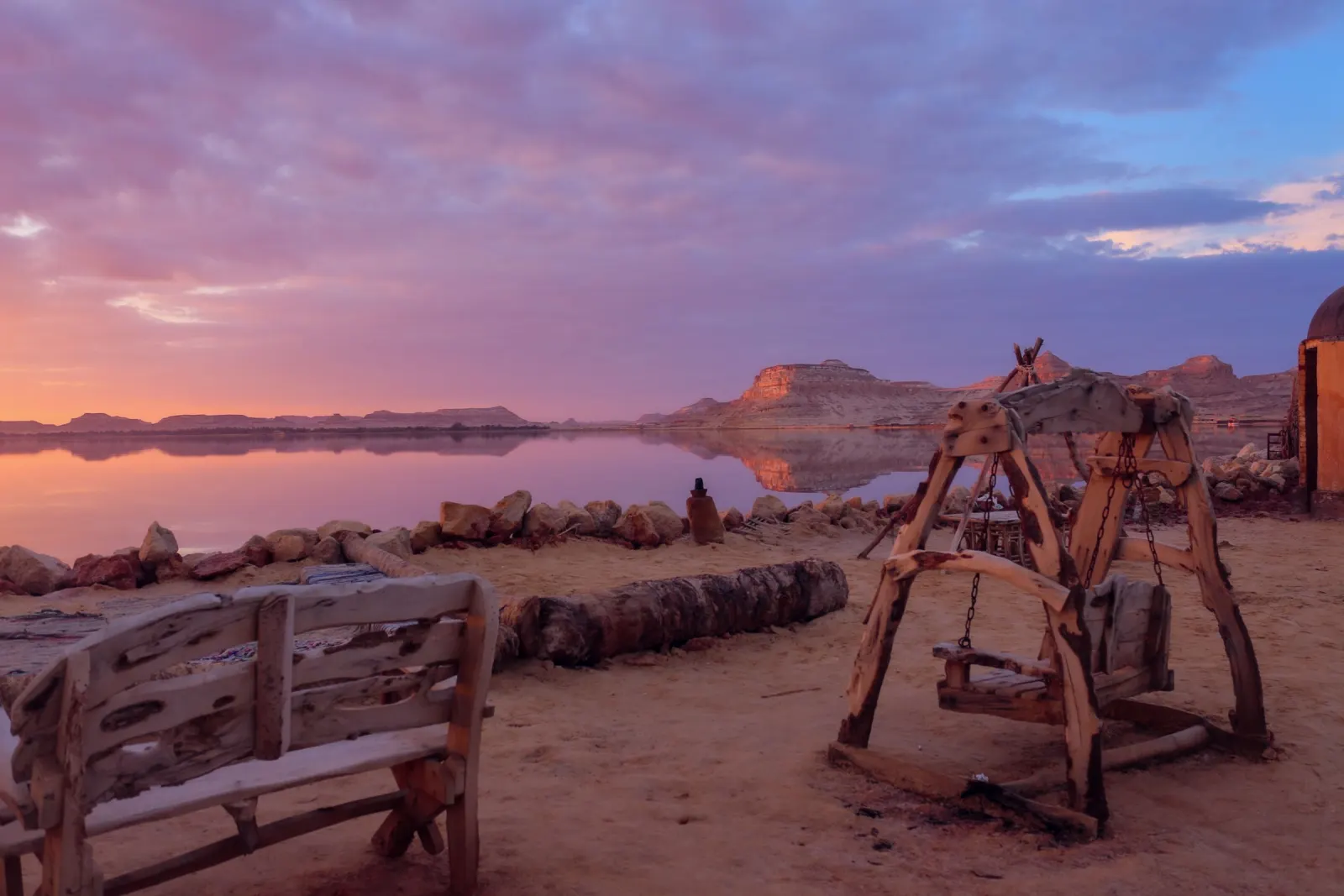
Shali. The ruined town rises on a rock outcrop above modern Siwa. It was built of kershef, salt-rich mud brick with palm logs, which is why heavy rain in 1926 damaged it so badly; today it is floodlit at night (Wikipedia, Siwa Oasis, checked 19 November 2026). Wikivoyage dates its founding to the early 13th century and says it stayed the main settlement until the 1920s (Wikivoyage, Siwa, checked 19 November 2026). Those floodlights are also a reason the camp sits well out in the sand.
The Oracle Temple. The shrine on the hill of Aghurmi was built by the pharaoh Amasis, who reigned 570 to 526 BC. Livius notes that it does not look like a typical Egyptian temple and reads it as a political gesture to the Libyan tribes (Livius, Ammon (Siwa), checked 19 November 2026). Alexander made a detour here to consult the god; the background is in Alexander the Great in Siwa. It sits about 4 km east of town, per Wikivoyage.
Gebel al-Mawta. The "Mountain of the Dead" is a limestone hill about 1 km north of the centre, with tombs mostly from the Ptolemaic and Roman periods. The tomb of Si-Amun has the best-coloured reliefs, and photography is not allowed inside the tombs (Wikivoyage, Siwa, checked 19 November 2026).
Springs and salt pools. The oasis has about 200 natural springs (Wikipedia). NASA explains that they draw on the Nubian Sandstone Aquifer System, and that evaporation ponds in the depression are used to harvest salt (NASA Earth Observatory, checked 19 November 2026). Siwa lies in a depression that reaches about 20 m (65 ft) below sea level.
Bir Wahed and the Great Sand Sea. Bir Wahed is about 15 km south-west of town: a spring feeds a pool of about 30C, the lake beside it is cold, and the minerals stain swimwear and towels (Wikivoyage, as above). Beyond it lies the Great Sand Sea, an erg of about 72,000 km² stretching roughly 650 km north to south across western Egypt and eastern Libya (Wikipedia, Great Sand Sea, checked 19 November 2026). How far out the crew camps depends on wind and the sky event; ask us if distance matters to you.
The road and timings
Short answer: Day 1 and Day 4 are long road days. Days 2 and 3 are in and around the oasis, and Day 3 ends late.
| Leg | Distance and time |
|---|---|
| Cairo to Siwa (Day 1) | ~750 km, ~9 h driving, ~10 h with stops |
| Marsa Matruh to Siwa | ~300 km, ~3 h 45 (the last leg of the same drive) |
| Siwa town to Bir Wahed (Day 3) | About 15 km, by 4x4 over sand |
| Siwa to Cairo (Day 4) | ~750 km, ~9 h driving, ~10 h with stops |
Siwa is about 750 km from Cairo by road: about 9 hours of driving, or about 10 hours with stops. Siwa's airfield (SEW) has no scheduled passenger flights. The nearest airport with flights is Marsa Matruh (MUH), about 300 km and 4 hours north by road, and its flights run mostly in summer.
Day 4 follows a short night, so plan to sleep in the car. We do not use the desert road from Bahariya: on the road between Bahariya and Siwa the UK government (FCDO) "advises against all but essential travel" (FCDO regional risks, checked 19 November 2026), and we route via Cairo. Carry your passport for checkpoints; the desert permit is included. See permits and checkpoints. Ask us what time the car leaves on Days 1 and 4.
Season and weather for this trip
Sunset in mid-December is around 17:21, and the sky is fully dark by about 18:45 (timeanddate, Siwa Oasis, checked 19 November 2026). Long winter nights give you more dark hours, but they are the coldest.
| Departure month | What it means on the camp night |
|---|---|
| December | Long dark nights; a sleeping bag is essential |
| January | The coldest month; frost is possible before dawn |
| February | Still cold after midnight |
| March | Milder, but the windiest month |
| April | Comfortable nights; dust risk |
| May | Hot afternoons, pleasant pre-dawn watch |
| July | Warm all night; we keep the day short |
Town figures understate the cold out on open sand. Rain hardly matters: NASA puts the yearly total at about 10 mm (NASA Earth Observatory, checked 19 November 2026). Monthly highs, lows and records are on Siwa weather, with more on Siwa in December and Siwa in winter.
The camp night, hour by hour
Dinner is cooked on the fire, then we move mattresses onto the sand facing the right part of the sky. The Geminids are best after midnight, when the radiant in Gemini is high. For the Quadrantids and Eta Aquariids the radiant only climbs in the last hours of the night, so you sleep first and we wake you around 03:00 with tea.
There is no electricity, no shower and only a basic toilet tent at camp. That is the price of the darkness. More on what to expect in camping in Siwa.
What to bring
- A sleeping bag rated to around 0C for December to February. It is not included, and the blankets alone are not enough on a January night.
- Down jacket, hat, gloves and thick socks. You are lying still for hours.
- A head torch with a red mode, and a power bank.
- Binoculars if you have them. A tripod if you want to photograph the sky.
- Leave drones at home: the FCDO says not to use one in Egypt without prior Ministry of Defence permission (FCDO safety and security, checked 19 November 2026).
- Old swimwear and a spare towel for Bir Wahed and the salt pools.
- For May and July: sun protection for the day, and a light layer for the small hours.
The full kit list is in our Siwa packing list.
Families and accessibility
Children. A full-moon date is the gentler choice: children can see each other and the dunes around them. Keep young ones inside the circle of mats after dark. The hard part for small children is the two road days, not the sky. Ask us about children's prices and age limits.
Walking. Shali means climbing uneven mud-brick lanes, and Gebel al-Mawta is a hill with tombs cut into its slopes. Tell us in advance if steps or slopes are hard for you.
The 4x4 and camp. The drive to camp crosses dunes and can be bumpy; tell us about back problems or pregnancy before you book. At camp you sleep on mattresses on the ground, there is no plumbing, and medical help is back in town; see health and pharmacies in Siwa. If getting up and down from the ground is hard, ask us what we can arrange before you book.
With us or on your own
| On your own | Sky Nights | |
|---|---|---|
| Getting there | Night bus of 10 to 13 hours, or self-drive | Private car from your hotel |
| Choosing the night | Your own Moon and shower research | We set the camp night by the sky |
| Into the dunes | Hire a desert driver in town and arrange the permit | 4x4, driver, guide and permit included |
| Camp | Bring or rent kit and food | Mattresses, blankets, dinner and breakfast included |
| Cost | Lower | See prices below |
The dunes at night are not a do-it-yourself option. The FCDO advises using a qualified guide and a Ministry of Interior permit for off-road travel, and not driving outside main cities and resorts at night (FCDO safety and security, checked 19 November 2026). For a cheaper independent visit, see Siwa trip cost and stargazing in Siwa for spots near town.
Prices
Short answer: About US$530 to 880 per person for two travellers. Solo travellers pay more per person; four sharing a car pay less.
The range depends on the lodge you choose for the two oasis nights and whether you want a simple camp or private glamping in the dunes. Late December and early January dates overlap with the holidays, so ask early. We send an exact quote for your dates on WhatsApp.
Prices updated November 2026.
Honest caveats
- A sky event is never guaranteed. Meteor rates vary year to year, and the Geminids ZHR is an ideal figure.
- Winter nights in the desert are genuinely cold. If that worries you, a full-moon date in March is milder.
- Late March and April bring khamsin winds that can lift dust and hide the stars for a day or two.
- The oasis is busy over New Year, so plan ahead for those dates.
Book a sky night
Send us your preferred departure from the table, or your own dates, on our contact page, and we will confirm the camp night and the Moon for you. For the holiday period see Christmas and New Year in Siwa, and compare every trip on our tours page.
Questions people ask
How many Geminids will I actually see?+
The ZHR of 150 is an ideal rate for a perfectly dark sky with the radiant overhead. From a dune camp on 13/14 December a realistic count is lower, but several dozen an hour in the best hours after midnight is a reasonable hope on a clear night. Rates are never guaranteed.
Why is the Quadrantids camp night 3/4 January and not 4/5?+
The peak falls at 05:25 Egypt time on 4 January and the shower is short, with rates dropping off within hours. The night of 3/4 January catches the pre-dawn peak; the next night is too late.
How cold is a winter sky night?+
Siwa's mean January low is 6.1C and the record is -2.2C, so lying still in the dunes after midnight is cold. Bring a down jacket, a hat, gloves and a sleeping bag; we provide blankets and mats.
What happens if it is cloudy?+
Rain is rare in Siwa, about 10 mm a year according to NASA, but high cloud or dust can still dim a night. If the forecast is poor we swap Day 2 and Day 3 where the sky event allows.
Can we go on other dates?+
Yes. Every departure is private, so any date works. Tell us your month and we pick the camp night by the Moon: near new moon for dark skies, near full moon for silver dunes.
Can I see the Milky Way core in winter?+
No. From December to February the bright core is too close to the Sun. You get the fainter winter band running through Auriga and past Orion. By our calculation the core starts rising a few hours before dawn from about March.
Is this trip suitable for children?+
It can be, on a full-moon date, which is easier for children than total darkness. The harder parts are two road days of about 10 hours and a cold night with no plumbing. Ask us about children's prices and the youngest age we take.
Can we return through Bahariya and the White Desert?+
Not on this trip. For the Bahariya-Siwa road the UK government (FCDO) 'advises against all but essential travel', so we route via Cairo. For both deserts, see our White Desert and Siwa trip.
Go with us
Trips that include this
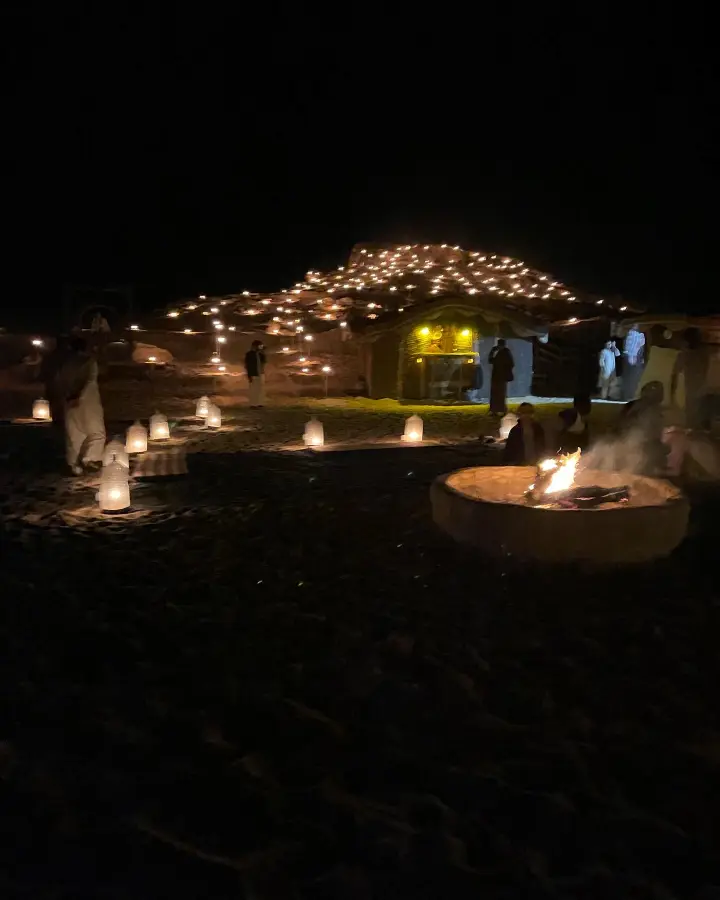
About 20 hours (afternoon to next late morning)
Overnight Desert Camp from Siwa (Private)About US$120 to 220 per person for two travellers
Check dates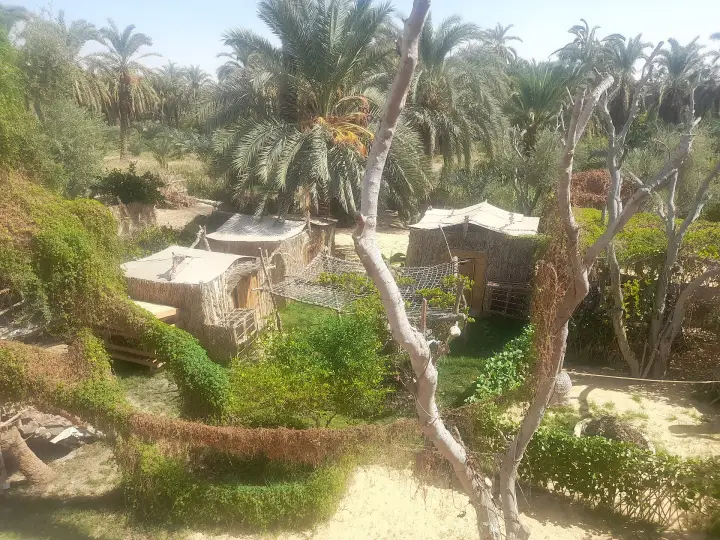
4 days, 3 nights
Siwa in 4 Days: Eco-Lodge and a Night in the Great Sand SeaAbout US$495 to 825 per person for two travellers (the lodge level decides the price)
Check dates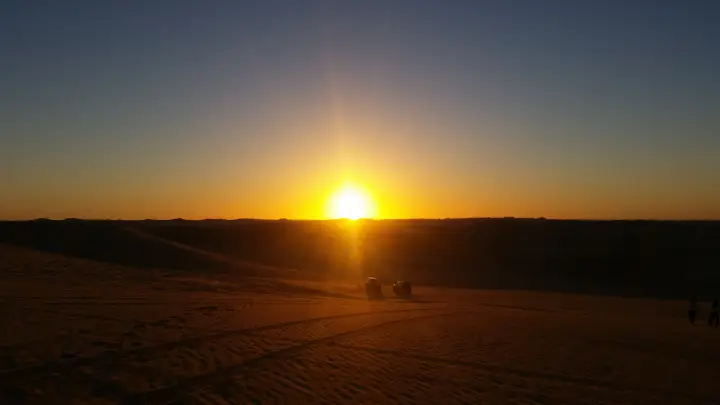
4 days, 3 nights
Siwa Christmas and New Year Trips from Cairo, 2026-27From about US$495 per person for two travellers, plus a holiday supplement quoted for your dates (prices updated November 2026)
Check datesHow booking works
Free written quote
Message us on WhatsApp. We reply with the plan and a total price in writing, with no obligation.
50% deposit
To confirm, you usually pay 50% of the tour price; the balance is due before you arrive.
Permits handled
We arrange the desert permits; we just need a passport copy for each traveller.
Clear cancellation
Charges rise from 35% to 100% as your date gets closer. If weather spoils a camp night, we move it where we can or refund that night's camp portion.