The short answer
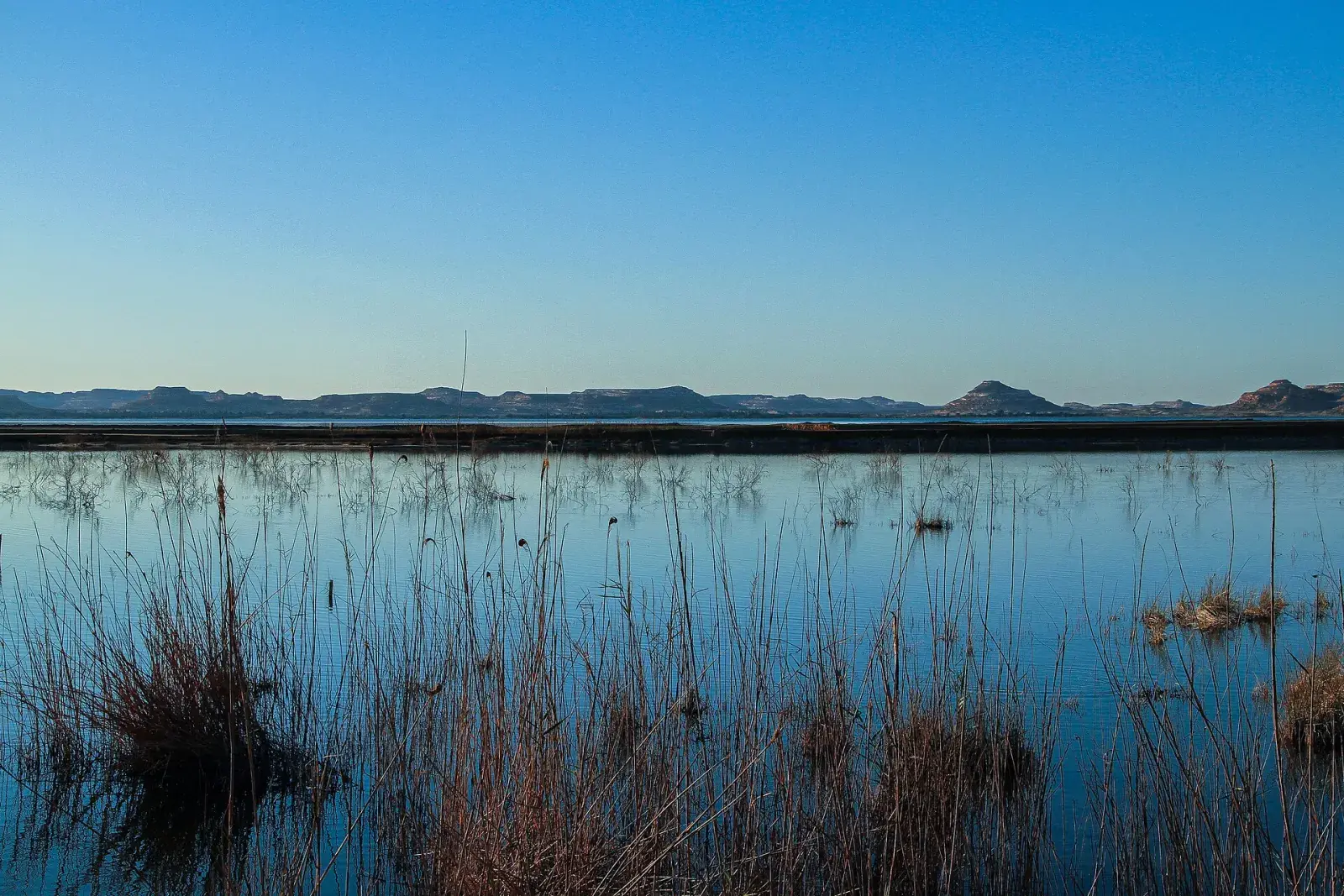
Lake Siwa (Birket Siwa) is the shallow salt lake spreading west of Siwa town, about 15 km² of brine edged with salt crust, reeds and palm gardens. Fatnas, Taghaghien Island and several lodges sit on its shores. Its muddy edges are poor for swimming; people come for the sunsets, the winter flamingos and the salt pools beside it.
Ask us on WhatsAppLake Siwa at a glance
Short answer: The salt lake on the west side of the oasis, second in size to Lake Zeitoun. Too salty to drink or irrigate with and too muddy to swim in, it is the backdrop to Siwa's best sunsets, its island lodges and its winter birdlife. There is no ticket; most visitors see it from Fatnas in the last hour of daylight.
| Type | Shallow salt lake in a depression that reaches about 20 m below sea level |
| Where | West of Siwa town and Shali |
| Size | About 3,600 feddans, roughly 15 km² |
| On its shores | Fatnas (about 4.5 km by road from the market square), Taghaghien Island (about 7 km), Adrère Amellal below the White Mountain (about 17 km) |
| Entry | Free; cafés and lodges charge for what you order |
| Swimming | In salt pools and springs nearby, not the lake |
| Time needed | 1 to 2 hours for a sunset visit; half a day with a salt-pool float |
| Best time | Late afternoon to sunset; birds from late autumn to spring |
Getting to the shore from the market square
Short answer: The lake is close enough to cycle to. Fatnas is the nearest viewpoint with seats and tea; the island and the far-shore lodges are better reached by car.
Distances below are from the market square below Shali. Bike and tuk-tuk times are estimates at an easy pace, not timed runs.
| Lakeside place | Distance | Bike (easy pace) | Tuk-tuk or car | Notes |
|---|---|---|---|---|
| Fatnas | About 4.5 km | 20 to 25 minutes | About 10 minutes | Cafés, a spring pool, the classic sunset |
| Taghaghien Island | About 7 km from town | 30 to 35 minutes | About 15 minutes | Island in the lake, further from town than Fatnas |
| Adrère Amellal and the White Mountain | About 17 km | Not practical | About 30 minutes | Lodge on the far shore; ask us whether non-guests can visit |
The ground is flat all the way, but the lanes outside the centre are unlit. If you ride out for sunset, carry front and rear lights, or arrange a tuk-tuk for the return before you leave town. See getting around Siwa and the Siwa map for the other sights.
The Fatnas figure is measured on OpenStreetMap; Wikivoyage gives 6 km for Fatnas and 7 km from town for Taghaghien (Wikivoyage, checked 17 November 2026). The Adrère Amellal distance is an OSRM driving route of 17.2 km, about 30 minutes (checked 17 November 2026): the road loops round the lake.
The lakes of the oasis compared
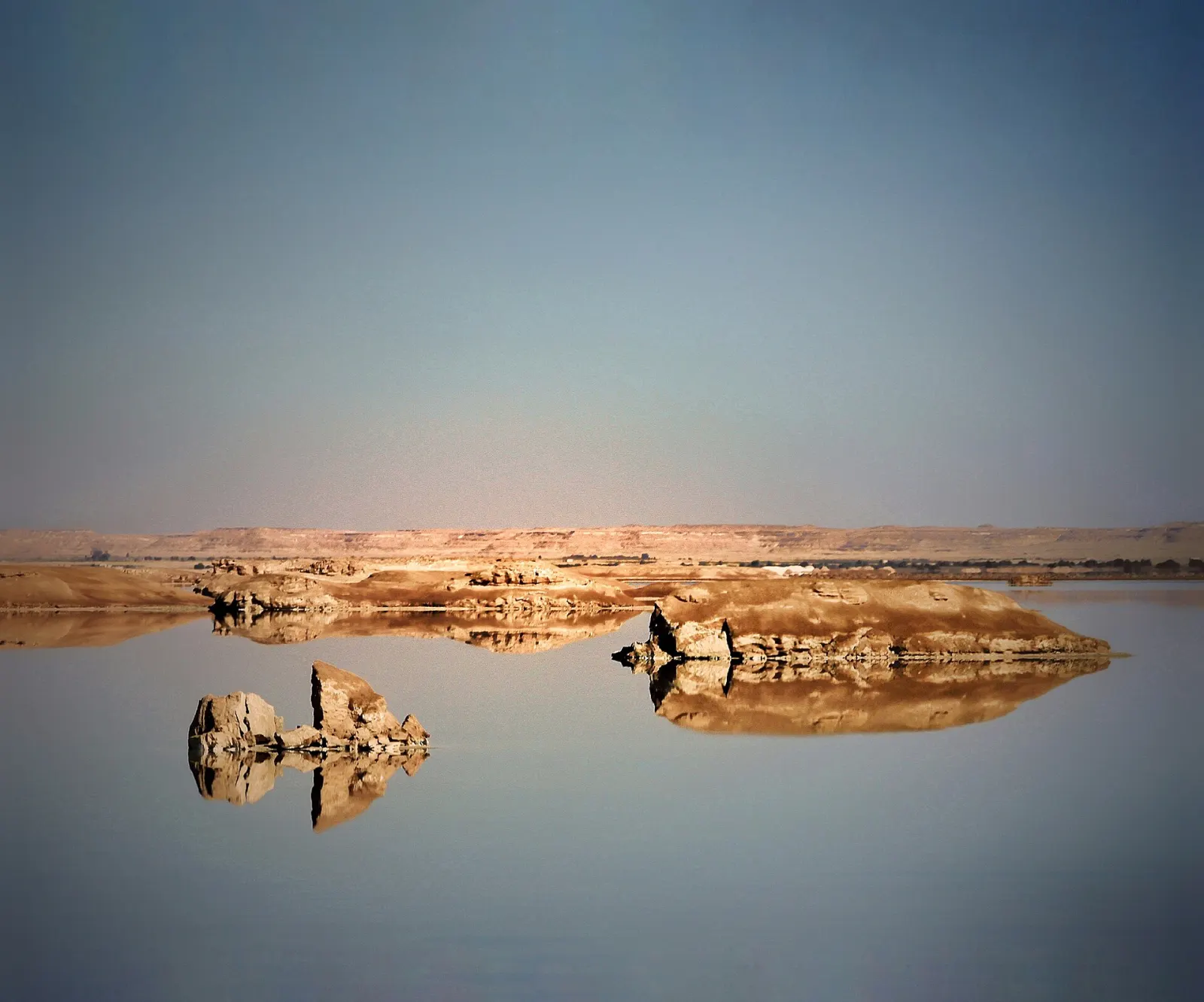
Short answer: Siwa has four main salt lakes and several small ones. Zeitoun in the east is the largest; Lake Siwa is the one most visitors see, because it lies closest to town and the lodges.
| Lake | Where | Rough size | Why you might go |
|---|---|---|---|
| Zeitoun | East, past Abu Shuruf | Ruined village, salt works; see Abu Shuruf and Zeitoun | |
| Siwa | West of town | Fatnas sunsets, lodges, birds | |
| Al-Mua'aser | North-east | Seldom on itineraries | |
| Maraqi | Far west, Bahi ad-Din | Rarely visited |
Areas are those published by Egyptian Geographic, which also names smaller lakes at Taghaghien, Shayta and Fatnas. The small lake beside the Oracle Temple at Aghurmi, with salt pools on its edge, is the one you pass on the way to the temple. Lake outlines shift with the seasons and the years, so treat the areas as a guide rather than a survey.
Why the lake is salty, and why it keeps growing
Short answer: It sits at the low point of the depression. Spring and drainage water flows in, the sun evaporates it, and the salt stays behind. Inflow now outpaces evaporation, so the lake spreads.
Lake Siwa has no outlet. Water reaching it from springs, wells and garden drains can only leave by evaporation, which concentrates the salt into white crusts along the shore. The springs are fed by shallow groundwater drawing on the Nubian Sandstone Aquifer System, and NASA notes that pumping for irrigation has made the lakes' area swing widely, with poor drainage letting surplus water pool on low ground (NASA Earth Observatory).
A 1997 study measured the water table rising about 1.3 cm a year in 1962 to 1977 and about 4.6 cm a year in 1977 to 1990, and blamed excess irrigation and poor drainage. The same NASA article cites a study in which olive yields fell about 46% and date yields about 55% between 2000 and 2011 as salt built up in the soil. You can see the effect from the lakeside roads: dead palms standing in water and gardens turned to marsh.
Fatnas was once a true island. As the shoreline changed it joined the land, which is why you can now ride to its cafés.
What to do at the lake
Short answer: Watch the sun set from Fatnas or Taghaghien, stay at a lodge on the western shore, float in a salt pool nearby and look for flamingos in winter.
- Sunset at Fatnas: tea on the palm-covered spit as the sun drops behind the hills across the water. See Fatnas for its month-by-month sunset table.
- Another sunset spot: Taghaghien Island, about 7 km from town, is the alternative to Fatnas; go by car.
- Stay on the shore: Adrère Amellal sits below the White Mountain on the west side. See where to stay and eco-lodges.
- Float nearby: the turquoise salt pools are old quarries beside the lakes, much saltier and clearer than the lake itself.
- Look across to Timasirayn: a small temple ruin about 12 km from Aghurmi, across Lake Siwa. A 2013 announcement reported that, seen from it, the spring and autumn equinox sun rises over the Aghurmi mound and the Oracle Temple; the first known public viewing was on 21 March 2014 (Wikipedia). Wikivoyage warns you will see little without strong binoculars or a long lens.
- Photograph it: still water, reeds and the flat-topped hills give the best reflections in the first and last hours of light. See photo spots.
When to go
Short answer: Any month for the sunset, but October to April is the most comfortable. Birds are on the water from late autumn to spring; summer afternoons are too hot to linger on the shore.
| Season | At the lake | Plan for |
|---|---|---|
| November to February | Cool, clear evenings; migrant waterbirds present | A warm layer for the ride back; sunset as early as about 17:20 |
| March to April | Birds still present; warm days | Khamsin winds can push it above 40 °C as early as March |
| May to September | Very hot afternoons; few birds | Go only for the last hour of light; carry plenty of water |
| October | Heat easing; evenings pleasant | Clock-time sunset jumps an hour earlier when Egypt's summer time ends (29 October in 2026) |
In November 2026 the sun sets at Siwa between 17:32 on the 1st and 17:19 on the 30th, local time (timeanddate.com, checked 17 November 2026). For temperatures by month, see Siwa weather; for the whole calendar, best time to visit.
What it costs
Short answer: The lake is free. Your costs are getting there, a drink at the shore, and anything at a lodge.
| Item | What to expect |
|---|---|
| Lake shore and Fatnas | No ticket |
| Bike hire for the afternoon | Rented by the day or half day near the square; ask us for current prices |
| Tuk-tuk to Fatnas and back | Agree the fare for both legs, and the waiting time, before you set off |
| Tea or juice at a Fatnas café | Ask the price before ordering |
| Salt pools nearby | Pool fees are being re-checked; ask us which pools are open and what they cost |
| Lodge lunch or dinner on the far shore | Not every lodge serves non-guests; ask us before you go |
We do not print fares here because they change often and vary by season. For a full-trip budget, see Siwa trip cost.
What to combine it with
Short answer: The lake is an end-of-day stop. Spend the afternoon at a spring or salt pool, then finish at Fatnas.
| Plan | Order | Rough timing |
|---|---|---|
| Afternoon by bike | Cleopatra Spring (about 3.4 km from the square), then Fatnas for sunset | 3 to 4 hours |
| Afternoon by car | Salt-pool float, then Fatnas or Taghaghien | 3 to 4 hours |
| Morning and evening | Oracle Temple and Gebel al-Mawta in the morning, back to the lake at dusk | A full day with a midday break |
| Lodge evening | Drive along the shore to the White Mountain for dinner at a lodge, if it takes outside diners | Evening; ask ahead |
For where the lake fits in a longer stay, see Siwa in 3 days and how many days in Siwa.
Birds on Lake Siwa
Short answer: The lakes are a wintering and stopover site for migrating waterbirds. Greater flamingos and little egrets are the ones you are most likely to see.
A survey of Siwa's lakes from November 2021 to May 2023, at Fatnas and two other lake sites, recorded 26 waterbird species: 3 resident and 23 migratory. Greater flamingos and little egrets stood out in numbers, and waders such as sandpipers and plovers made up the largest group of species (Mohallal, 2023). Bring binoculars and keep to firm ground; the reed beds hide soft mud.
Mistakes to avoid
- Arriving at sunset, not before it. Seats at Fatnas face west and fill first; aim to be there an hour early.
- Walking into the reeds. The shore looks firm but the crust breaks into deep mud. Stay on paths and dry ground.
- Flip-flops on the salt. The crust is sharp. Wear closed shoes.
- No light for the ride back. In November civil twilight ends about 25 minutes after sunset (timeanddate.com), and the lanes are unlit.
- Expecting a swim in the lake. Swim in a salt pool, a spring or a lodge pool instead.
- Flying a drone. The UK government notes that drones may not be imported or used in Egypt without prior Ministry of Defence permission, and that doing so can bring a prison sentence of up to 7 years (GOV.UK, checked 17 November 2026).
- Photographing people without asking. The shore is working farmland; ask before photographing anyone in the gardens.
- Forgetting repellent. Wikivoyage notes mosquitoes can be a nuisance in Siwa, and small flies bite near the reeds at dusk.
Families and limited mobility
- Children: the shore has no fences and the mud is deep in places, so keep small children by the hand near the water. Fatnas, with café seats and a small spring pool, is the easiest place to stop with a family.
- Wheelchairs and limited mobility: the lake can be seen from a car along the shore roads. Expect sand and uneven ground off the road, and do not count on accessible toilets. Ask us how close a car can get and what facilities there are before you go.
On a trip
Our Siwa oasis day tour ends at Fatnas for sunset, and Siwa in 3 days includes a salt-pool float. Both are private: the car and guide are yours alone. See also things to do in Siwa.
Sources: lake areas from Egyptian Geographic; water-table rise from Misak, Abdel Baki and El-Hakim, Journal of Arid Environments 37 (1997); aquifer, irrigation and yields from NASA Earth Observatory; birds from Mohallal, Egyptian Journal of Aquatic Biology and Fisheries (2023); Fatnas and Taghaghien guidebook distances from Wikivoyage; sunset times from timeanddate.com; drone rules from GOV.UK; khamsin heat and the Timasirayn alignment from Wikipedia.
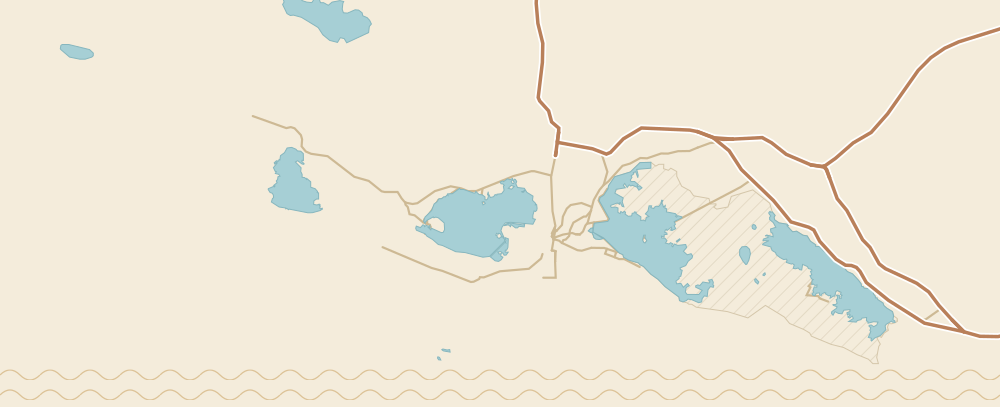
Map of the oasis
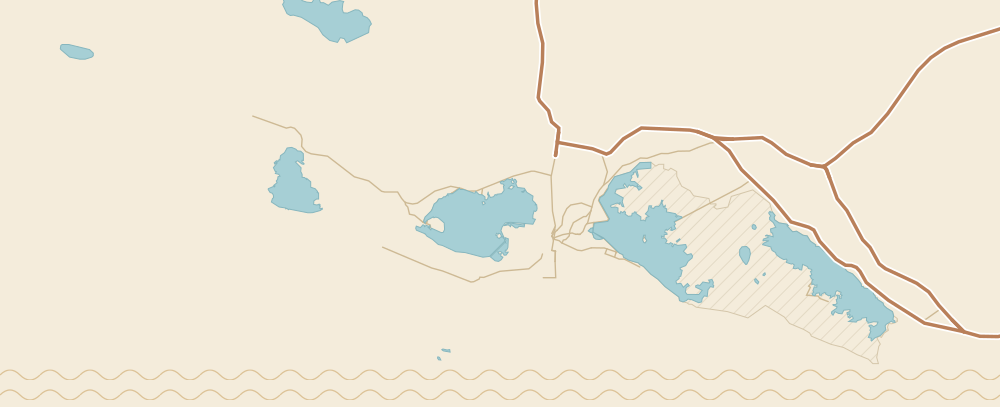
Close-up: around Siwa town
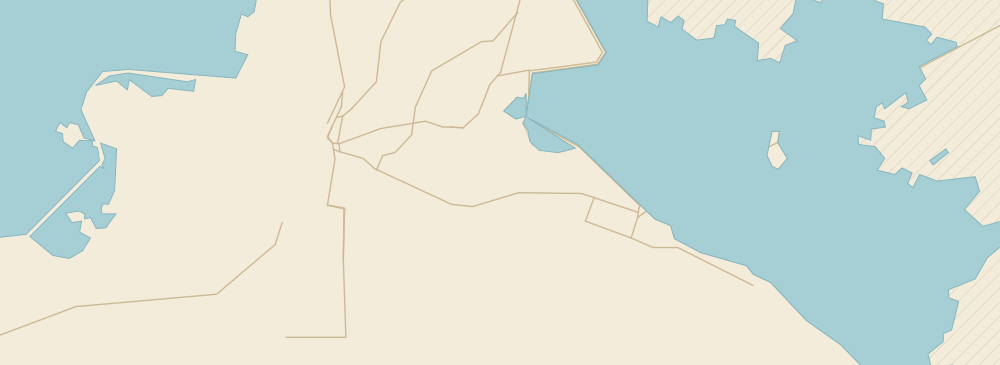
Lakes and roads drawn from OpenStreetMap; pin positions are approximate. The salt flats (hatched) dry out and flood with the seasons. Map data © OpenStreetMap contributors, ODbL.
Questions people ask
Can you swim in Lake Siwa?+
Not really. The lake is shallow, with soft mud and reeds at the edges. For a swim, use the salt pools cut beside the lakes, a spring such as Cleopatra Spring, or a lodge pool.
How far is Lake Siwa from Siwa town?+
The eastern shore starts on the western edge of town. Fatnas, the usual viewpoint, is about 4.5 km by road from the market square; Taghaghien Island is about 7 km out, and Adrère Amellal, below the White Mountain, about 17 km (roughly 30 minutes by car).
Is there an entry fee for Lake Siwa?+
No. The shore and Fatnas have no ticket. You pay for transport, for whatever you order at a lakeside café, and for a meal or room if you visit a lodge. Agree prices before you order or set off.
Which is the biggest lake in Siwa?+
Lake Zeitoun in the east of the oasis, at roughly 5,760 feddans (about 24 km²). Lake Siwa, west of town, is second at roughly 3,600 feddans (about 15 km²).
Are there flamingos at Lake Siwa?+
Yes, in the cooler months. A survey from November 2021 to May 2023 at Fatnas and two other lake sites recorded 26 waterbird species, 23 of them migrants, with greater flamingos and little egrets standing out in numbers.
Why is Lake Siwa getting bigger?+
More water reaches it than evaporates. Wells and springs irrigate the gardens, the surplus drains downhill into the lakes, and the water table has risen for decades, drowning some low palm gardens.
What time is sunset over the lake in November?+
In November 2026 sunset at Siwa falls from 17:32 on the 1st to 17:19 on the 30th, local time. Leave the market square about an hour and a half before if you are cycling to Fatnas.
Go with us
Trips that include this
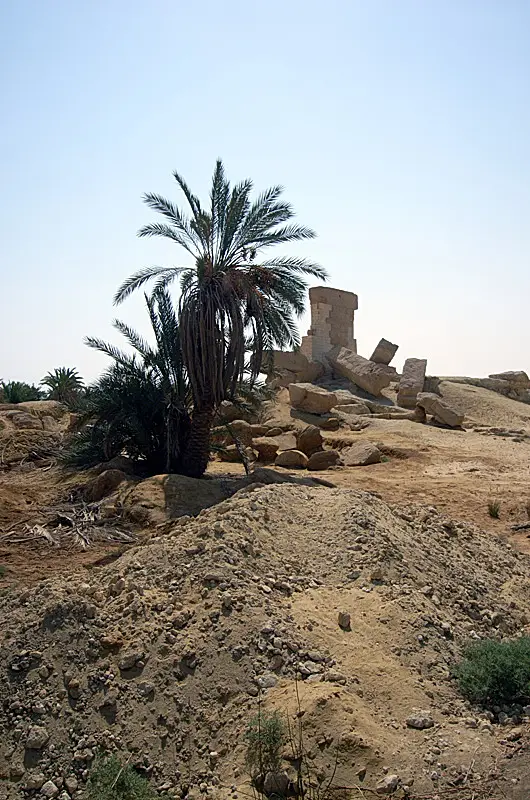
About 8 hours
Siwa Oasis Day Tour (from Your Siwa Hotel)About US$65 to 80 per person for two travellers (about US$130 to 160 per car)
Check dates
3 days, 2 nights
Siwa Oasis in 3 Days from Cairo (Private Trip)About US$420 to 650 per person for two travellers
Check dates