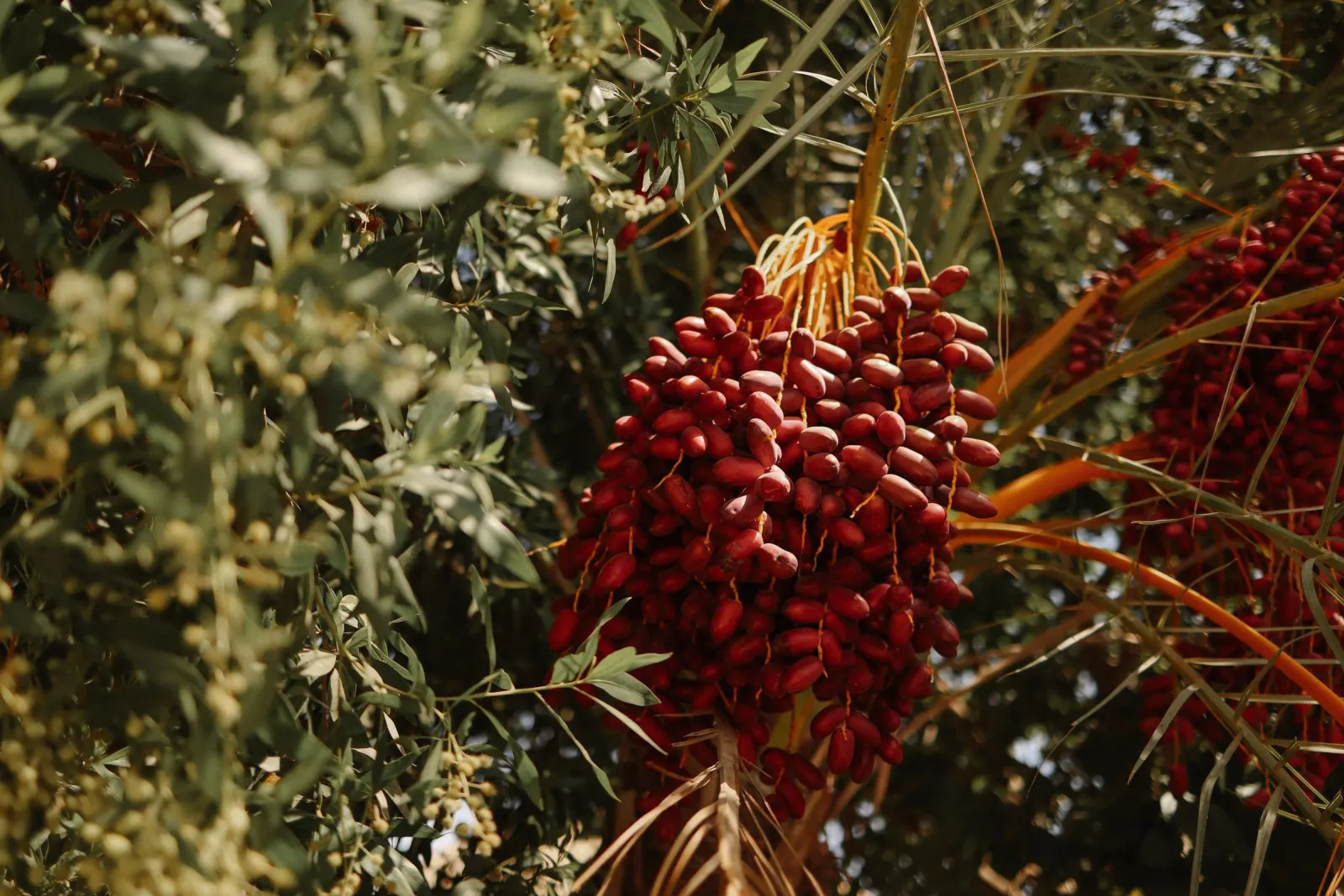
The short answer
Siwa grows about 280,000 date palms, producing about 25,000 tonnes of dates and 27,500 tonnes of olives a year, according to the UN's FAO. Dates are picked from September to January by variety, most in October; olives mainly from October to December. Visitors can walk the palm gardens with a guide and buy dates, date paste, table olives and olive oil around the market square.
Ask us on WhatsAppDates and olives at a glance
Short answer: Siwa is a farming oasis first. About 280,000 date palms and large olive groves fill the gardens around the springs, and the harvest runs from September into the new year. You can taste and buy both in town, and see the gardens with a guide.
The UN Food and Agriculture Organization (FAO) recognised Siwa's date production system as a Globally Important Agricultural Heritage System in 2016. Its figures are the ones we use across this site (checked 21 November 2026):
| Dates | Olives | |
|---|---|---|
| Scale (FAO) | About 280,000 palms; about 25,000 tonnes a year, roughly 2% of Egypt's dates | About 27,500 tonnes a year |
| Main varieties | Siwi, Frehi, Azzawi; rarer Ghazaal, Takdat, Amnzou | Hamed (table), Wateken and Maraki (oil) |
| Harvest | September to January by variety, peak in October | Mainly October to December |
| What you can buy | Fresh, semi-dry and dried dates; agwa paste; stuffed dates | Green and black table olives; olive oil |
| Best months to see it | October and early November | November and December |
Other published counts vary widely, and some Egyptian press reports give palm numbers several times higher, which is why we stick to FAO's. For scale, Egypt as a whole grows about 19% of the world's dates, according to Industry Minister Khaled Hashem's speech, delivered on his behalf, at the 2026 dates festival in Siwa (Ahram Online, checked 21 November 2026).
How the gardens work
Short answer: Each garden is a family plot, flood-irrigated from springs and wells, with palms on top, olives and fruit trees below and vegetables on the ground.
FAO describes three layers of planting in the same plot: date palms as the canopy, fruit trees such as olives in the middle, and vegetables, herbs and fodder underneath. It counts 46 crop species in the oasis. Water comes from the aquifer beneath the depression, through natural springs and many drilled wells, and runs by gravity into small basins of about 4 to 16 square metres. A traditional water official, the ahisab, manages the distribution and the canal schedules.
Slow Food's Siwa dates presidium adds that the well water is brackish, and that dates, olives, mint and sorrel are among the few crops it suits. Each plot often has a palm or an olive tree in the middle (checked 21 November 2026). The drainage water has to go somewhere: Siwa's two large salt lakes are fed by water draining off the farms.
For centuries this harvest was Siwa's link to the outside world. Camel caravans carried dates and olives out of the oasis, and Bedouin families traded grain and animal products for Siwan dates and olive oil. When Muhammad Ali brought Siwa under Cairo's control in the 19th century, dates and olives were what he taxed. The story is told in Siwa history and Siwi people and culture.
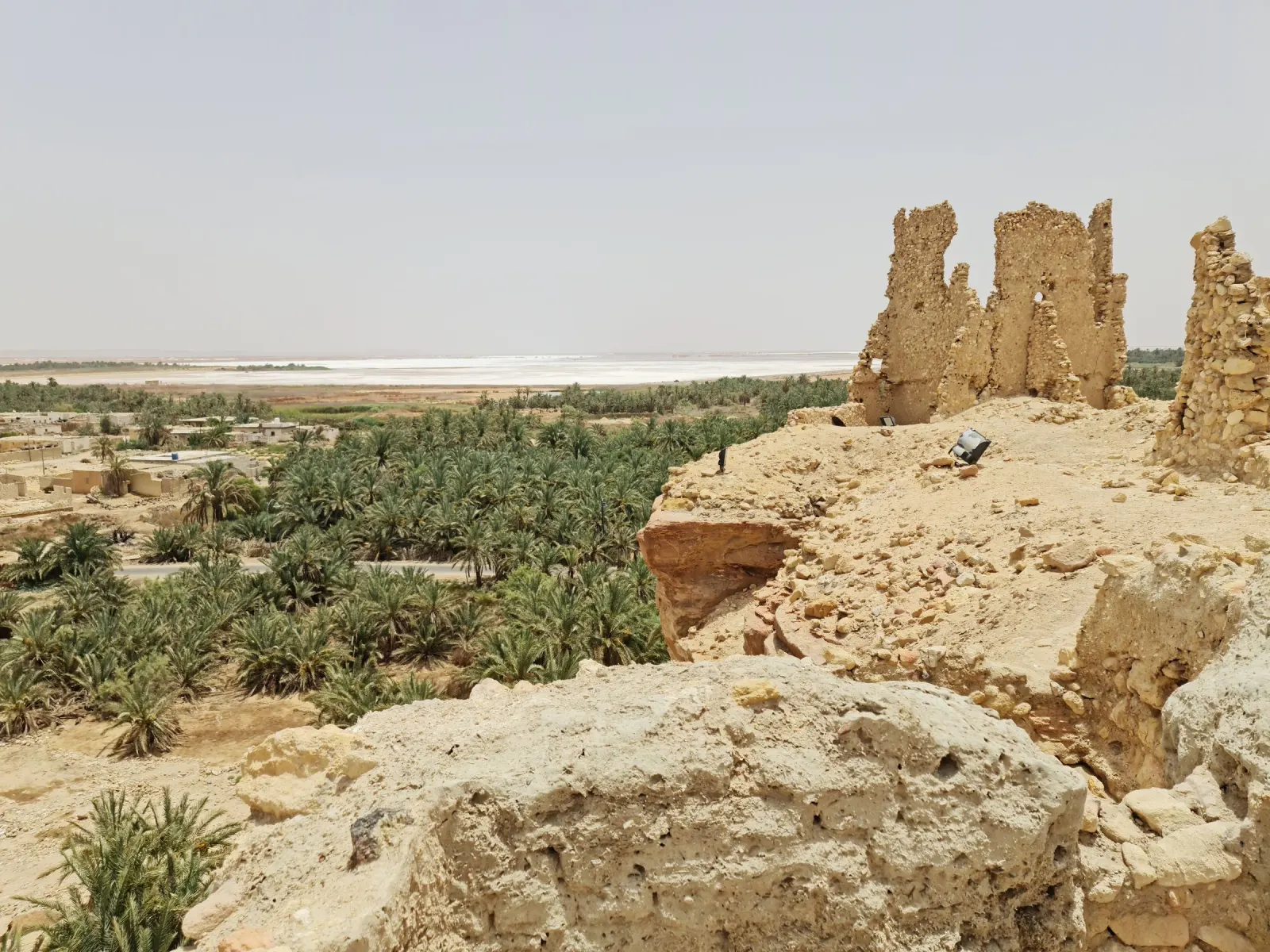
Siwa's dates
Short answer: Siwi is the oasis's main date: semi-dry and a good keeper. Rarer varieties ripen either side of it, from September to January.
Slow Food names three main varieties, Siwi, Frehi and Azzawi, and three it describes as at risk because they are grown in such small quantities: Ghazaal, Takdat and Amnzou. Its harvest calendar is the one used on our Siwa food page:
| Variety | Harvest month | Status (Slow Food) |
|---|---|---|
| Amnzou | September | Rare; the first to ripen |
| Siwi | Early October | Main variety |
| Azzawi | Early October | Main variety |
| Frehi | Not given by month | Main variety |
| Ghazaal | Late October | Rare |
| Takdat | December to January | Rare; very soft |
A few facts from the same source help when you are standing under a palm. A tree starts fruiting at about 10 years old, is most productive between 10 and 25 years, and gives about 50 kg of dates a year on average. FAO notes that each crown must be climbed at least three times a year: to pollinate, to harvest and to prune. Pickers go up by hand with a belt of palm fibre. Dates not sold fresh are dried, which Slow Food says is now done in ovens at about 70 °C.
Production and sales for the presidium are organised by Siwa Community Development Environmental Conservation (SCDEC), whose council of 13 is elected by the oasis's 13 villages; Slow Food lists 87 member producers.
The dates factory and the festival
Siwa's government-owned dates factory was rehabilitated with support from the UAE's Khalifa International Award for Date Palm and Agricultural Innovation and its upgraded facility was inaugurated at the ninth International Egyptian Dates Festival, held in Siwa from 14 to 16 October 2026. According to Daily News Egypt, it has lines for washing, sorting and packing, and makes stuffed dates, date paste, date syrup and vinegar; the minister described Siwa as a key area for high-value semi-dry dates (checked 21 November 2026). The festival's first edition was also held in Siwa, in 2015, Ahram Online notes. No host or dates for 2027 had been announced when we checked; see Siwa in October for the rest of that month's calendar.
Siwa's olives
Short answer: Three of Egypt's local olive varieties come from Siwa: Hamed for the table, Wateken and Maraki for oil. Picking runs mainly from October to December.
Egypt grows olives mostly for the table: table olives make up almost 80% of its crop, according to the International Olive Council's country profile (2012 edition, checked 21 November 2026). The same document traces three of Egypt's local varieties to the oasis:
| Variety | Main use | What the IOC says | Best harvest |
|---|---|---|---|
| Hamed | Table olives, green and black | Very ancient, hardy, large fruit; resists drought and salinity | Not given |
| Wateken | Mainly oil (dual purpose) | Oil high in oleic acid and low in bitterness; limited outside Siwa | October to December |
| Maraki | Oil | Very heavy fruit; oil very high in oleic acid, medium bitterness; now propagated commercially | November to December |
Varieties from elsewhere grow here too. Researchers have trialled Aggizi Shami, a Fayoum table olive, alongside Picual and Kalamata in Siwa orchards (Journal of Plant Production, checked 21 November 2026), so the olives in a market jar are not always a Siwan variety. Ask which they are.
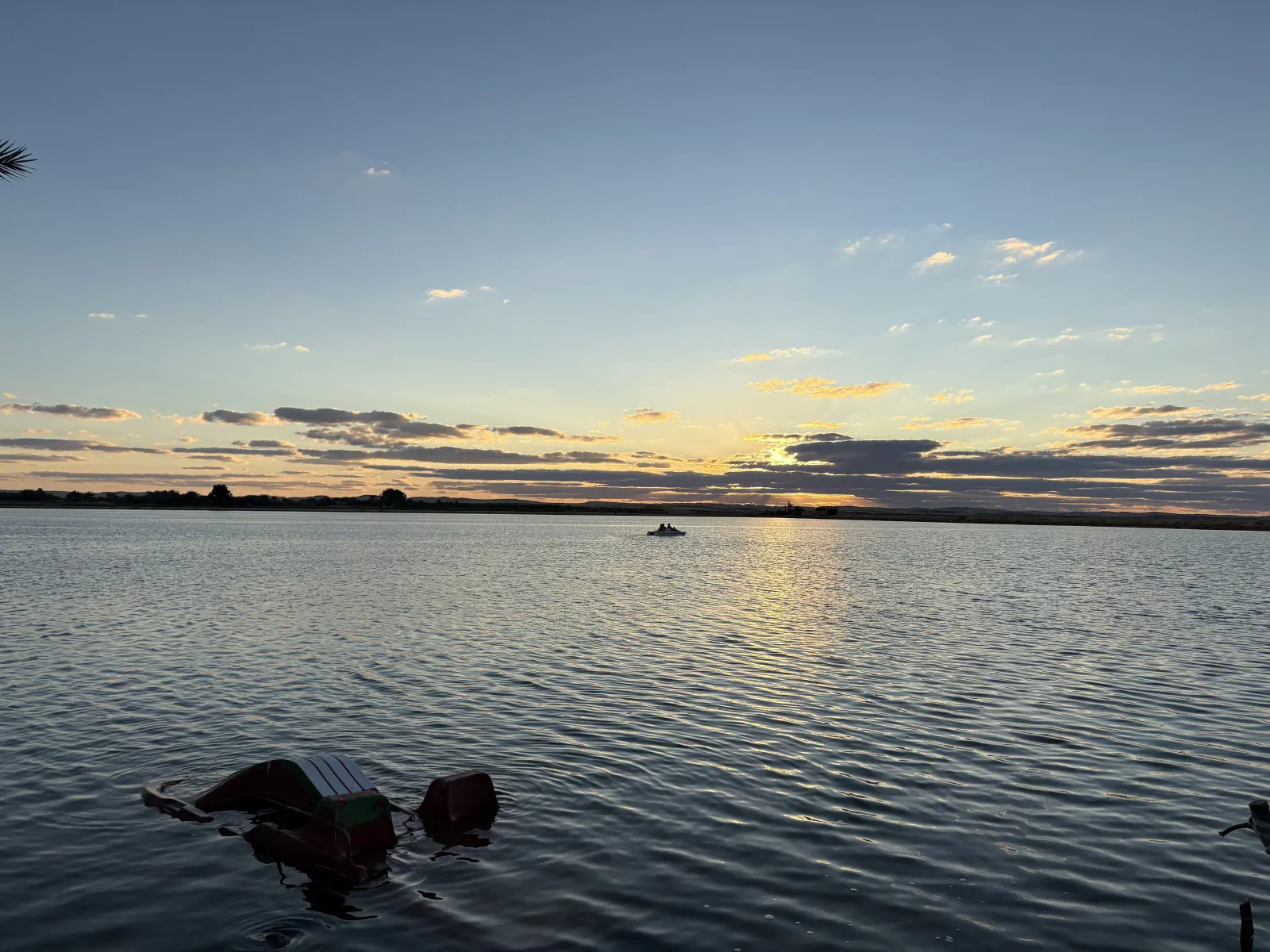
What you will see, month by month
Short answer: October is the date month, November and December the olive months. Outside the harvest the gardens are quieter, but dried dates and bottled oil are on sale all year.
| Month | In the gardens | In the shops |
|---|---|---|
| September | First dates (Amnzou); heat still strong | Last season's dried dates; the first fresh fruit |
| October | Peak date harvest: Siwi and Azzawi, then Ghazaal | Fresh and semi-dry dates; the widest choice |
| November | Dates drying and packing; olive picking under way | The new season's dates |
| December | Olive harvest; Takdat dates | New olive oil and table olives |
| January | Last Takdat dates; the olive season ending | Dates and oil of the season |
| February to August | Pollination, pruning and irrigation | Dried dates, paste and oil from stock |
The weather matters as much as the crop. September and May to August are hot, and the most comfortable months for walking the gardens are October to April; see best time to visit Siwa and the monthly pages for November and December.
What to taste and buy
Short answer: Buy semi-dry Siwi dates, a tub of agwa and a small bottle of oil from the shops on and around the market square below Shali. Taste first and pay in Egyptian pounds.
| Product | What to ask or check | How it travels |
|---|---|---|
| Semi-dry Siwi dates | Which variety and which season's harvest | Very well, for months in a cool place |
| Fresh dates (autumn only) | Firm skin, no fermented smell | Badly; eat them in Siwa |
| Agwa (date paste) | Pressed into blocks or tubs, for baking and sweets | Well, if sealed |
| Stuffed dates | Often with almonds or other nuts | Well, packed |
| Table olives | Green or black, in brine; which variety | Only in sealed jars or pouches |
| Olive oil | A sealed bottle; when it was pressed | In checked luggage only |
| Date syrup | Dark and thick, for breakfast or baking | Sealed, in checked luggage |
The craft and date shops line the market square and the lanes off it, beside the embroidery and basket sellers described in Siwan crafts. We do not print prices here because they change with the season and the exchange rate. Carry small notes: almost everything outside the larger lodges is cash only, as explained in money, ATMs and internet.
To taste rather than buy, order chicken with olives, a dish travellers often praise in restaurants in Siwa.
Visiting a palm garden
Short answer: Go with a guide, keep to the paths, never pick fruit, and do not photograph women.
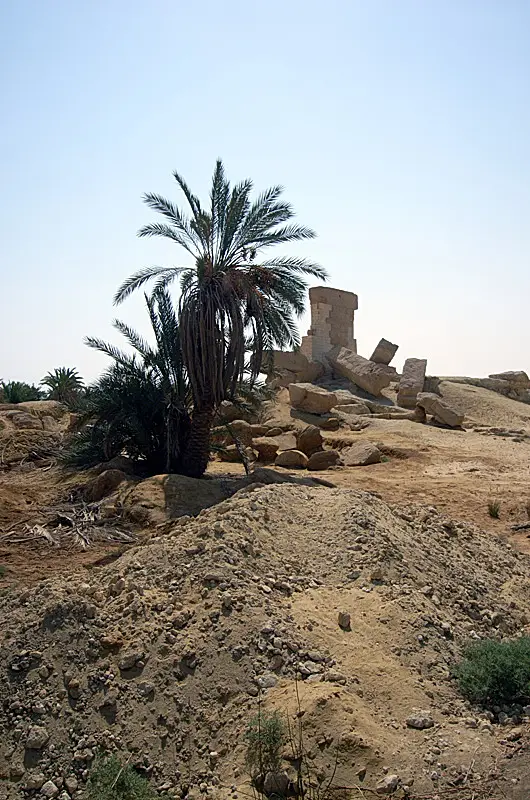
Siwa's gardens are private property and family livelihoods. A Siwan guide can take you into one whose owners are happy to have visitors, explain the irrigation and, at harvest, let you watch the climbing from a safe distance. Our Siwa oasis day tour visits the Oracle Temple at Aghurmi and the Temple of Umm Ubayda among the palms below it; tell us when you book if you want time in a garden as well.
- Ask before you photograph anyone. Women should not be photographed at all. See Siwa etiquette.
- Stay off the basin walls. The low earth banks hold the irrigation water.
- Do not pick fruit, even fallen fruit. If dates are offered, take them with your right hand.
- Stand well back from a palm being climbed at harvest.
- Wear closed shoes. Paths are sandy, and muddy near the channels.
Taking dates and olive oil home
Short answer: Dates are allowed into the UK and the EU without a plant health certificate. Pack olive oil, olives in brine and syrup in checked luggage, sealed and wrapped.
UK. GOV.UK lists dates among the fruits you can bring into Great Britain without a phytosanitary (plant health) certificate; most other fresh fruit and vegetables from outside the EU need one. Processed and packaged plant products are also allowed (GOV.UK, checked 21 November 2026).
EU. Plants and plant products in passengers' luggage from outside the EU need a phytosanitary certificate, with five fruits exempt: pineapples, coconuts, durians, bananas and dates (European Commission, checked 21 November 2026).
Elsewhere. Countries such as Australia, New Zealand and the United States run their own strict biosecurity checks, so read your customs authority's page before you fly and declare food if asked.
On the plane. Liquid limits in hand luggage depend on the airport you fly from, as GOV.UK says for UK airports (checked 21 November 2026). You will be flying out of Egypt whatever the rules at home, so put oil, olives in brine and syrup in the hold. Tape the cap, bag the bottle and wrap it in clothes. Dried dates can go in either bag.
Mistakes to avoid
- Buying a big box before tasting. Varieties differ more than you expect; buy small bags of two or three, then go back for the one you like.
- Planning an olive trip for early October. Dates peak in October; both Siwan oil varieties are in their harvest window in November and December, so those are the safer months for olives.
- Assuming every jar is Siwan. Olives from other parts of Egypt are sold here too. Ask which variety and whose trees.
- Carrying fresh dates home. They spoil in a warm bag. Eat fresh dates in Siwa and travel with semi-dry or dried ones.
- Walking into a garden alone. It is someone's farm. Go with a guide.
Fit it into a trip
The harvest is easy to add to any visit. Our 3-day trip from Cairo ends with time at the market for dates and olive oil, and the 4-day trip with an eco-lodge and a desert night cycles or takes a donkey cart through the palm gardens. Siwa is about 750 km from Cairo by road: about 9 hours of driving, or about 10 hours with stops, so how to get to Siwa and Siwa trip cost are the next guides to read. If the harvest is the reason for your trip, send us your dates and we will tell you what should be ripe.
Questions people ask
When is the date harvest in Siwa?+
From September to January, depending on the variety. Slow Food lists Amnzou in September, Siwi and Azzawi in early October, Ghazaal in late October and Takdat in December and January, so October is the busiest month in the palm gardens.
When are olives harvested in Siwa?+
Mainly from October to December. The International Olive Council gives October to December as the best harvest window for Wateken and November to December for Maraki, two oil varieties that come from Siwa.
Can I visit a date garden?+
Yes, with a guide. The gardens are private family plots, so go with someone who knows the owners rather than walking in. Harvest season, from September to November, is the most interesting time to see them.
Can I take Siwa dates home to the UK or the EU?+
Yes. Dates are on both the UK and EU lists of fruit that travellers can bring in without a plant health certificate (checked 21 November 2026). Most other fresh fruit needs one. Buy sealed, packed dates and check your own country's rules if you live elsewhere.
Can I take olive oil on the plane?+
Put it in checked luggage, sealed and wrapped. Cabin liquid limits depend on the airport you fly from, so a large bottle in hand luggage is likely to be taken off you at security.
What is the best Siwa souvenir to eat?+
Semi-dry Siwi dates, which travel well and are what the oasis is known for, plus a tub of agwa (date paste) or a small bottle of local olive oil. Taste two or three varieties before buying a box.
Go with us
Trips that include this
About 8 hours
Siwa Oasis Day Tour (from Your Siwa Hotel)About US$65 to 80 per person for two travellers (about US$130 to 160 per car)
Check dates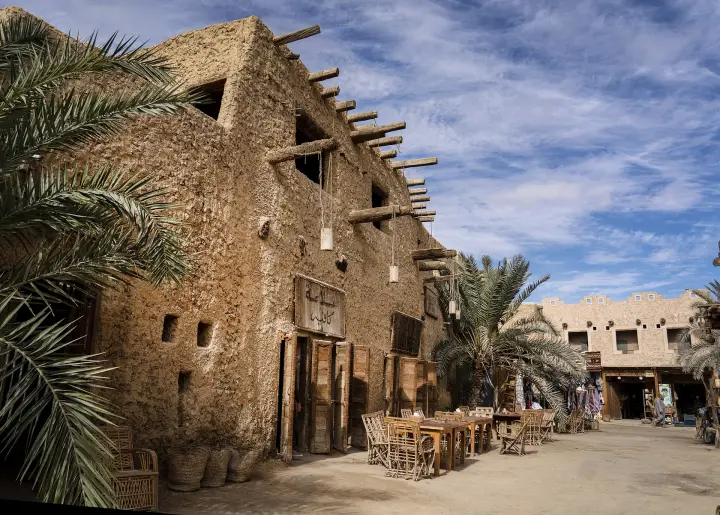
3 days, 2 nights
Siwa Oasis in 3 Days from Cairo (Private Trip)About US$420 to 650 per person for two travellers
Check dates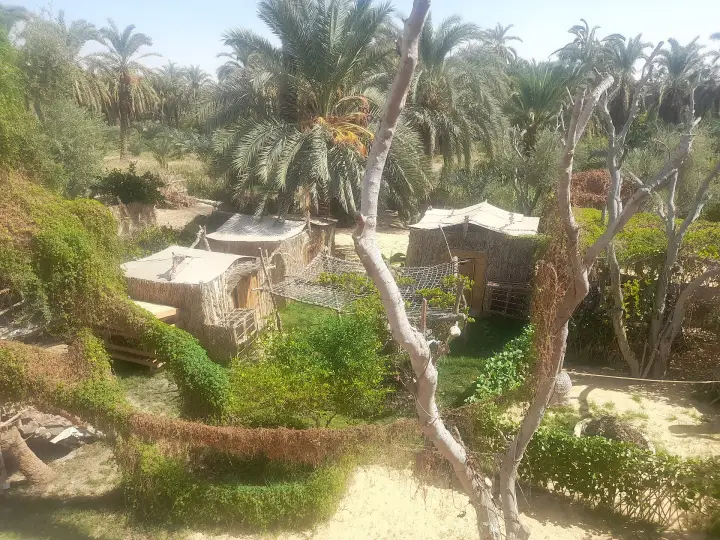
4 days, 3 nights
Siwa in 4 Days: Eco-Lodge and a Night in the Great Sand SeaAbout US$495 to 825 per person for two travellers (the lodge level decides the price)
Check dates