The short answer
On Monday 2 August 2027, totality in Siwa town runs from 12:42:34 to 12:48:07 Egypt summer time: 5 minutes 33 seconds, with the Sun 75.5 degrees high. Satellite records show no August eclipse-day cloud over parts of western Egypt in 23 years. Near the centreline, about 65 km north-east towards Marsa Matruh, totality stretches to about 6 minutes 19 seconds.
Ask us on WhatsAppThe 2027 eclipse in Siwa at a glance
Short answer: Siwa is inside the path of totality. In town the Sun is fully covered for 5 minutes 33 seconds, from 12:42:34 Egypt time on Monday 2 August 2027, with the Sun high in the south-east and almost no history of cloud on the day.
Eclipse trip: we are taking names for a private Siwa eclipse trip with an air-conditioned lodge, a scouted viewing site and glasses for everyone. The planned dates are 29 July to 4 August 2027, confirmed on registration. Register your interest on the eclipse tour page; the site and prices follow after our December 2026 scouting.
It is widely described as the longest total eclipse over easily reached land this century, and its track crosses the whole of northern Egypt. Siwa sits about 73 km south of the centreline, roughly halfway between that line and the southern edge of a shadow path about 255 km wide (the width is Fred Espenak's, from NASA's 2027 eclipse path data, checked 15 November 2026). The whole oasis is inside it, with a little more totality on its northern side than its southern.
| Fact | Siwa town (29.20N, 25.52E) |
|---|---|
| Date | Monday 2 August 2027 |
| Totality | 12:42:34 to 12:48:07 Egypt summer time |
| Length of totality | 5 min 33 s |
| Whole eclipse, first to last contact | about 2 h 46 min |
| Sun height at mid-eclipse | 75.5 degrees, to the south-east |
| Magnitude | 1.020 |
| Moon phase | New moon the same day, so eclipse-week evenings are moon-free |
| August weather | Clear skies are the norm: see weather and sky odds |
| August heat | Mean high 38.7C, mean low 23.6C (1991-2020); highest August reading 46.2C, 363 h of sun, no rain (WMO 1961-1990) |
Contact times for Siwa town
Short answer: partial phase from 11:22:17, totality 12:42:34 to 12:48:07, partial phase ends 14:08:03, all in Egypt summer time (UTC+3).
| Contact | What happens | Egypt time (UTC+3) | Sun height |
|---|---|---|---|
| C1 | The Moon takes its first nick out of the Sun | 11:22:17 | about 60 degrees |
| C2 | Last bead of sunlight vanishes; totality begins | 12:42:34 | about 75 degrees |
| Max | Mid-eclipse, darkest moment | 12:45:21 | 75.5 degrees |
| C3 | First bead of sunlight returns; totality ends | 12:48:07 | about 76 degrees |
| C4 | The Moon leaves the Sun's disc | 14:08:03 | about 75 degrees |
The times above come from Eclipseando's calculation for Siwa town. Other calculators, including the one behind Wikipedia's figures, differ by up to about 14 seconds. Treat each contact as accurate to a few seconds, and remember they shift slightly with every kilometre you move. Solar noon in Siwa that day is 13:24, sunrise about 06:39 and sunset about 20:09.
Egypt runs summer time from the last Friday of April to the last Thursday of October, so on 2 August clocks are three hours ahead of UTC. If your phone shows UTC+2, it has not updated. For the whole track across Europe, North Africa and the Middle East, with an animated map, see timeanddate's 2 August 2027 eclipse page.
How long totality lasts around Siwa
Short answer: going north gains time, going south loses it fast. The best practical gain is about 45 seconds, near the centreline north-east of town.
The centreline at Siwa's longitude runs near 29.86N, about 73 km due north of town, across open plateau. The southern edge of the shadow is near 28.55N, in the dune fields roughly 73 km south. Totality grows from nothing at that edge to its maximum on the centreline.
| Where (along Siwa's longitude unless stated) | Approx. distance from town | Totality |
|---|---|---|
| Southern edge of the path, Great Sand Sea | about 73 km south | 0 (partial only) |
| Dunes south of the oasis | about 45 km south | under 4 min |
| Edge of the dune sea | about 22 km south | just under 5 min |
| Siwa town | 0 | 5 min 33 s |
| Plateau north of the oasis | about 22 km north | just under 6 min |
| Matruh road candidate, near 29.7N 25.8E | about 65 km north-east in a straight line | about 6 min 19 s (provisional) |
| Centreline, off-road | about 73 km north | about 6 min 19 s |
The town figure is Eclipseando's (Siwa page); timeanddate gives 5 min 31 s for the same oasis. The centreline duration, path width and greatest duration are NASA's figures, linked above. Both were checked on 15 November 2026. The in-between rows are our own rough calculation, rounded down, so treat them as a guide to the trend rather than exact figures. The greatest duration anywhere on the track is 6 min 23.2 s, near 26.8N 31.1E in the Nile Valley between Asyut and Sohag, and Luxor gets about 6 min 23 s. See Siwa or Luxor if you are choosing between the two.
Weather and sky odds
Short answer: among the best odds on Earth for a total eclipse. Heat and haze are the realistic risks, not cloud.
Eclipse climatologist Jay Anderson's Eclipsophile page on the 2027 eclipse reports no August eclipse-day cloud over parts of the track in Libya and western Egypt in 23 years of satellite records, and singles out Siwa and Bahariya as having almost no prospect of cloud. Mean August dust haze along this part of the track is low (an aerosol optical depth of about 0.3). Shallow night fog is common between Marsa Matruh and Siwa, but it should clear well before the shadow arrives at midday.
The one weather factor that shapes the day is heat. August is one of Siwa's hottest months and its sunniest. The 1991-2020 normals for the Siwa station give an August mean daily high of 38.7C and a mean low of 23.6C (Meteostat). The official WMO 1961-1990 normals add a highest August reading of 46.2C, about 363 hours of sunshine and no measurable rain (NOAA copy of the WMO table). Those are averages, so plan for 40C or more at midday. More on that below, and in Siwa in August.
What totality looks like from Siwa
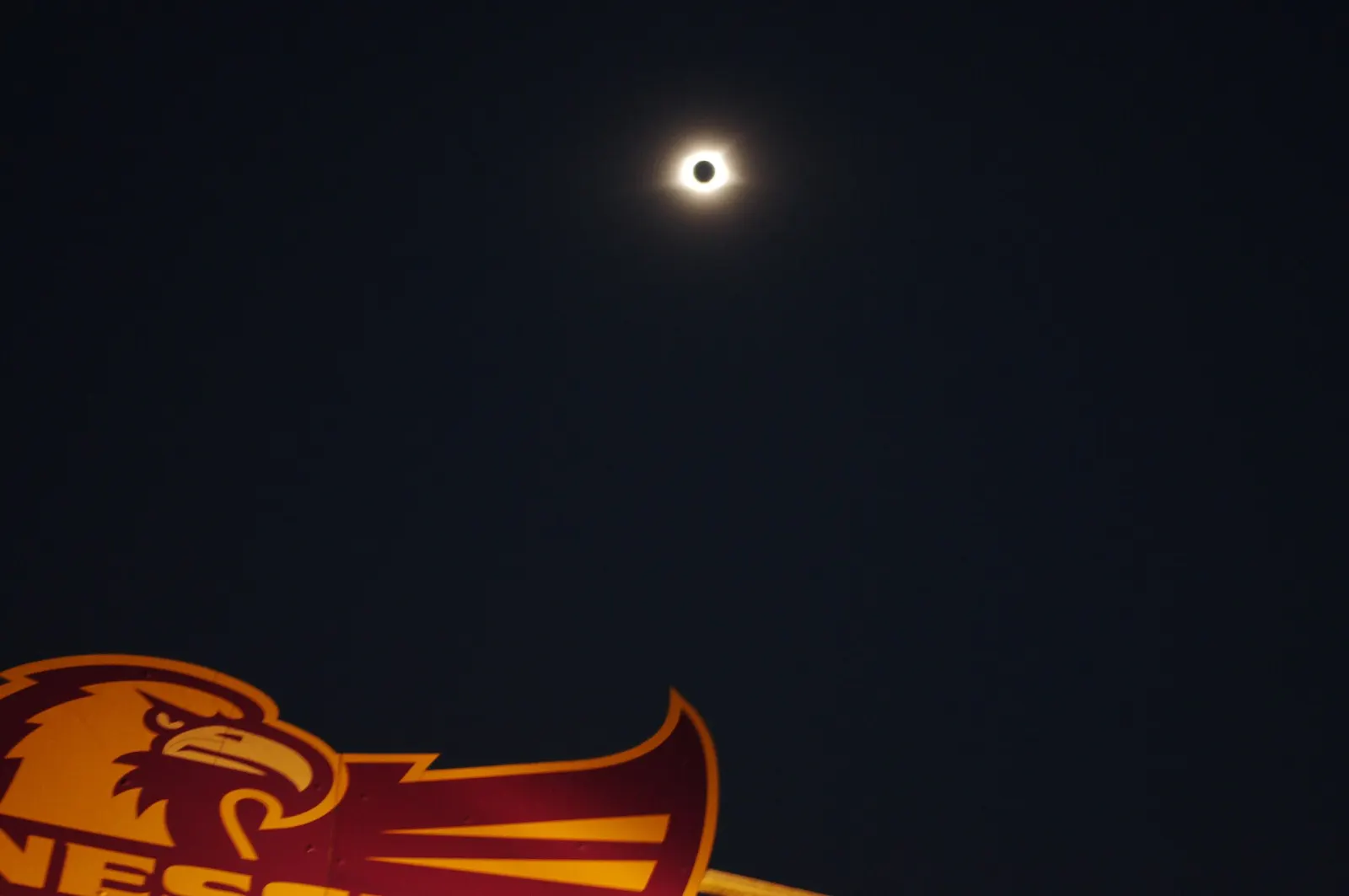
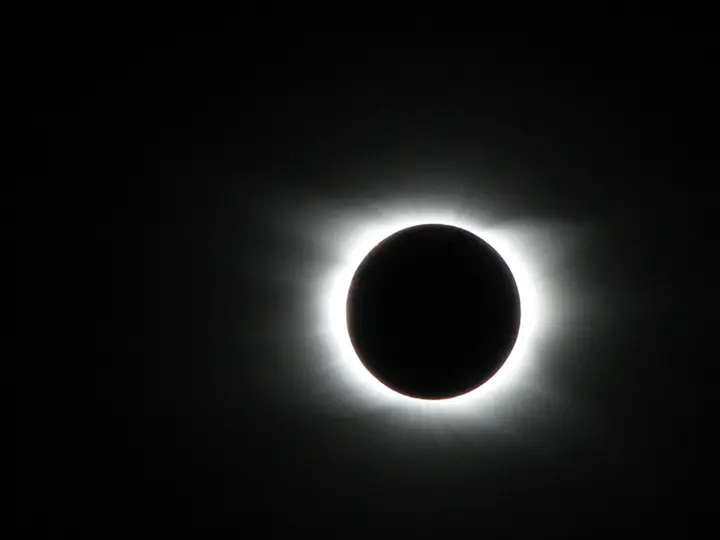
Short answer: an hour of strange, thinning light, then a wall of shadow from the west-north-west, a sudden blue-black sky with planets out, and the white corona around a black disc almost overhead.
- From about 12:00. Over a third of the Sun is already covered. The gaps between palm leaves throw hundreds of small crescent Suns onto the ground.
- From about 12:30. With four-fifths and then nine-tenths gone, the light turns flat and metallic, shadows sharpen and the air starts to cool.
- The last two minutes. Look low to the west-north-west, where the Moon's shadow rushes in across the desert as a darkening sky.
- 12:42:34. Baily's beads flicker along the Moon's edge, then the diamond ring, then totality. Glasses off.
- During totality. The corona spreads around the Moon at about 75 degrees up, so you will be looking almost straight up. Pink prominences may show at the rim. Venus sits only about 3 degrees from the Sun, inside the outer corona's glow; Mercury shines about 10 degrees away; Jupiter is lower to the east with Regulus right beside it. Around the whole horizon runs a band of sunset colour.
- 12:48:07. A second diamond ring on the opposite side, and daylight returns in seconds. Glasses back on.
Plan at least one full minute of totality with no camera in your hands. Some first-timers who spend totality behind a camera say afterwards that they barely saw it.
Eye safety
Short answer: certified eclipse glasses to ISO 12312-2 for every partial minute, naked eyes only during totality, and solar filters over the front of every lens.
- Bring glasses that meet ISO 12312-2, one pair per person plus spares. The American Astronomical Society keeps a list of safe suppliers; see the FAQ below on buying them for an Egypt trip.
- Before use, check each pair for scratches or pinholes. Damaged filters go in the bin.
- The partial phases last about 80 minutes either side of totality. Even with 99 per cent of the Sun covered, the remaining sliver can burn your retina without any pain.
- Binoculars, cameras and telescopes need a proper solar filter on the front of the lens. Never look through optics while wearing eclipse glasses instead.
- Take glasses off only when the diamond ring has gone at C2, and put them back on the moment you see the second one at C3. Children need an adult watching them at both moments.
The heat plan
Short answer: treat eclipse day as a desert summer day with a fixed appointment at noon: shade, water, salt, rest and an escape to air conditioning.
The eclipse falls in the hottest hours of one of the hottest months. With the Sun at 75 degrees, palms and walls cast almost no shade, so you have to bring your own.
- Shade. A proper canopy or tent fly at your viewing spot, plus a wide-brimmed hat. Recliners or ground mats spare your neck, since you will look up for long periods.
- Water. At least three litres per person between 10:00 and 15:00, with oral rehydration salts. Keep spare bottles in a cool box.
- Timing. Be at your spot and set up by 11:00, rested and fed. Avoid long walks at noon and leave strenuous plans for early morning.
- Equipment. Cameras and phones can overheat in full sun. Shade them with a white cloth and keep spare batteries in the cool box.
- Afterwards. Head back to an air-conditioned room once the partial phase ends. Not every Siwa lodge has air conditioning, so check before you book.
- Health. Know the signs of heat exhaustion: headache, nausea, dizziness, cramps. Our health and pharmacies guide covers what is available locally.
Where to watch: town or centreline
Short answer: Siwa town is a superb, easy option. Our provisional plan is an on-road site near the centreline north-east of town; we will confirm it after scouting in December 2026.
Siwa town and the oasis. Town and its surroundings get around five and a half minutes, a little more on the northern side. Raised ground such as Gebel al-Mawta gives a view west for the incoming shadow, though crowds will gather at the obvious hills. You are close to shade, toilets, water and your room.
The Matruh road near the centreline. By our calculation, the road from Siwa to Marsa Matruh crosses the centreline about 65 km north-east of town in a straight line (about 70 km by road), near 29.7N 25.8E. That is worth about 45 seconds more totality on a public road. It is a computed position, and before we commit we need to check it against detailed path maps and on the ground: where vehicles can safely pull off, how the checkpoints on that road will run on the day, and what shade and toilets we can set up.
The off-road centreline. About 73 km due north of town, on the open plateau. It gives the same duration as the road site with emptier horizons, but desert travel outside the oasis needs permits, and eclipse-day rules are not yet published. See permits and checkpoints and restricted areas.
South into the Great Sand Sea. Spectacular dunes, but totality shrinks quickly towards the path's southern edge, and it is a long, hot drive. We would not choose it for eclipse day; save the Great Sand Sea for another morning.
We do not name a confirmed viewing site yet, and you should be cautious of anyone who does before the access questions are answered.
Crowds and booking
Short answer: book beds, transport and glasses now. Siwa's lodges are small, some overseas eclipse tours have already sold out, and the road is a full day's drive from Cairo.
Ahram Online reported on 27 October 2026 that tour operators in at least ten overseas markets, from the US and UK to Japan and Australia, were showing limited availability or sold-out eclipse departures. The same report noted that this does not mean every hotel or tour in Egypt is full. Siwa's accommodation is mostly small lodges and camps, so capacity is limited.
- Now: secure beds for at least the nights of 31 July, 1 and 2 August, and transport there and back. See where to stay and how to get to Siwa.
- Arrive by 31 July. The trip from Cairo is a long day by road, and checkpoints may be busier than usual. Our guide to getting to Siwa for the eclipse covers routes, timing and the drive out.
- Leave on 3 August or later. The afternoon of the eclipse is when everyone tries to drive out at once.
- Spend the nights outside. New moon falls on 2 August, so evenings are moon-free and only a thin waning crescent rises before dawn early in the week. The Southern Delta Aquariids peak on 31 July and the Perseids are already active. See our meteor shower guide, the 2027 moon calendar, the sky calendar and camping in Siwa.
Register your interest
Short answer: message us on WhatsApp with your group size and dates, and we will put you on the list while we confirm the site.
Our Siwa trips are run on the ground by Siwan guides and drivers. Our eclipse plan, for the planned dates of 29 July to 4 August 2027 (confirmed on registration), is a private trip, an air-conditioned lodge, shade and water at a scouted site near the centreline, glasses for everyone and an optional desert camp night. The site, a backup and prices will follow once the December scouting is done; deposit and lodge-hold terms are on request. Send us your dates, how many you are and whether you want a desert camp night, and we will put you on the list. The Siwa eclipse tour page has the plan as it stands.
Questions people ask
What time is the total eclipse in Siwa?+
On Monday 2 August 2027 the Moon first touches the Sun at 11:22:17, totality runs from 12:42:34 to 12:48:07, and the last bite leaves the Sun at 14:08:03. All times are Egypt summer time (UTC+3) for Siwa town. Published sources differ by up to about 14 seconds.
How long is totality in Siwa?+
5 minutes 33 seconds in Siwa town. Driving north towards the centreline adds time: just under 6 minutes about 22 km north of town and about 6 minutes 19 seconds on the centreline itself, some 73 km due north, or about 65 km north-east near the Marsa Matruh road.
Is Siwa better than Luxor for the 2027 eclipse?+
Luxor gets longer totality, about 6 minutes 23 seconds, against 5 minutes 33 seconds in Siwa town and about 6 minutes 19 seconds on the centreline near Siwa. Both have excellent weather odds. Siwa trades a little time for a quieter oasis, the option of a desert camp night and moon-free evenings all eclipse week.
Is Marsa Matruh in the path of totality?+
No. The coast sits north of the shadow's edge. Marsa Matruh sees a deep partial eclipse with about 97.5 per cent of the Sun covered, which is still bright daylight. You need to be inland, around Siwa or on the road south of the coast, to see totality.
How hot will it be on eclipse day?+
Very hot. August at the Siwa weather station averages a high of 38.7C and a low of 23.6C (Meteostat, 1991-2020), and the highest August reading in the WMO 1961-1990 record is 46.2C. The eclipse falls in the middle of the day under a near-overhead Sun. Plan shade, at least three litres of water each, and an air-conditioned room to return to.
Where will you watch it?+
Our provisional plan is an on-road site near the centreline, north-east of town towards Marsa Matruh, worth about 45 extra seconds. We are scouting it, with a backup, in December 2026 and will confirm it only once access is checked. Siwa town remains an excellent fallback.
Where can I buy eclipse glasses in Egypt?+
Buy them before you travel and do not count on finding them in Siwa. Choose glasses marked ISO 12312-2 from a manufacturer or authorised dealer on the American Astronomical Society's list of safe solar viewer suppliers (eclipse.aas.org), and bring one pair per person plus spares. Check each pair for scratches or pinholes before use and throw away any that are damaged. If you join our eclipse trip, glasses are provided.
Go with us
Trips that include this
7 days, 6 nights (planned dates: 29 July to 4 August 2027, confirmed on registration)
Siwa Total Solar Eclipse Tour 2027 (29 Jul to 4 Aug)On request (set by group size, the lodge you choose and whether you add a camp night)
Check dates
4 days, 3 nights
Siwa in 4 Days: Eco-Lodge and a Night in the Great Sand SeaAbout US$495 to 825 per person for two travellers (the lodge level decides the price)
Check dates
3 days, 2 nights
Siwa Oasis in 3 Days from Cairo (Private Trip)About US$420 to 650 per person for two travellers
Check dates