The short answer
Fayoum is the easy one, about 100 km from Cairo and fine as a day trip. Bahariya and Farafra lead to the Black and White Deserts and suit a 2 to 3 day camping trip. Siwa is about 750 km by road and needs 3 days or more for its springs, salt lakes and Amazigh culture. Dakhla and Kharga are remote and best on a week-long loop to Luxor.
Ask us on WhatsAppThe six oases at a glance
Short answer: Fayoum for a day, Bahariya and Farafra for a desert camping weekend, Siwa for a 3 to 5 day oasis trip, and Dakhla and Kharga for a slow week on the road to Luxor.
| Road distance from Cairo | Drive time (no stops) | Days needed | Best for | |
|---|---|---|---|---|
| Fayoum | about 100 km | 1 to 1.5 h | Day trip or 1 night | A first taste of the desert, fossils, families |
| Bahariya (Bawiti) | about 370 km | 4.5 to 5 h | 2 days | The Black Desert and Crystal Mountain, a quick camp |
| Farafra (and the White Desert) | about 550 km | 6.5 to 7 h | 2 to 3 days | Camping among the chalk formations |
| Siwa | about 750 km | about 9 h (10 h with stops) | 3 to 5 days | Springs, salt lakes, dunes and a living Amazigh culture |
| Dakhla (Mut) | about 850 km via Farafra | 10 h or more | 2 nights there, as part of a loop | Mud-brick villages, quiet travel |
| Kharga | about 1,040 km via Farafra and Dakhla, or 410 km from Luxor via Baris | 12 h from Cairo, 5 to 6 h from Luxor | 1 to 2 nights, as part of a loop | Temples and early Christian tombs |
Distances and drive times are from OpenStreetMap routing (OSRM), Cairo city centre to each oasis town, checked 13 November 2026. The Siwa row uses the figures rechecked on 15 November 2026 and shown on Siwa at a glance; the Bahariya and Farafra rows use the rounded figures on our sister site, egyptwhitedesert.com. They exclude meal stops and police checkpoints, so add an hour or more on the long routes. The White Desert camping area sits about 45 km north of Farafra town, so a White Desert trip from Cairo is a drive of about 500 km.
Fayoum
Short answer: the closest oasis to Cairo, green and farmed rather than remote, with a UNESCO fossil valley in the desert beyond it.
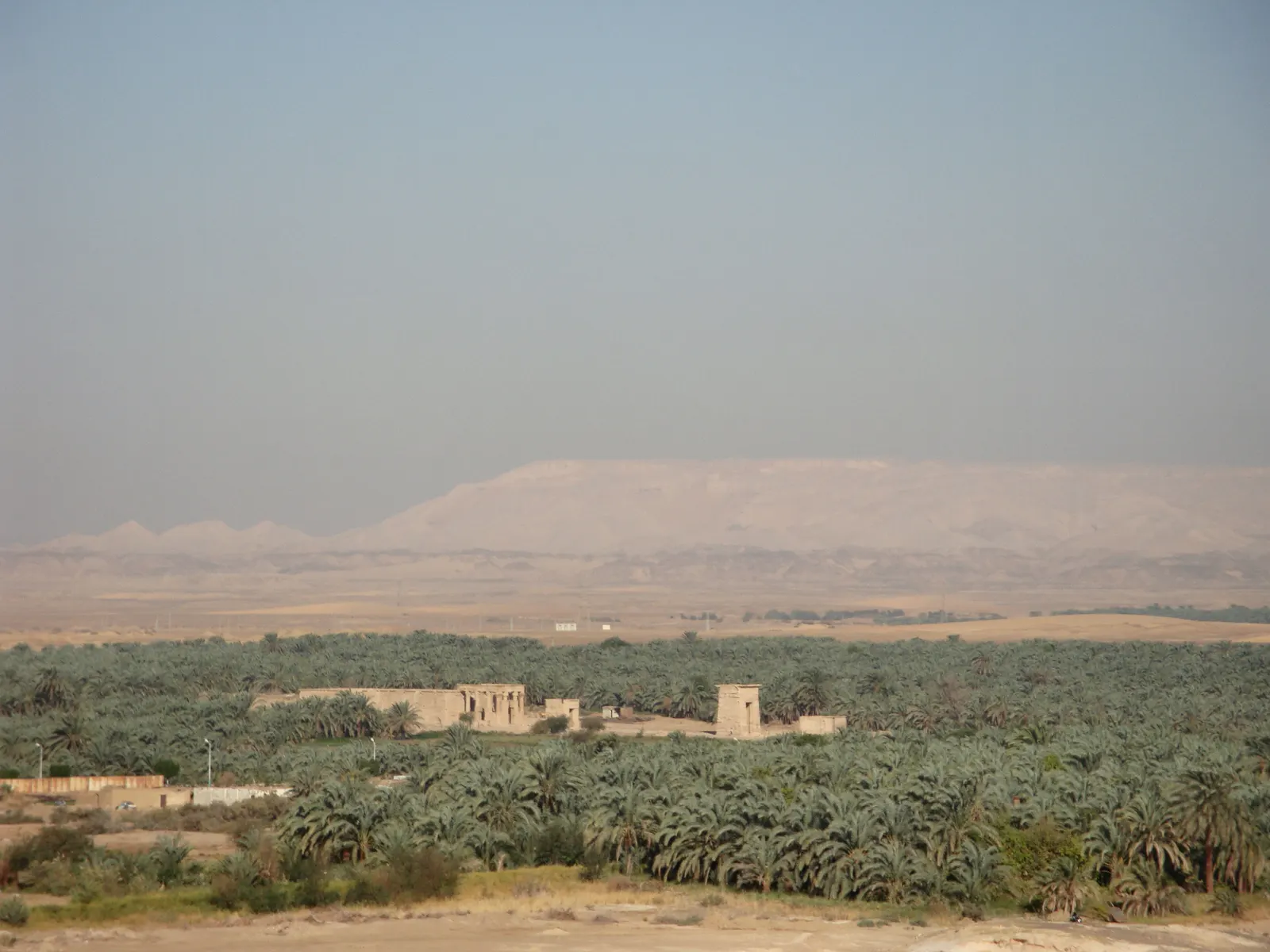
Fayoum is a depression fed by a branch of the Nile, so it feels like countryside: fields, canals, Lake Qarun and the pottery village of Tunis. The desert part is Wadi El Rayan, with its lakes and small falls, and Wadi Al-Hitan, a UNESCO World Heritage Site since 2005, where skeletons of early whales such as Basilosaurus and Dorudon lie in the open. Wadi Al-Hitan is further out than Fayoum town: about 190 km and 3.5 hours by road from central Cairo.
Choose Fayoum if you have one day, are travelling with young children, or care most about fossils. See Siwa vs Fayoum.
Bahariya
Short answer: the gateway to the Black and White Deserts, about 4.5 hours from Cairo, and the base for most short desert trips.
Bahariya's main town is Bawiti. The oasis has palm gardens, hot and cold springs and the Valley of the Golden Mummies, a Greco-Roman cemetery found in the 1990s. Most visitors pass through on the way south: the Black Desert's volcanic-looking hills and Crystal Mountain sit on the road to Farafra. Our sister site has a full guide to Bahariya Oasis and the White Desert.
Choose Bahariya if you have a weekend and want a night under the stars without a full day in the car. See Siwa vs Bahariya.
Farafra and the White Desert
Short answer: the smallest and quietest of the big oases, famous for the chalk formations of the White Desert to its north.
The White Desert became a protected area in 2002. Its wind-cut chalk towers, the "mushroom" and the "chicken" among them, start about 45 km north of Qasr al-Farafra, the oasis town. Nearly every trip here is a camping trip: you drive from Bahariya through the Black Desert, reach the chalk by late afternoon and sleep out. Farafra town itself is small, with springs and farms, and is mainly an overnight stop on the loop south.
Choose Farafra if camping is the point of the trip. See Siwa vs the White Desert.
Siwa
Short answer: the most self-contained oasis, with enough in and around it for three to five days.
Siwa sits close to the Libyan border and is reached by the coast road via Marsa Matruh, not through the other oases. In return for the long drive you get the Oracle Temple of Amun that Alexander the Great consulted in 331 BC, the mud-brick Shali fortress, salt lakes you float in, springs and the dunes of the Great Sand Sea on the edge of town. Siwans are Amazigh (Berber) and speak their own language, Siwi, which gives the oasis a character the others do not share. It also has the best range of places to stay, from simple hotels to eco-lodges.
Choose Siwa if you have at least three nights and want an oasis to explore, not only a desert to camp in. See how many days in Siwa and how to get to Siwa.
Dakhla
Short answer: a large farming oasis with some of the best-kept mud-brick architecture in Egypt, far from Cairo and visited mostly on the loop.
The main town is Mut. The highlight is Al-Qasr, a fortified Islamic town of mud-brick houses up to four storeys high, built from the 12th century on the remains of a Roman fort. Nearby is Deir el-Hagar, a sandstone temple begun under the Roman emperor Nero. Dakhla is about 280 km past Farafra and 190 km before Kharga, so it rarely works as a trip on its own.
Choose Dakhla if you like slow travel, old villages and very few other tourists.
Kharga
Short answer: the capital of the New Valley governorate, with the best-known temples and tombs of the desert oases, closer to Luxor than to Cairo.
Kharga has the Temple of Hibis, dating to around 500 BC, and the Bagawat necropolis, a Christian cemetery in use from the 3rd to the 7th century AD and one of the oldest of its kind. Further south are the temple sites of Qasr el-Ghueita and Qasr Dush. Kharga is a modern town, so it is best for a night or two of sightseeing.
Choose Kharga if you are interested in Late Period, Roman and early Christian sites, or want a desert detour on a Luxor trip.
Siwa vs Dakhla
Short answer: Choose Siwa for a first oasis trip: it is a little closer by road, has more to see in a few days and has the better places to stay. Choose Dakhla for old mud-brick villages and very few visitors, as part of the loop.
| Siwa | Dakhla | |
|---|---|---|
| From Cairo | ~750 km, ~10 h with stops | ~850 km via Bahariya and Farafra, 10 h or more |
| Days needed | 3 to 5 | 2 nights, inside a 6 to 8 day loop |
| Highlights | Oracle Temple, Shali, salt lakes, springs, Great Sand Sea | Al-Qasr, Deir el-Hagar and the farmland around Mut |
| Culture | Amazigh, with its own language, Siwi | Egyptian oasis farming villages |
| Fits with | A separate trip by the coast road | Farafra, the White Desert, Kharga and Luxor |
There is no road between the two that visitors can use, so they belong to different trips.
Siwa vs Kharga
Short answer: Kharga is the better pick if you want temples and early Christian tombs on a Luxor trip; it is about 410 km from Luxor. Siwa is the better pick for a self-contained oasis break from Cairo or Alexandria.
| Siwa | Kharga | |
|---|---|---|
| Nearest start | Cairo ( |
Luxor (~410 km via Baris) |
| Days needed | 3 to 5 | 1 to 2 nights |
| Highlights | Oracle Temple, salt lakes, springs, dunes | Temple of Hibis, Bagawat necropolis, Qasr el-Ghueita |
| Feel | Small town, palm gardens, lodges | A modern regional capital |
Kharga works as a detour from the Nile. Siwa needs its own block of days.
The Western Desert loop
Short answer: Bahariya, Farafra, Dakhla and Kharga sit on one road that runs from Cairo to Luxor. Siwa is not on it.
The classic loop drives Cairo, Bahariya, Farafra (with the White Desert), Dakhla, Kharga and then east to Luxor via Baris: about 1,450 km of driving in total. Allow 6 to 8 days to see the places rather than just pass through them. You can run it in either direction, or start from Luxor and turn back after Dakhla.
Siwa is a separate trip. From Siwa there is no direct way across: the UK Foreign Office's Egypt warnings advise against all but essential travel on the desert road to Bahariya. To combine Siwa with the White Desert you go via the coast and Cairo, which is what our White Desert and Siwa in 4 days trip does. Six to eight days is more comfortable; the routes and outlines are in Siwa vs the White Desert.
Safety and travel advice
Short answer: the oasis towns and the main roads between them are excepted from the UK's Western Desert warning; some side roads are not.
The UK Foreign Office's travel advice for Egypt, as updated on 27 October 2026 and checked on 15 November 2026, warns against all but essential travel west of the Nile Valley outside a list of named areas. Starting from Siwa's end, those are Siwa town, the Marsa Matruh to Siwa road and the coast between the Nile Delta and Marsa Matruh, then the Fayoum governorate, the White and Black Deserts, the oasis towns of Bahariya, Farafra, Dakhla and Kharga, the road from Giza to Farafra (but not the road from Bahariya to Siwa), the road between Farafra, Dakhla and Kharga, and the road from Kharga to Luxor via Baris. The road from Kharga to Assiut is not on that list, so plan the loop to finish at Luxor. Desert trips beyond these roads need permits and an escort; see permits and checkpoints.
Which oasis for your trip?
| You have | Go to |
|---|---|
| One day from Cairo | Fayoum |
| A weekend | Bahariya and the White Desert |
| 3 to 5 days | Siwa |
| About a week | Siwa, then Cairo, then the White Desert |
| 7 to 10 days and a car | The loop from Cairo to Luxor via Dakhla and Kharga |
| A Luxor trip with 2 spare days | Kharga, and Dakhla if time allows |
Tell us your dates and how you like to travel, and we will suggest the route that fits. Our trips start from Cairo; browse them on the tours page.
Questions people ask
How many oases are there in Egypt?+
Five large oases lie in the Western Desert: Siwa, Bahariya, Farafra, Dakhla and Kharga. Fayoum, south-west of Cairo, is usually counted with them, although it is fed by Nile water rather than springs alone. There are also many small uninhabited oases.
Which oasis is closest to Cairo?+
Fayoum, about 100 km by road, roughly 1.5 to 2.5 hours with city traffic. Of the desert oases, Bahariya is closest: about 370 km to Bawiti.
Can I drive from Siwa to Bahariya?+
Not as a visitor. The desert road between them is closed to ordinary travellers, and the UK Foreign Office advises against all but essential travel on it. You go back through Cairo or along the coast.
Which oasis is best for a first trip?+
With 2 days, Bahariya and a night in the White Desert. With 3 or more, Siwa, which has the most to see in the oasis itself.
Can I visit Dakhla and Kharga from Luxor?+
Yes. Kharga is about 410 km from Luxor by road via Baris, a drive of 5 to 6 hours, and Dakhla is about 190 km further west.
Is it safe to visit Egypt's oases?+
The UK Foreign Office lists the oasis towns of Siwa, Bahariya, Farafra, Dakhla and Kharga, the White and Black Deserts and Fayoum as exceptions to its Western Desert warning, along with the main roads between them, but not the road between Bahariya and Siwa. Check the current advice before you book.
Go with us
Trips that include this
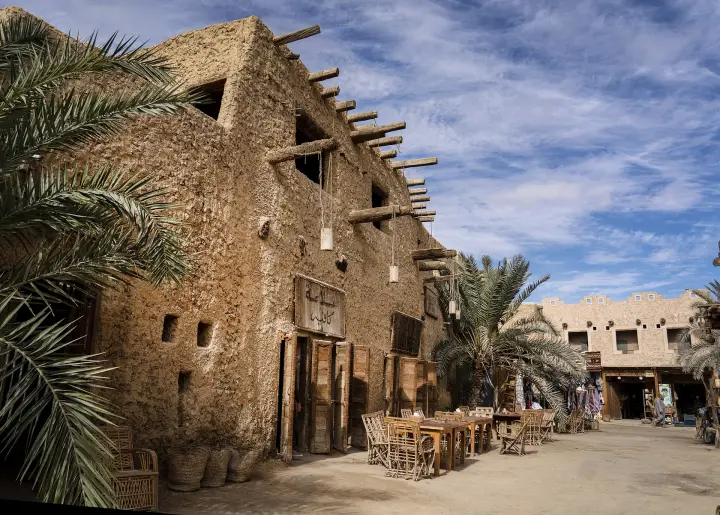
3 days, 2 nights
Siwa Oasis in 3 Days from Cairo (Private Trip)About US$420 to 650 per person for two travellers
Check dates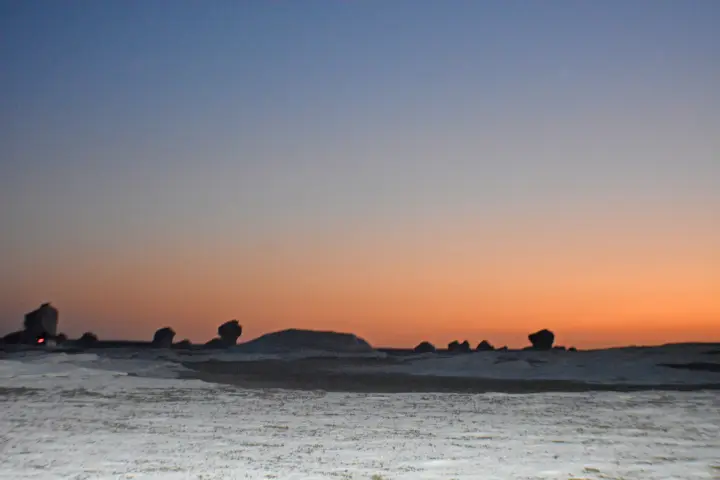
4 days, 3 nights (5-day slower version recommended)
White Desert and Siwa in 4 Days: Private Trip from CairoAbout US$600 to 950 per person for two travellers (more over Christmas and New Year)
Check dates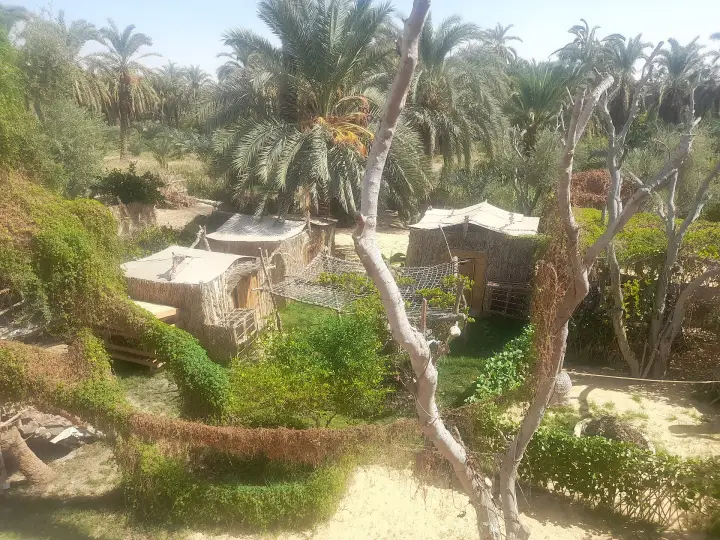
4 days, 3 nights
Siwa in 4 Days: Eco-Lodge and a Night in the Great Sand SeaAbout US$495 to 825 per person for two travellers (the lodge level decides the price)
Check dates